
THE TRIALS OF PHILLIS WHEATLEY: AMERICA’S FIRST BLACK POET (Part 13)
“AT LAST, PHILLIS, WE UNDERSTAND. WE KNOW NOW THAT YOU WERE ONLY A SICKLY LITTLE BLACK GIRL, SNATCHED FROM YOUR HOME AND COUNTRY, WHO STILL STRUGGLED TO SING THE SONG THAT WAS YOUR GIFT. IT IS NOT SO MUCH WHAT YOU SANG, AS THAT YOU KEPT ALIVE THE NOTION OF SONG.” ALICE WALKER.
In November 1973, Jackson State University held the first PHILLIS WHEATLEY POETRY FESTIVAL to celebrate the two hundredth anniversary of the publication of her 1773 book POEMS ON VARIOUS SUBJECTS, RELIGIOUS AND MORAL.
One of the speakers was Pulitzer Prize winner Alice Walker, author of THE COLOR PURPLE and many other novels, poems and essays. Her remarks were later published as an essay.
IN SEARCH OF OUR MOTHERS’ GARDEN: HONORING THE CREATIVITY OF THE BLACK WOMAN
BY ALICE WALKER
These grandmothers and mothers of ours were not "Saints," but Artists; driven to a numb and bleeding madness by the springs of creativity in them for which there was no release....But this is not the end of the story, for all the young women--our mothers and grandmothers, ourselves--have not perished in the wilderness. And if we ask ourselves why, and search for and find the answer, we will know beyond all efforts to erase it from our minds, just exactly who, and of what, we Black American women are.
One example, perhaps the most pathetic, most misunderstood one, can provide a backdrop for our mother's work: Phillis Wheatley, a slave in the 1700s.
Virginia Woolf, in her book, A ROOM OF ONE’S OWN, wrote that in order for a woman to write fiction she must have two things, certainly: a room of her own (with key and lock) and enough money to support herself.
What then are we to make of Phillis Wheatley, a slave, who owned not even herself? This sickly, frail, Black girl who required a servant of her own at times--her health was so precarious--and who, had she been white, would have been easily considered the intellectual superior of all the women and most of the men in the society of her day.
Virginia Woolf wrote further, speaking of course not of our Phillis, that "any woman born with a great gift in the sixteenth century [insert eighteen century, insert Black woman, insert born or made a slave] would certainly have gone crazed, shot herself, or ended her days in some lonely cottage outside the village, half witch, half wizard [insert Saint], feared and mocked at. For it needs little skill and psychology to be sure that a highly gifted girl who had tried to use her gift for poetry would have been so thwarted and hindered by contrary instincts [add chains, guns, the lash, the ownership of one's body by someone else, submission to an alien religion] that she must have lost her health and sanity to a certainty."
The key words, as they relate to Phillis, are "contrary instincts." For when we read the poetry of Phillis Wheatley--as when we read the novels of Nella Larsen or the oddly false-sounding autobiography of that freest of all Black women writers, Zora Hurston--evidence of "contrary instincts" is everywhere. Her loyalties were completely divided, as was, without question, her mind.
But how could this be otherwise? Captured at seven, a slave of wealthy, doting whites who instilled in her the "savagery" of the Africa they "rescued" her from...one wonders if she was even able to remember her homeland as she had known it, or as it really was.
Yet, because she did try to use her gift for poetry in a world that made her a slave, she was "so thwarted and hindered by ...contrary instincts, that she...lost her health..." In the last years of her brief life, burdened not only with the need to express her gift with also with a penniless, friendless "freedom" and several small children for whom she was forced to do strenuous work to feed, she lost her health, certainly. Suffering from malnutrition and neglect and who knows what mental agonies, Phillis Wheatley died.
So torn by "contrary instincts" was Black, kidnapped, enslaved Phillis that her description of "the Goddess"--as she poetically called the Liberty she did not have--is ironically, cruelly humorous. And, in fact, has held Phillis up to ridicule for more than a century. It is usually read prior to hanging Phillis's memory as that of a fool. She wrote:
The Goddess comes, she moves divinely fair, Olive and laurel binds her golden hair: Wherever shines this native of the skies, Unnumber'd charms and recent graces rise.
It is obvious that Phillis, the slave, combed the "Goddess's" hair every morning; prior, perhaps to bringing n the milk, or fixing her mistress's lunch. She took her imagery from the one thing she saw elevated above all others.
With the benefit of hindsight we ask, "How could she?"
But at last, Phillis, we understand. No more snickering when your stiff, struggling, ambivalent lines are forced on us. We know now that you were not an idiot nor a traitor; only a sickly little Black girl, snatched from your home and country and made a slave; a woman who still struggled to sing the song that was your gift, although in a land of barbarians who praised you for your bewildered tongue. It is not so much what you sang, as that you kept alive, in so many of our ancestors, the notion of song.
Guided by my heritage of a love of beauty and a respect for strength--in search of my mother's garden, I found my own.
And perhaps in Africa over 200 years ago, there was just such a mother; perhaps she painted vivid and daring decorations in oranges and yellows and greens on the walls of her hut; perhaps she sang--in a voice like Roberta Flack's--sweetly over the compounds of her village; perhaps she wove the most stunning mats or told the most ingenious stories of all the village storytellers. Perhaps she was herself a poet--though only her daughter's name is signed to the poems that we know.
Perhaps Phillis Wheatley's mother was also an artist. Perhaps in more than Phillis Wheatley's biological life is her mother's signature made clear.
GOLIATH OF GATH.
1 SAM. CHAP. 7th.
BY PHILLIS WHEATEY
YE martial powers, and all ye tuneful Nine,
Inspire my song, and aid my high design.
The dreadful scenes and toils of war I write,
The ardent warriors and the fields of fight:
You best remember, and you best can sing
The acts of heroes to the vocal string:
Resume the lays with which your sacred lyre,
Did then the poet and the sage inspire.
Now front to front the armies were displayed,
Here Israel ranged, and there the foes arrayed;
The hosts on two opposing mountains stood,
Thick as the foliage of the waving wood:
Between them an extensive valley lay,
O'er which the gleaming armour poured the day;
When, from the camp of the Philistine foes,
Dreadful to view, a mighty warrior rose;
In the dire deeds of bleeding battle skilled,
The monster stalks, the terror of the field.
From Gath he sprung, Goliath was his name,
Of fierce deportment and gigantic frame:
A brazen helmet on his head was placed,
A coat of mail his form terrific graced;
The greaves his legs, the targe his shoulders prest:
Dreadful in arms, high towering o'er the rest,
A spear he proudly waved, whose iron head,
Strange to relate, six hundred shekels weighed:
He strode along, and shook the ample field,
While Phoebus blazed refulgent on his shield.
Through Jacob's race a chilling horror ran,
When thus the huge, enormous chief began:
"Say, what the cause, that in this proud array,
"You set your battle in the face of day?
"One hero find in all your vaunting train,
"Then see who loses, and who wins the plain;
"For he who wins, in triumph may demand
"Perpetual service from the vanquished land:
"Your armies I defy, your force despise,
"By far inferior in Philistia's eyes:
"Produce a man, and let us try the fight,
"Decide the contest, and the victor's right."
Thus challenged he: all Israel stood amazed,
And ev'ry chief in consternation gazed;
But Jesse's son, in youthful bloom appears,
And warlike courage far beyond his years;
He left the folds, he left the flow'ry meads,
And soft recesses of the sylvan shades.
Now Israel's monarch and his troops arise,
With peals of shouts ascending to the skies;
In Elab's vale, the scene of combat lies.
When the fair morning blushed with orient red,
What David's sire enjoined, the son obeyed;
And swift of foot towards the trench he came,
Where glowed each bosom with the martial flame.
He leaves his carriage to another's care,
And runs to greet his brethren of the war.
While yet they spake the giant chief arose,
Repeats the challenge, and insults his foes:
Struck with the sound, and trembling at the view,
Affrighted Israel from its post withdrew.
"Observe ye this tremendous foe, they cry'd,
"Who in proud vaunts our armies hath defy'd.
"Whoever lays him prostrate on the plain,
"Freedom in Israel for his house shall gain;
"And on him wealth unknown the king will pour,
"And give his royal daughter for his dower."
Then Jesse's youngest hope:--"My brethren, say,
"What shall be done for him who takes away
"Reproach from Jacob, who destroys the chief,
"And puts a period to his country's grief?
"He vaunts the honours of his arms abroad,
"And scorns the armies of the living God."
Thus spoke the youth; the attentive people eyed
The wondrous hero, and again reply'd:
"Such the rewards our monarch will bestow
"On him who conquers and destroys his foe."
Eliab heard, and kindled into ire,
To hear his shepherd brother thus inquire,
And thus begun: "What errand brought thee, say,
"Who keeps thy flock? or does it go astray?
"I know the base ambition of thine heart,
"But back in safety from the field depart."
Eliab thus, to Jesse's youngest heir,
Expressed his wrath in accents most severe.
When to his brother mildly he reply'd,
"What have I done? or what the cause to chide?"
The words were told before the king, who sent
For the young hero to his royal tent.
Before the monarch, dauntless, he began;
"For this Philistine, fail no heart of man:
"I 'll take the vale, and with the giant fight:
"I dread not all his boasts nor all his might."
When thus the king: "Durst thou, a stripling, go,
"And venture combat with so great a foe,
"Who all his days has been inured to fight,
"And made its deeds his study and delight?
"Battles and bloodshed brought the monster forth,
"And clouds and whirlwinds ushered in his birth."
When David thus: "I kept the fleecy care,
"And out there rushed a lion and a bear:
"A tender lamb the hungry lion took,
"And with no other weapon than my crook,
"Bold I pursued, and chased him o'er the field,
"The prey delivered, and the lion killed.
"As thus the lion and the bear I slew,
"So shall Goliath fall, and all his crew:
"The God who saved me from these beasts of prey,
"By me this monster in the dust shall lay."
So David spoke. The wondering king reply'd;
"Go thou, with heaven and victory on thy side:
"This coat of mail, this sword, gird on," he said,
And placed a mighty helmet on his head.
The coat, the sword, the helm, he laid aside,
Nor chose to venture with those arms untry'd;
Then took his staff, and to the neighbouring brook
Instant he ran, and thence five pebbles took.
Meantime descended to Philistia's son
A radiant cherub, and he thus begun:
"Goliath, well thou know'st thou hast defy'd
"Yon Hebrew armies, and their God deny'd.
"Rebellious wretch! audacious worm! forbear,
"Nor tempt the vengeance of their God too far:
"Them who with his omnipotence contend,
"No eye shall pity and no arm defend.
"Proud as thou art, in short-lived glory great,
"I come to tell thee thine approaching fate.
"Regard my words. The Judge of all the gods,
"Beneath whose steps the tow'ring mountain nods,
"Will give thine armies to the savage brood,
"That cut the liquid air, or range the wood.
"Thee, too, a well aimed pebble shall destroy,
"And thou shalt perish by a beardless boy.
"Such is the mandate from the realms above,
"And, should I try the vengeance to remove,
"Myself a rebel to my king would prove.
"Goliath, say, shall grace to him be shown,
"Who dares heaven's monarch, and insults his throne?"
"Your words are lost on me," the giant cries,
While fear and wrath contended in his eyes;
When thus the messenger from heaven replies:
"Provoke no more Jehovah's awful hand
"To hurl its vengeance on thy guilty land:
"He grasps the thunder, and he wings the storm,
"Servants, their sov'reign's orders to perform."
The angel spoke, and turned his eyes away,
Adding new radiance to the rising day.
Now David comes: the fatal stones demand
His left, the staff engaged his better hand.
The giant moved, and from his tow'ring height
Surveyed the strippling, and disdained the sight,
And thus began: "Am I a dog with thee?
"Bring'st thou no armour but a staff to me?
"The gods on thee their vollied curses pour,
"And beasts and birds of prey thy flesh devour."
David, undaunted, thus: "Thy spear and shield
"Shall no protection to thy body yield:
"Jehovah's name--no other arms I bear;
"I ask no other in this glorious war.
"To-day the Lord of Hosts to me will give
"Victory, to-day thy doom thou shalt receive;
"The fate you threaten shall your own become,
"And beasts shall be your animated tomb,
"That all the earth's inhabitants may know
"That there's a God who governs all below:
"This great assembly, too, shall witness stand,
"That needs nor sword nor spear, the Almighty's hand:
"The battle his, the conquest he bestows,
"And to our power consigns our hated foes."
Thus David spoke. Goliath heard, and came
To meet the hero in the field of fame.
Ah! fatal meeting to thy troops and thee;
But thou wast deaf to the divine decree:
Young David meets thee, meets thee not in vain;
'T is thine to perish on the ensanguined plain.
And now the youth the forceful pebble flung;
Philistia trembled as it whizzed along.
In his dread forehead, where the helmet ends,
Just o'er the brows the well-aimed stone descends:
It pierced the skull, and shattered all the brain--
Prone on his face he tumbled to the plain.
Goliath's fall no smaller terror yields,
Than riving thunders in aerial fields:
The soul still lingered in its loved abode,
Till conquering David o'er the giant strode:
Goliath's sword then laid its master dead,
And from the body hewed the ghastly head;
The blood in gushing torrents drenched the plains,
The soul found passage through the spouting veins.
And now aloud the illustrious victor said,
"Where are your boastings, now your champion's dead?"
Scarce had he spoke, when the Philistines fled;
But fled in vain; the conqueror swift pursued:
What scenes of slaughter, and what seas of blood!
There, Saul, thy thousands grasped the empurpled sand
In pangs of death, the conquest of thine hand;
And David, there were thy ten thousands laid:
Thus Israel's damsels musically played.
Near Gath and Ekron many a hero lay,
Breathed out their souls, and cursed the light of day:
Their fury, quenched by death, no longer burns,
And David with Goliath's head returns.
To Salem brought, but in his tent he placed
The load of armour which the giant graced.
His monarch saw him coming from the war,
And thus demanded of the son of Ner.
"Say, who is this amazing youth?" he cry'd,
When thus the leader of the host replied:
"As lives thy soul, I know not whence he sprung,
"So great in prowess, though in years so young."
"Inquire whose son is he," the sov'reign said,
"Before whose conquering arm Philistia fled."
Before the king behold the stripling stand,
Goliath's head depending from his hand.
To him the king: "Say, of what martial line
"Art thou, young hero, and what sire was thine?"
He humbly thus: "The son of Jesse, I;
"I came the glories of the field to try.
"Small is my tribe, but valiant in the fight;
"Small is my city, but thy royal right."
"Then take the promised gifts," the monarch cry'd,
Conferring riches and the royal bride.
"Knit to my soul, forever thou remain
"With me, nor quit my regal roof again."
In November 1973, Jackson State University held the first PHILLIS WHEATLEY POETRY FESTIVAL to celebrate the two hundredth anniversary of the publication of her 1773 book POEMS ON VARIOUS SUBJECTS, RELIGIOUS AND MORAL.
One of the speakers was Pulitzer Prize winner Alice Walker, author of THE COLOR PURPLE and many other novels, poems and essays. Her remarks were later published as an essay.
IN SEARCH OF OUR MOTHERS’ GARDEN: HONORING THE CREATIVITY OF THE BLACK WOMAN
BY ALICE WALKER
These grandmothers and mothers of ours were not "Saints," but Artists; driven to a numb and bleeding madness by the springs of creativity in them for which there was no release....But this is not the end of the story, for all the young women--our mothers and grandmothers, ourselves--have not perished in the wilderness. And if we ask ourselves why, and search for and find the answer, we will know beyond all efforts to erase it from our minds, just exactly who, and of what, we Black American women are.
One example, perhaps the most pathetic, most misunderstood one, can provide a backdrop for our mother's work: Phillis Wheatley, a slave in the 1700s.
Virginia Woolf, in her book, A ROOM OF ONE’S OWN, wrote that in order for a woman to write fiction she must have two things, certainly: a room of her own (with key and lock) and enough money to support herself.
What then are we to make of Phillis Wheatley, a slave, who owned not even herself? This sickly, frail, Black girl who required a servant of her own at times--her health was so precarious--and who, had she been white, would have been easily considered the intellectual superior of all the women and most of the men in the society of her day.
Virginia Woolf wrote further, speaking of course not of our Phillis, that "any woman born with a great gift in the sixteenth century [insert eighteen century, insert Black woman, insert born or made a slave] would certainly have gone crazed, shot herself, or ended her days in some lonely cottage outside the village, half witch, half wizard [insert Saint], feared and mocked at. For it needs little skill and psychology to be sure that a highly gifted girl who had tried to use her gift for poetry would have been so thwarted and hindered by contrary instincts [add chains, guns, the lash, the ownership of one's body by someone else, submission to an alien religion] that she must have lost her health and sanity to a certainty."
The key words, as they relate to Phillis, are "contrary instincts." For when we read the poetry of Phillis Wheatley--as when we read the novels of Nella Larsen or the oddly false-sounding autobiography of that freest of all Black women writers, Zora Hurston--evidence of "contrary instincts" is everywhere. Her loyalties were completely divided, as was, without question, her mind.
But how could this be otherwise? Captured at seven, a slave of wealthy, doting whites who instilled in her the "savagery" of the Africa they "rescued" her from...one wonders if she was even able to remember her homeland as she had known it, or as it really was.
Yet, because she did try to use her gift for poetry in a world that made her a slave, she was "so thwarted and hindered by ...contrary instincts, that she...lost her health..." In the last years of her brief life, burdened not only with the need to express her gift with also with a penniless, friendless "freedom" and several small children for whom she was forced to do strenuous work to feed, she lost her health, certainly. Suffering from malnutrition and neglect and who knows what mental agonies, Phillis Wheatley died.
So torn by "contrary instincts" was Black, kidnapped, enslaved Phillis that her description of "the Goddess"--as she poetically called the Liberty she did not have--is ironically, cruelly humorous. And, in fact, has held Phillis up to ridicule for more than a century. It is usually read prior to hanging Phillis's memory as that of a fool. She wrote:
The Goddess comes, she moves divinely fair, Olive and laurel binds her golden hair: Wherever shines this native of the skies, Unnumber'd charms and recent graces rise.
It is obvious that Phillis, the slave, combed the "Goddess's" hair every morning; prior, perhaps to bringing n the milk, or fixing her mistress's lunch. She took her imagery from the one thing she saw elevated above all others.
With the benefit of hindsight we ask, "How could she?"
But at last, Phillis, we understand. No more snickering when your stiff, struggling, ambivalent lines are forced on us. We know now that you were not an idiot nor a traitor; only a sickly little Black girl, snatched from your home and country and made a slave; a woman who still struggled to sing the song that was your gift, although in a land of barbarians who praised you for your bewildered tongue. It is not so much what you sang, as that you kept alive, in so many of our ancestors, the notion of song.
Guided by my heritage of a love of beauty and a respect for strength--in search of my mother's garden, I found my own.
And perhaps in Africa over 200 years ago, there was just such a mother; perhaps she painted vivid and daring decorations in oranges and yellows and greens on the walls of her hut; perhaps she sang--in a voice like Roberta Flack's--sweetly over the compounds of her village; perhaps she wove the most stunning mats or told the most ingenious stories of all the village storytellers. Perhaps she was herself a poet--though only her daughter's name is signed to the poems that we know.
Perhaps Phillis Wheatley's mother was also an artist. Perhaps in more than Phillis Wheatley's biological life is her mother's signature made clear.
GOLIATH OF GATH.
1 SAM. CHAP. 7th.
BY PHILLIS WHEATEY
YE martial powers, and all ye tuneful Nine,
Inspire my song, and aid my high design.
The dreadful scenes and toils of war I write,
The ardent warriors and the fields of fight:
You best remember, and you best can sing
The acts of heroes to the vocal string:
Resume the lays with which your sacred lyre,
Did then the poet and the sage inspire.
Now front to front the armies were displayed,
Here Israel ranged, and there the foes arrayed;
The hosts on two opposing mountains stood,
Thick as the foliage of the waving wood:
Between them an extensive valley lay,
O'er which the gleaming armour poured the day;
When, from the camp of the Philistine foes,
Dreadful to view, a mighty warrior rose;
In the dire deeds of bleeding battle skilled,
The monster stalks, the terror of the field.
From Gath he sprung, Goliath was his name,
Of fierce deportment and gigantic frame:
A brazen helmet on his head was placed,
A coat of mail his form terrific graced;
The greaves his legs, the targe his shoulders prest:
Dreadful in arms, high towering o'er the rest,
A spear he proudly waved, whose iron head,
Strange to relate, six hundred shekels weighed:
He strode along, and shook the ample field,
While Phoebus blazed refulgent on his shield.
Through Jacob's race a chilling horror ran,
When thus the huge, enormous chief began:
"Say, what the cause, that in this proud array,
"You set your battle in the face of day?
"One hero find in all your vaunting train,
"Then see who loses, and who wins the plain;
"For he who wins, in triumph may demand
"Perpetual service from the vanquished land:
"Your armies I defy, your force despise,
"By far inferior in Philistia's eyes:
"Produce a man, and let us try the fight,
"Decide the contest, and the victor's right."
Thus challenged he: all Israel stood amazed,
And ev'ry chief in consternation gazed;
But Jesse's son, in youthful bloom appears,
And warlike courage far beyond his years;
He left the folds, he left the flow'ry meads,
And soft recesses of the sylvan shades.
Now Israel's monarch and his troops arise,
With peals of shouts ascending to the skies;
In Elab's vale, the scene of combat lies.
When the fair morning blushed with orient red,
What David's sire enjoined, the son obeyed;
And swift of foot towards the trench he came,
Where glowed each bosom with the martial flame.
He leaves his carriage to another's care,
And runs to greet his brethren of the war.
While yet they spake the giant chief arose,
Repeats the challenge, and insults his foes:
Struck with the sound, and trembling at the view,
Affrighted Israel from its post withdrew.
"Observe ye this tremendous foe, they cry'd,
"Who in proud vaunts our armies hath defy'd.
"Whoever lays him prostrate on the plain,
"Freedom in Israel for his house shall gain;
"And on him wealth unknown the king will pour,
"And give his royal daughter for his dower."
Then Jesse's youngest hope:--"My brethren, say,
"What shall be done for him who takes away
"Reproach from Jacob, who destroys the chief,
"And puts a period to his country's grief?
"He vaunts the honours of his arms abroad,
"And scorns the armies of the living God."
Thus spoke the youth; the attentive people eyed
The wondrous hero, and again reply'd:
"Such the rewards our monarch will bestow
"On him who conquers and destroys his foe."
Eliab heard, and kindled into ire,
To hear his shepherd brother thus inquire,
And thus begun: "What errand brought thee, say,
"Who keeps thy flock? or does it go astray?
"I know the base ambition of thine heart,
"But back in safety from the field depart."
Eliab thus, to Jesse's youngest heir,
Expressed his wrath in accents most severe.
When to his brother mildly he reply'd,
"What have I done? or what the cause to chide?"
The words were told before the king, who sent
For the young hero to his royal tent.
Before the monarch, dauntless, he began;
"For this Philistine, fail no heart of man:
"I 'll take the vale, and with the giant fight:
"I dread not all his boasts nor all his might."
When thus the king: "Durst thou, a stripling, go,
"And venture combat with so great a foe,
"Who all his days has been inured to fight,
"And made its deeds his study and delight?
"Battles and bloodshed brought the monster forth,
"And clouds and whirlwinds ushered in his birth."
When David thus: "I kept the fleecy care,
"And out there rushed a lion and a bear:
"A tender lamb the hungry lion took,
"And with no other weapon than my crook,
"Bold I pursued, and chased him o'er the field,
"The prey delivered, and the lion killed.
"As thus the lion and the bear I slew,
"So shall Goliath fall, and all his crew:
"The God who saved me from these beasts of prey,
"By me this monster in the dust shall lay."
So David spoke. The wondering king reply'd;
"Go thou, with heaven and victory on thy side:
"This coat of mail, this sword, gird on," he said,
And placed a mighty helmet on his head.
The coat, the sword, the helm, he laid aside,
Nor chose to venture with those arms untry'd;
Then took his staff, and to the neighbouring brook
Instant he ran, and thence five pebbles took.
Meantime descended to Philistia's son
A radiant cherub, and he thus begun:
"Goliath, well thou know'st thou hast defy'd
"Yon Hebrew armies, and their God deny'd.
"Rebellious wretch! audacious worm! forbear,
"Nor tempt the vengeance of their God too far:
"Them who with his omnipotence contend,
"No eye shall pity and no arm defend.
"Proud as thou art, in short-lived glory great,
"I come to tell thee thine approaching fate.
"Regard my words. The Judge of all the gods,
"Beneath whose steps the tow'ring mountain nods,
"Will give thine armies to the savage brood,
"That cut the liquid air, or range the wood.
"Thee, too, a well aimed pebble shall destroy,
"And thou shalt perish by a beardless boy.
"Such is the mandate from the realms above,
"And, should I try the vengeance to remove,
"Myself a rebel to my king would prove.
"Goliath, say, shall grace to him be shown,
"Who dares heaven's monarch, and insults his throne?"
"Your words are lost on me," the giant cries,
While fear and wrath contended in his eyes;
When thus the messenger from heaven replies:
"Provoke no more Jehovah's awful hand
"To hurl its vengeance on thy guilty land:
"He grasps the thunder, and he wings the storm,
"Servants, their sov'reign's orders to perform."
The angel spoke, and turned his eyes away,
Adding new radiance to the rising day.
Now David comes: the fatal stones demand
His left, the staff engaged his better hand.
The giant moved, and from his tow'ring height
Surveyed the strippling, and disdained the sight,
And thus began: "Am I a dog with thee?
"Bring'st thou no armour but a staff to me?
"The gods on thee their vollied curses pour,
"And beasts and birds of prey thy flesh devour."
David, undaunted, thus: "Thy spear and shield
"Shall no protection to thy body yield:
"Jehovah's name--no other arms I bear;
"I ask no other in this glorious war.
"To-day the Lord of Hosts to me will give
"Victory, to-day thy doom thou shalt receive;
"The fate you threaten shall your own become,
"And beasts shall be your animated tomb,
"That all the earth's inhabitants may know
"That there's a God who governs all below:
"This great assembly, too, shall witness stand,
"That needs nor sword nor spear, the Almighty's hand:
"The battle his, the conquest he bestows,
"And to our power consigns our hated foes."
Thus David spoke. Goliath heard, and came
To meet the hero in the field of fame.
Ah! fatal meeting to thy troops and thee;
But thou wast deaf to the divine decree:
Young David meets thee, meets thee not in vain;
'T is thine to perish on the ensanguined plain.
And now the youth the forceful pebble flung;
Philistia trembled as it whizzed along.
In his dread forehead, where the helmet ends,
Just o'er the brows the well-aimed stone descends:
It pierced the skull, and shattered all the brain--
Prone on his face he tumbled to the plain.
Goliath's fall no smaller terror yields,
Than riving thunders in aerial fields:
The soul still lingered in its loved abode,
Till conquering David o'er the giant strode:
Goliath's sword then laid its master dead,
And from the body hewed the ghastly head;
The blood in gushing torrents drenched the plains,
The soul found passage through the spouting veins.
And now aloud the illustrious victor said,
"Where are your boastings, now your champion's dead?"
Scarce had he spoke, when the Philistines fled;
But fled in vain; the conqueror swift pursued:
What scenes of slaughter, and what seas of blood!
There, Saul, thy thousands grasped the empurpled sand
In pangs of death, the conquest of thine hand;
And David, there were thy ten thousands laid:
Thus Israel's damsels musically played.
Near Gath and Ekron many a hero lay,
Breathed out their souls, and cursed the light of day:
Their fury, quenched by death, no longer burns,
And David with Goliath's head returns.
To Salem brought, but in his tent he placed
The load of armour which the giant graced.
His monarch saw him coming from the war,
And thus demanded of the son of Ner.
"Say, who is this amazing youth?" he cry'd,
When thus the leader of the host replied:
"As lives thy soul, I know not whence he sprung,
"So great in prowess, though in years so young."
"Inquire whose son is he," the sov'reign said,
"Before whose conquering arm Philistia fled."
Before the king behold the stripling stand,
Goliath's head depending from his hand.
To him the king: "Say, of what martial line
"Art thou, young hero, and what sire was thine?"
He humbly thus: "The son of Jesse, I;
"I came the glories of the field to try.
"Small is my tribe, but valiant in the fight;
"Small is my city, but thy royal right."
"Then take the promised gifts," the monarch cry'd,
Conferring riches and the royal bride.
"Knit to my soul, forever thou remain
"With me, nor quit my regal roof again."


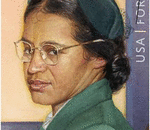
Phillis' gift for illuminating a story seem easily crafted in her poetry.
Jo Anna Bella
Poet at Heart
(c) Jan 20, 2010