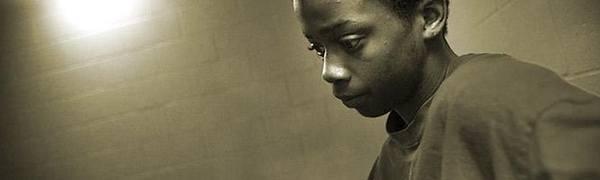
Across the country, thousands of children are languishing in abusive prisons and jails. These youths are disproportionately African American and Latino. Most live in poverty.
Many of these children were needlessly pushed out of school and into the juvenile justice system. But schools are just one entry point to the juvenile justice system – a system that too frequently cuts short the life chances of the young people it’s supposed to serve. Many youths are criminalized because of their experiences with failing foster care and mental health systems. Children and teens of color are imprisoned at almost three times the rate of their white counterparts – suggesting that they are often unfairly targeted for arrest and confinement.
Once arrested, children can stay in detention facilities for weeks or months before a judge hears their case. They often encounter abuse and neglect in overcrowded, squalid facilities – some operated for profit by private corporations. Few local juvenile detention centers have the resources to meet their educational, medical and mental health needs.
When a judge hears their case, court-involved youths may be sentenced to a juvenile prison where they frequently endure brutal conditions. The SPLC has helped to expose instances of physical and s*xual abuse, shackling of children and inadequate mental health care.
Today, an estimated 100,000 children and teens are locked up in juvenile facilities across the country, and thousands more are incarcerated in adult prisons. Children in adult prisons and jails face even worse conditions than those in the juvenile justice system.
U.S. Department of Justice research shows that youths incarcerated with adults are eight times more likely to commit suicide than in juvenile facilities, five times more likely to be s*xually assaulted, three times more likely to be assaulted by prison staff and 50 percent more likely to be assaulted with a weapon than youths in a juvenile facility. And incarcerating children in the adult system doesn’t only put them at risk of unspeakable abuses – it fails to protect communities. The Department of Justice also has found “higher recidivism rates among juveniles convicted for violent offense in criminal court when compared with similar offenders retained in juvenile court.”
By reforming the juvenile justice system and providing support in our schools and communities, this cycle can be broken and we can dramatically reduce our country’s prison population – the world’s largest.
The SPLC uses legal action, community education and mobilization, and media and legislative advocacy to ensure that students get the educational services that can mean the difference between incarceration and graduation and to prevent school discipline practices from pushing students out of school. We work to replace unnecessary juvenile detention with proven, community-based alternatives. And we seek to protect imprisoned children and teens from abuse and safely reduce the number of imprisoned children.
We currently operate juvenile justice and education reform projects in Alabama, Florida, Louisiana and Mississippi – four of the states where children are most at risk of ending up in the juvenile justice system or dropping out of school. We’re also working with advocates for children in other Southern states and across the country.
Reforming School Discipline
For far too many children, the path to prison begins in our under-funded schools. Rather than invest in the basic educational and social services that will help troubled children succeed, many schools rely on harsh, “zero-tolerance” discipline policies that result in suspensions, dropouts and arrests for even minor, nonviolent misbehavior. These policies push students into a juvenile justice system that criminalizes many of them.
Too often, the juvenile justice system writes off misbehavior in affluent school districts as “typical adolescent rebellion” while the same behavior by a student in a poor, minority school district is likely to be viewed as “criminal behavior” that warrants harsh consequences. This misguided approach to school discipline is driving up the dropout rates for both students and teachers. It does little to improve school climates or make our communities safer. Reversing this trend will require a sea change in the way schools approach discipline.
A cultural shift from zero-tolerance policies is needed in our schools. One research-based alternative, known as Positive Behavior Interventions and Supports (PBIS), is gaining momentum among educators as a way to improve overall school climates, as well as academic performance, while keeping children in the classroom. PBIS has been successfully used in both urban and rural school districts and in districts with high and low concentrations of poverty.
Implementation of PBIS is a key provision in several class action settlements reached between the SPLC and school districts in Louisiana, Mississippi and Florida. The results have been promising. For example, two years after PBIS was implemented throughout the Jefferson Parish, La., school district, the out-of-school suspension rate for special education students was cut in half. Out-of-school suspensions for general education students dropped 24 percent after the first year.
PBIS implementation is just one of the ways we’re working to ensure that all children have access to a quality education. We’ve also launched campaigns to address the use of alternative schools to warehouse students and deny them the educational services to which they are entitled. In addition, we work to ensure that youths most likely to be pushed out of school receive individualized support to increase their chances of graduating, to address racial disparities in school discipline practices and to increase parental engagement in the formation of school discipline policies and practices.
 Posted By: DAVID JOHNSON
Wednesday, September 5th 2012 at 6:38PM
You can also
click
here to view all posts by this author...