Re: Re: ''Harlem New York'' music history is Latin really ?.lies! here is Truth ! {Truth or Deletion of Truth}
If you say your from New York and you dont know the music you telling lies ,because NEW YORK was the place every body came to be seen, to be heard ,when downtown shut down for the night it was time to go
UPTOWN TO ''HARLEM WORLD''
A world with in itself,,, come with me THE BLOG KING and lets take a ride into the music and life of HARLEM NEW YORK ,,,,,
Harlem stretches from the East River to west to the Hudson River between 159th Street;where it meets Washington Heights—to a ragged border along the south. Central Harlem begins at 110th Street, at the northern boundary of Central Park; Spanish Harlem extends east Harlem’s boundaries south to 96th Street, while in the west it begins north of Upper West Side, which gives an irregular border west of Morningside Avenue. Harlem’s boundaries have changed over the years; as Ralph Ellison observed: “Wherever Negroes live uptown is considered Harlem.”
The neighborhood contains a number of smaller, cohesive districts. The following are some examples
West Harlem (west of St. Nicholas Avenue and north of 123rd Street
Harlem Community
Hamilton Heights, around the Hamilton Grange
Sugar Hill
Manhattanville, north of Morningside Heights
Central Harlem
Mount Morris, extending west from Marcus Garvey Park
Strivers’ Row, centered on 139th Street
Astor Row, centered on 130th Street
Spanish Harlem, also known as East Harlem or El Barrio (east of Fifth Avenue)
From the legendary Palladium days of the 1940s and 1950s, which showcased the music of Machito and His Afro Cubans as well as the musical battles between the two Titos (Puente and Rodriguez), to the birth of Latin jazz, the early days of the Fania Records dynasty and the percussive jam sessions of Tito Puente, Mongo Santamaria, Willie Bobo, and Ray Barretto, Alava
Jazz Was the Sound of Harlem Renaissance Music!
Before we go there lets take a look around the corner and see the Battle of Harlem Heights, sometimes referred to as the Battle of Harlem or Battle of Harlem War caused the burning of Harlem to the ground On September 16, 1776 !
Now lets look at the rebirth,, Rebuilding took decades, During the Civil War, Harlem saw draft riots, along with the rest of the city, but the neighborhood was a significant beneficiary of the economic boom that followed the end of the war, starting in 1868. The neighborhood continued to serve as a refuge for New Yorkers, but increasingly those coming north were poor and Jewish or Italian. Factories, homes, churches, and retail buildings were built at great speedThe Panic of 1873 caused Harlem property values to drop 80% and gave the City of New York the opportunity to annex the troubled community as far north as 155th Street.
"
Black people have been present in Harlem continually since the 1630s, and as the neighborhood modernized in the late 19th century, they could be found especially in the area around 125th Street and "Negro tenements" on West 130th Street. By 1900, tens of thousands of blacks lived in Harlem.In 1910, Central Harlem was about 10% black. By 1930, it had reached 70%.
Since the 1920s, this period of Harlem's history has been highly romanticized. With the increase in a poor population, it was also the time when the neighborhood began to deteriorate to a slum, and some of the storied traditions of the Harlem Renaissance were driven by poverty, crime, or other social ills.
Now lets look at the Harlem Renaissance ''the music the night life'' Music in the 1920s Jazz Was the Sound of Harlem Renaissance Music there was no better medium to nurture the pure jazz sound than 1920's Harlem.
Jazz became the "people's" music despite some trouble being accepted by the black "cultural elite."Jazz remained very popular with most of Harlem's citizens and it's popularity was growing quickly nationally and worldwide.
Nightclubs like the Savoy Ballroom, the Apollo Theater, and the Cotton Club were perfect venues to display the vibrant intimacy of jazz.
Going to nightclubs and rent parties was very popular they were "the special passion of the community" jazz is too often left out of Harlem Renaissance history.
Jazz historians believe there was a profound desire for well-to-do blacks to assimilate into the white business culture of the large American north-eastern cities where jazz was gaining in popularity: New York, Chicago, Detroit, Saint Louis and others.
The advent of the "Harlem Stride Style" of piano helped bridge the gulf between the "low life" culture as jazz musicians were perceived, and the black social elite.
The piano(for many was a symbol of affluence) rather than the brass band (a symbol of the south) defined this style of jazz.
With the Harlem stride style of jazz, the music became more accessible not only for wealthy blacks, but also for whites. Jazz's popularity was at an all time high as the fervor grew throughout the country.
Jazz Was Popular Entertainment and Became a Huge Business!
Harlem Renaissance music was defined by the lively clubs and characters who constantly improved and modified jazz's sound.
Men like Duke Ellington, Jelly Roll Morton, and Willie "The Lion" Smith were the "gladiators" of jazz in these early years.
Perfectionists, they had little patience for musicians without the talent or skills to keep up. The competition and innovation during the 1920s was fierce.
Harlem Renaissance music was more than just music, for many, jazz was a way of life.During this time period, the musical style of blacks was becoming more and more attractive to whites. White novelists, dramatists and composers started to exploit the musical tendencies and themes of African-Americans in their works. Composers used poems written by African American poets in their songs, and would implement the rhythms, harmonies and melodies of African-American music—such as blues, spirituals, and jazz—into their concert pieces. Negros began to merge with Whites into the classical world of musical composition. The first Negro male to gain wide recognition as a concert artist in both his region and internationally was Roland Hayes. He trained with Arthur Calhoun in Chattanooga, and at Fisk University in Nashville. Later, he studied with Arthur Hubbard in Boston and with George Henshel and Amanda Ira Aldridge in London, England.
African-American expressions of writing, music, and art during the 1920s and 1930s are well represented in the vast collections of the Library of Congress. This guide presents the Library's resources as well as links to external Web sites on the Harlem Renaissance and a bibliography.
http://www.loc.gov/rr/program/bib/harlem/h...
Spanish Harlem, also known as East Harlem or El Barrio (east of Fifth Avenue) From the legendary Palladium days of the 1940s and 1950s, which showcased the music of Machito and His Afro Cubans as well as the musical battles between the two Titos (Puente and Rodriguez), to the birth of Latin jazz, the early days of the Fania Records dynasty and the percussive jam sessions of Tito Puente, Mongo Santamaria, Willie Bobo, and Ray Barretto, Alava Jazz Was the Sound of Harlem Renaissance Music! But they was two different worlds Spanish Harlem and Harlem {black}
Walter’s World: Trav’lin- The New 1930’s Harlem Musical
One of the highlights of the New York Musical Theatre Festival was Trav’lin the new 1930’s Harlem musical.
http://youtu.be/VIXBRTrvPSA http://youtu.be/oaeaS2yY3X4
Early in the 1940s, young musicians such as Charlie Parker andDizzy Gillespie, steeped in the sounds of swing, began experimenting with melodic and harmonic dissonances as well as rhythmic alterations, such as beginning and ending improvised phrases in uncommon places in the measure.
The Creation of Bebop
Minton’s Playhouse, a jazz club in Harlem, New York, became the laboratory for these experimental musicians. By 1941, Parker, Gillespie, Thelonious Monk, Charlie Christian, and Kenny Clarke were playing regularly at jam sessions there.
During this period, there were two main musical paths forged. One was a nostalgic movement that reexamined the hot jazz of New Orleans. It became known as Dixieland. The other was the new, forward looking, experimental music that departed from swing and the music that preceded it. It was known as bebop.
1948, Miles Davis and drummer Max Roach, fed up with Charlie Parker’s reckless lifestyle, left his band. Davis formed his own nonet, and in 1949 recorded the unconventional ensemble. Some of the arrangements were by a young Gil Evans, and the restrained style of the music came to be known as cool jazz. The record, released almost a decade later, in 1957, was called Birth of the Cool.
By the end of the 1940s, bebop was the ideal among young jazz musicians. Unlike swing, bebop was untethered to popular demands. Its primary concern was musical advancement. By the early 1950s it had already spread into new streams such as hard bop, cool jazz, and afro-cuban jazz.
bebop allowed for an explosion of innovation. Inspired by the more harmonically and rhythmically experimental players in swing era, such as Coleman Hawkins, Lester Young, Art Tatum, and Roy Eldridge, bebop musicians expanded the palette of musical devices from which to choose while improvising. Many aspects of swing were imported, including the triplet-based swing feel and a proclivity for the blues.
YOU CAN COME TO HARLEM NOW AND HEAR THE BEST OF JAZZ
Morningside/Harlem Heights
Washington Heights
Hamilton Heights
Central Harlem
Manhattanville
East Harlem
Sugar Hill
1. Village Vanguard
, Jazz & Blues
178 7th Ave S
New York, NY 10014
(212) 255-4037
2. Big Apple Jazz Tours
Jazz & Blues
Harlem
200 Central Park S
Harlem, NY 10027
(718) 606-8442
3. American Legion Post 398
Categories: Jazz & Blues, Dive Bars
Neighborhood: Harlem
12 reviews
248 W 132nd St
New York, NY 10027
(212) 283-9701
4. Dizzy's Club Coca Cola
Category: Jazz & Blues
Neighborhood: Upper West Side
33 W 60th St, 5th Fl
New York, NY 10023
(212) 258-9595
This place is very fancy for a New York jazz club. They often feature big names, but I personally think that this is not quite the NY jazz club experience that one should expect. However, I can't deny that I love
5. Smoke Jazz Club
Categories: Jazz & Blues, Music Venues, Soul Food
2751 Broadway
New York, NY 10025
(212) 864-6662
6. Lenox Lounge
, Jazz & Blues, Soul Food
Neighborhood: Harlem
288 Lenox Ave
New York, NY 10027
(212) 427-0253
7. Shrine
Categories: Bars, Restaurants, Music Venues
Neighborhood: Harlem
2271 Adam Clayton Powell Blvd
New York, NY 10030
(212) 690-7807
8. Birdland
Categories: Jazz & Blues, Cajun/Creole, Southern
Neighborhoods: Hell's Kitchen, Midtown West, Theater District
315 W 44th St
New York, NY 10036
(212) 581-3080
9. Ginny's Supper Club
Categories: Southern, Jazz & Blues
Neighborhood: Harlem
310 Lenox Ave
New York, NY 10027
(212) 421-3821
10 Swing 46
, Jazz & Blues
349 W 46th St
New York, NY 10036
(212) 262-9554
I recently discovered the Swing 46 Jazz & Supper Club on Restaurant Row.
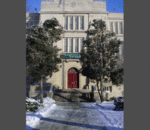
SEE PIC OF BEFORE AND AFTER,,,, HARLEM
http://forum.skyscraperpage.com/showthread...
HOPE YOU ENJOYED THE WALK ,,,,
THE BLOG KING !
Posted By: THE BLOG KING DAVID JOHNSON SR
Saturday, January 12th 2013 at 3:19PM
Report obscenity | post comment
Share |
Posted By: Saint Jake
Saturday, January 12th 2013 at 4:29PM
Report obscenity | post comment | edit | delete
UPTOWN TO ''HARLEM WORLD''
A world with in itself,,, come with me THE BLOG KING and lets take a ride into the music and life of HARLEM NEW YORK ,,,,,
Harlem stretches from the East River to west to the Hudson River between 159th Street;where it meets Washington Heights—to a ragged border along the south. Central Harlem begins at 110th Street, at the northern boundary of Central Park; Spanish Harlem extends east Harlem’s boundaries south to 96th Street, while in the west it begins north of Upper West Side, which gives an irregular border west of Morningside Avenue. Harlem’s boundaries have changed over the years; as Ralph Ellison observed: “Wherever Negroes live uptown is considered Harlem.”
The neighborhood contains a number of smaller, cohesive districts. The following are some examples
West Harlem (west of St. Nicholas Avenue and north of 123rd Street
Harlem Community
Hamilton Heights, around the Hamilton Grange
Sugar Hill
Manhattanville, north of Morningside Heights
Central Harlem
Mount Morris, extending west from Marcus Garvey Park
Strivers’ Row, centered on 139th Street
Astor Row, centered on 130th Street
Spanish Harlem, also known as East Harlem or El Barrio (east of Fifth Avenue)
From the legendary Palladium days of the 1940s and 1950s, which showcased the music of Machito and His Afro Cubans as well as the musical battles between the two Titos (Puente and Rodriguez), to the birth of Latin jazz, the early days of the Fania Records dynasty and the percussive jam sessions of Tito Puente, Mongo Santamaria, Willie Bobo, and Ray Barretto, Alava
Jazz Was the Sound of Harlem Renaissance Music!
Before we go there lets take a look around the corner and see the Battle of Harlem Heights, sometimes referred to as the Battle of Harlem or Battle of Harlem War caused the burning of Harlem to the ground On September 16, 1776 !
Now lets look at the rebirth,, Rebuilding took decades, During the Civil War, Harlem saw draft riots, along with the rest of the city, but the neighborhood was a significant beneficiary of the economic boom that followed the end of the war, starting in 1868. The neighborhood continued to serve as a refuge for New Yorkers, but increasingly those coming north were poor and Jewish or Italian. Factories, homes, churches, and retail buildings were built at great speedThe Panic of 1873 caused Harlem property values to drop 80% and gave the City of New York the opportunity to annex the troubled community as far north as 155th Street.
"
Black people have been present in Harlem continually since the 1630s, and as the neighborhood modernized in the late 19th century, they could be found especially in the area around 125th Street and "Negro tenements" on West 130th Street. By 1900, tens of thousands of blacks lived in Harlem.In 1910, Central Harlem was about 10% black. By 1930, it had reached 70%.
Since the 1920s, this period of Harlem's history has been highly romanticized. With the increase in a poor population, it was also the time when the neighborhood began to deteriorate to a slum, and some of the storied traditions of the Harlem Renaissance were driven by poverty, crime, or other social ills.
Now lets look at the Harlem Renaissance ''the music the night life'' Music in the 1920s Jazz Was the Sound of Harlem Renaissance Music there was no better medium to nurture the pure jazz sound than 1920's Harlem.
Jazz became the "people's" music despite some trouble being accepted by the black "cultural elite."Jazz remained very popular with most of Harlem's citizens and it's popularity was growing quickly nationally and worldwide.
Nightclubs like the Savoy Ballroom, the Apollo Theater, and the Cotton Club were perfect venues to display the vibrant intimacy of jazz.
Going to nightclubs and rent parties was very popular they were "the special passion of the community" jazz is too often left out of Harlem Renaissance history.
Jazz historians believe there was a profound desire for well-to-do blacks to assimilate into the white business culture of the large American north-eastern cities where jazz was gaining in popularity: New York, Chicago, Detroit, Saint Louis and others.
The advent of the "Harlem Stride Style" of piano helped bridge the gulf between the "low life" culture as jazz musicians were perceived, and the black social elite.
The piano(for many was a symbol of affluence) rather than the brass band (a symbol of the south) defined this style of jazz.
With the Harlem stride style of jazz, the music became more accessible not only for wealthy blacks, but also for whites. Jazz's popularity was at an all time high as the fervor grew throughout the country.
Jazz Was Popular Entertainment and Became a Huge Business!
Harlem Renaissance music was defined by the lively clubs and characters who constantly improved and modified jazz's sound.
Men like Duke Ellington, Jelly Roll Morton, and Willie "The Lion" Smith were the "gladiators" of jazz in these early years.
Perfectionists, they had little patience for musicians without the talent or skills to keep up. The competition and innovation during the 1920s was fierce.
Harlem Renaissance music was more than just music, for many, jazz was a way of life.During this time period, the musical style of blacks was becoming more and more attractive to whites. White novelists, dramatists and composers started to exploit the musical tendencies and themes of African-Americans in their works. Composers used poems written by African American poets in their songs, and would implement the rhythms, harmonies and melodies of African-American music—such as blues, spirituals, and jazz—into their concert pieces. Negros began to merge with Whites into the classical world of musical composition. The first Negro male to gain wide recognition as a concert artist in both his region and internationally was Roland Hayes. He trained with Arthur Calhoun in Chattanooga, and at Fisk University in Nashville. Later, he studied with Arthur Hubbard in Boston and with George Henshel and Amanda Ira Aldridge in London, England.
African-American expressions of writing, music, and art during the 1920s and 1930s are well represented in the vast collections of the Library of Congress. This guide presents the Library's resources as well as links to external Web sites on the Harlem Renaissance and a bibliography.
http://www.loc.gov/rr/program/bib/harlem/h...
Spanish Harlem, also known as East Harlem or El Barrio (east of Fifth Avenue) From the legendary Palladium days of the 1940s and 1950s, which showcased the music of Machito and His Afro Cubans as well as the musical battles between the two Titos (Puente and Rodriguez), to the birth of Latin jazz, the early days of the Fania Records dynasty and the percussive jam sessions of Tito Puente, Mongo Santamaria, Willie Bobo, and Ray Barretto, Alava Jazz Was the Sound of Harlem Renaissance Music! But they was two different worlds Spanish Harlem and Harlem {black}
Walter’s World: Trav’lin- The New 1930’s Harlem Musical
One of the highlights of the New York Musical Theatre Festival was Trav’lin the new 1930’s Harlem musical.
http://youtu.be/VIXBRTrvPSA http://youtu.be/oaeaS2yY3X4
Early in the 1940s, young musicians such as Charlie Parker andDizzy Gillespie, steeped in the sounds of swing, began experimenting with melodic and harmonic dissonances as well as rhythmic alterations, such as beginning and ending improvised phrases in uncommon places in the measure.
The Creation of Bebop
Minton’s Playhouse, a jazz club in Harlem, New York, became the laboratory for these experimental musicians. By 1941, Parker, Gillespie, Thelonious Monk, Charlie Christian, and Kenny Clarke were playing regularly at jam sessions there.
During this period, there were two main musical paths forged. One was a nostalgic movement that reexamined the hot jazz of New Orleans. It became known as Dixieland. The other was the new, forward looking, experimental music that departed from swing and the music that preceded it. It was known as bebop.
1948, Miles Davis and drummer Max Roach, fed up with Charlie Parker’s reckless lifestyle, left his band. Davis formed his own nonet, and in 1949 recorded the unconventional ensemble. Some of the arrangements were by a young Gil Evans, and the restrained style of the music came to be known as cool jazz. The record, released almost a decade later, in 1957, was called Birth of the Cool.
By the end of the 1940s, bebop was the ideal among young jazz musicians. Unlike swing, bebop was untethered to popular demands. Its primary concern was musical advancement. By the early 1950s it had already spread into new streams such as hard bop, cool jazz, and afro-cuban jazz.
bebop allowed for an explosion of innovation. Inspired by the more harmonically and rhythmically experimental players in swing era, such as Coleman Hawkins, Lester Young, Art Tatum, and Roy Eldridge, bebop musicians expanded the palette of musical devices from which to choose while improvising. Many aspects of swing were imported, including the triplet-based swing feel and a proclivity for the blues.
YOU CAN COME TO HARLEM NOW AND HEAR THE BEST OF JAZZ
Morningside/Harlem Heights
Washington Heights
Hamilton Heights
Central Harlem
Manhattanville
East Harlem
Sugar Hill
1. Village Vanguard
, Jazz & Blues
178 7th Ave S
New York, NY 10014
(212) 255-4037
2. Big Apple Jazz Tours
Jazz & Blues
Harlem
200 Central Park S
Harlem, NY 10027
(718) 606-8442
3. American Legion Post 398
Categories: Jazz & Blues, Dive Bars
Neighborhood: Harlem
12 reviews
248 W 132nd St
New York, NY 10027
(212) 283-9701
4. Dizzy's Club Coca Cola
Category: Jazz & Blues
Neighborhood: Upper West Side
33 W 60th St, 5th Fl
New York, NY 10023
(212) 258-9595
This place is very fancy for a New York jazz club. They often feature big names, but I personally think that this is not quite the NY jazz club experience that one should expect. However, I can't deny that I love
5. Smoke Jazz Club
Categories: Jazz & Blues, Music Venues, Soul Food
2751 Broadway
New York, NY 10025
(212) 864-6662
6. Lenox Lounge
, Jazz & Blues, Soul Food
Neighborhood: Harlem
288 Lenox Ave
New York, NY 10027
(212) 427-0253
7. Shrine
Categories: Bars, Restaurants, Music Venues
Neighborhood: Harlem
2271 Adam Clayton Powell Blvd
New York, NY 10030
(212) 690-7807
8. Birdland
Categories: Jazz & Blues, Cajun/Creole, Southern
Neighborhoods: Hell's Kitchen, Midtown West, Theater District
315 W 44th St
New York, NY 10036
(212) 581-3080
9. Ginny's Supper Club
Categories: Southern, Jazz & Blues
Neighborhood: Harlem
310 Lenox Ave
New York, NY 10027
(212) 421-3821
10 Swing 46
, Jazz & Blues
349 W 46th St
New York, NY 10036
(212) 262-9554
I recently discovered the Swing 46 Jazz & Supper Club on Restaurant Row.
SEE PIC OF BEFORE AND AFTER,,,, HARLEM
http://forum.skyscraperpage.com/showthread...
HOPE YOU ENJOYED THE WALK ,,,,
THE BLOG KING !
Posted By: THE BLOG KING DAVID JOHNSON SR
Saturday, January 12th 2013 at 3:19PM
Report obscenity | post comment
Share |
Posted By: Saint Jake
Saturday, January 12th 2013 at 4:29PM
Report obscenity | post comment | edit | delete