
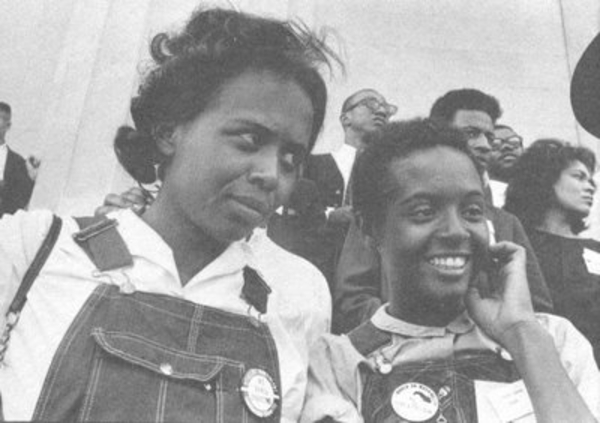
THE BLACK WOMEN WHO MOBILIZED THE MARCH ON WASHINGTON 50 YEARS AGO
Joyce and Dorie Ladner served on the front lines of the civil rights movement in the 1960s, showing up in “hot spots’’ across Mississippi to protest segregation and register blacks to vote.
Joyce Ladner stepped inside a whites-only church in Jackson, Miss., in 1963 and was jailed for a week.
Police had arrested her sister, Dorie, in that same city the year before for picketing a Woolworth store because blacks couldn’t eat at the counter.
But nothing jolted the sisters from Hattiesburg, Miss., like the murder of their mentor, NAACP field secretary Medgar Evers, in June 1963. They wanted the world to know what was happening to blacks across the South.
“It was so dangerous, so horrible. People were getting killed for attempting to register to vote,’’ recalled Joyce Ladner, 67. “It was hard going into these places where white people took pride in killing Negroes.‘’
So the Ladners helped raise money for buses to bring people to the March on Washington for Jobs and Freedom, where Rev. Martin Luther King, Jr., and other civil rights leaders were to call for an end to the mistreatment of blacks and their white supporters in the movement.
No one was sure people would show up. Organizers feared a failure would hurt the movement. “We had one opportunity and (then) that opportunity would go away,’’ said Dorie Ladner, 69, a retired social worker now living in Washington. “We would go back to our hamlets, our communities ... and face the same thing, with the same sheriffs in Selma, Ala., (and) Jackson, Miss.’’
But on Aug. 28, 1963, tens of thousands poured onto the National Mall, stepping off buses from Southern cities like Montgomery, Ala. and Jackson. Others came by train and car from Philadelphia and New York. Some trekked to the mall through D.C.’s segregated neighborhoods.
On Sunday, thousands are expected to gather again on the mall, this time for the dedication of a national monument honoring King, 48 years after he delivered his iconic “I Have a Dream’’ speech. Many who were there in 1963 remember the day as “joyous’’ and a “seminal moment.’’ Some will brave the crowds again for another chance to witness history.
I’ll be there with my cane, but I’ll be there,’’ said Mildred Brown, a 77-year-old native of Mobile, Ala. “I have to show my love and appreciation. I have to also feel that I’m getting some completion. I have supported this (civil rights) effort and I don’t want to miss that.’’
Brown remembers it was still dark in 1963 when she made her way to the mall around 4 a.m. She unfolded her flowered blanket, laying it out behind the fenced-off area to the right of the stage. Then she waited.
“When morning broke, we were afraid because it didn’t seem like enough folks were coming,’’ recalled Brown, who lives in Washington. “When day broke we just saw people coming from everywhere ... that excited us.’’
As a student at Alabama State University in the 1960s, Brown had joined protests outside the courthouse in Montgomery and attended mass meetings where King urged crowds to challenge injustice.
“It was scary, but you did it anyway,’’ said Brown, adding that King was persuasive. “He had a way of speaking that reassured you --that made you feel safe and peaceful. You had confidence that he was doing the right thing.’’
An unforgettable moment
It was King’s speech at the march that left an indelible mark on cab driver Bernard Tinner.
Tinner, already had heard King speak at a local park in Washington and at a Baptist church. Still, he thought that day would be special. So he parked his cab as close to the mall as he could and walked.
Along the way, buses from all over the country were unloading passengers. Soon, Tinner was swept up with the crowd.
Tinner said King’s message about being tired of racism resonated with him. Blacks weren’t welcome at some area hotels. And even in the nation’s capital, he had to ride in the back of street cars.
“They cheered and they cheered,’’ Tinner, 77, said of the crowds listening to King. “It struck a chord.’’
Eleanor Holmes Norton, the congressional delegate for D.C., called King’s speech “poetry.’’
“This was not simply a few good lines,’’ said Holmes Norton, then a law student at Yale University who had helped register blacks to vote in the Mississippi Delta for the Student Nonviolent Coordinating Committee. “People hung on every word because he (was) a Southerner with the Southern intonations of the Baptist preacher. He preached slowly enough so that we could hear his words and savor them and see how wonderful they were.’’
Much of King’s speech focused on barriers in the Deep South, said Joyce Ladner.
“It was not like a kumbaya moment,’’ said Ladner, a sociologist and former educator who now lives in Sarasota, Fla. “It was a coming together of people who were saying they were tired of seeing all these things happen and the government should intervene.’’
C.O. Simpkins of Shreveport, La., said he had heard King deliver a version of the “I Have a Dream” speech in 1958. Despite warnings to stay out of Shreveport and police threatening that “blood will flow like water,’’ King spoke to a packed house at Galilee Baptist Church.
“People had the courage and the will for freedom to be there,’’ recalled Simpkins, 86, then a board member for the Southern Christian Leadership Conference, a group King founded.
Simpkins, a long-time activist, would hear King repeat some of those words at the march.
“I was glad he said it and so many people could hear it,’’ said Simpkins, a dentist who had driven down from New York. “People had a negative feeling about everything. We couldn’t vote. Civil rights bills had not been passed ... But this was a time to show the world that we could come together as blacks and whites to make a change. And that’s what happened.’’
A people transformed
James McFadden, a founding member of SNCC, called the march a “transforming’’ experience.
“What impressed me was the number of the white people who were there. And there were a number of young people,’’ recalled McFadden, 72. “There was so much camaraderie. It seemed like mission accomplished. It seemed like finally we were getting people moving.’’
McFadden left the South for Philadelphia after he was expelled from Alabama State University for his civil rights work, including helping with the Montgomery bus boycott and staging a sit-in at a courthouse.
The morning of the march, McFadden and about 15 activists boarded the early train for Washington. “There was no other place in the world to be,’’ said McFadden.
From their spots backstage, the Ladners and Holmes Norton could see the fruits of their labor.
“Everywhere I looked even in trees I could see people,’’ said Dorie Ladner.
“The best seat in the house was looking out on that crowd and seeing as far as the eye could see, the people spread on both sides of the Lincoln Memorial,’’ said Holmes Norton, who had helped march organizers. “I just relished the sight.’’
Holmes Norton called it a “seminal moment.’’
“Somehow the march itself brought together 10 years of efforts that began with the Montgomery bus boycott and had included the student sit-ins and countless marches in the South and some in the North,’’ she said. “Somehow that all came to a wonderful head at the March on Washington.’’
Joyce Ladner said it also helped re-energize activists and “relieved some of the isolation of the lonely day-to-day journey of trying to live through this.’’
The next day, the Ladners headed back to Jackson. “The march was one day,’’ said Dorie Ladner. “But we had to go back to the battlefield.’’
Joyce Ladner stepped inside a whites-only church in Jackson, Miss., in 1963 and was jailed for a week.
Police had arrested her sister, Dorie, in that same city the year before for picketing a Woolworth store because blacks couldn’t eat at the counter.
But nothing jolted the sisters from Hattiesburg, Miss., like the murder of their mentor, NAACP field secretary Medgar Evers, in June 1963. They wanted the world to know what was happening to blacks across the South.
“It was so dangerous, so horrible. People were getting killed for attempting to register to vote,’’ recalled Joyce Ladner, 67. “It was hard going into these places where white people took pride in killing Negroes.‘’
So the Ladners helped raise money for buses to bring people to the March on Washington for Jobs and Freedom, where Rev. Martin Luther King, Jr., and other civil rights leaders were to call for an end to the mistreatment of blacks and their white supporters in the movement.
No one was sure people would show up. Organizers feared a failure would hurt the movement. “We had one opportunity and (then) that opportunity would go away,’’ said Dorie Ladner, 69, a retired social worker now living in Washington. “We would go back to our hamlets, our communities ... and face the same thing, with the same sheriffs in Selma, Ala., (and) Jackson, Miss.’’
But on Aug. 28, 1963, tens of thousands poured onto the National Mall, stepping off buses from Southern cities like Montgomery, Ala. and Jackson. Others came by train and car from Philadelphia and New York. Some trekked to the mall through D.C.’s segregated neighborhoods.
On Sunday, thousands are expected to gather again on the mall, this time for the dedication of a national monument honoring King, 48 years after he delivered his iconic “I Have a Dream’’ speech. Many who were there in 1963 remember the day as “joyous’’ and a “seminal moment.’’ Some will brave the crowds again for another chance to witness history.
I’ll be there with my cane, but I’ll be there,’’ said Mildred Brown, a 77-year-old native of Mobile, Ala. “I have to show my love and appreciation. I have to also feel that I’m getting some completion. I have supported this (civil rights) effort and I don’t want to miss that.’’
Brown remembers it was still dark in 1963 when she made her way to the mall around 4 a.m. She unfolded her flowered blanket, laying it out behind the fenced-off area to the right of the stage. Then she waited.
“When morning broke, we were afraid because it didn’t seem like enough folks were coming,’’ recalled Brown, who lives in Washington. “When day broke we just saw people coming from everywhere ... that excited us.’’
As a student at Alabama State University in the 1960s, Brown had joined protests outside the courthouse in Montgomery and attended mass meetings where King urged crowds to challenge injustice.
“It was scary, but you did it anyway,’’ said Brown, adding that King was persuasive. “He had a way of speaking that reassured you --that made you feel safe and peaceful. You had confidence that he was doing the right thing.’’
An unforgettable moment
It was King’s speech at the march that left an indelible mark on cab driver Bernard Tinner.
Tinner, already had heard King speak at a local park in Washington and at a Baptist church. Still, he thought that day would be special. So he parked his cab as close to the mall as he could and walked.
Along the way, buses from all over the country were unloading passengers. Soon, Tinner was swept up with the crowd.
Tinner said King’s message about being tired of racism resonated with him. Blacks weren’t welcome at some area hotels. And even in the nation’s capital, he had to ride in the back of street cars.
“They cheered and they cheered,’’ Tinner, 77, said of the crowds listening to King. “It struck a chord.’’
Eleanor Holmes Norton, the congressional delegate for D.C., called King’s speech “poetry.’’
“This was not simply a few good lines,’’ said Holmes Norton, then a law student at Yale University who had helped register blacks to vote in the Mississippi Delta for the Student Nonviolent Coordinating Committee. “People hung on every word because he (was) a Southerner with the Southern intonations of the Baptist preacher. He preached slowly enough so that we could hear his words and savor them and see how wonderful they were.’’
Much of King’s speech focused on barriers in the Deep South, said Joyce Ladner.
“It was not like a kumbaya moment,’’ said Ladner, a sociologist and former educator who now lives in Sarasota, Fla. “It was a coming together of people who were saying they were tired of seeing all these things happen and the government should intervene.’’
C.O. Simpkins of Shreveport, La., said he had heard King deliver a version of the “I Have a Dream” speech in 1958. Despite warnings to stay out of Shreveport and police threatening that “blood will flow like water,’’ King spoke to a packed house at Galilee Baptist Church.
“People had the courage and the will for freedom to be there,’’ recalled Simpkins, 86, then a board member for the Southern Christian Leadership Conference, a group King founded.
Simpkins, a long-time activist, would hear King repeat some of those words at the march.
“I was glad he said it and so many people could hear it,’’ said Simpkins, a dentist who had driven down from New York. “People had a negative feeling about everything. We couldn’t vote. Civil rights bills had not been passed ... But this was a time to show the world that we could come together as blacks and whites to make a change. And that’s what happened.’’
A people transformed
James McFadden, a founding member of SNCC, called the march a “transforming’’ experience.
“What impressed me was the number of the white people who were there. And there were a number of young people,’’ recalled McFadden, 72. “There was so much camaraderie. It seemed like mission accomplished. It seemed like finally we were getting people moving.’’
McFadden left the South for Philadelphia after he was expelled from Alabama State University for his civil rights work, including helping with the Montgomery bus boycott and staging a sit-in at a courthouse.
The morning of the march, McFadden and about 15 activists boarded the early train for Washington. “There was no other place in the world to be,’’ said McFadden.
From their spots backstage, the Ladners and Holmes Norton could see the fruits of their labor.
“Everywhere I looked even in trees I could see people,’’ said Dorie Ladner.
“The best seat in the house was looking out on that crowd and seeing as far as the eye could see, the people spread on both sides of the Lincoln Memorial,’’ said Holmes Norton, who had helped march organizers. “I just relished the sight.’’
Holmes Norton called it a “seminal moment.’’
“Somehow the march itself brought together 10 years of efforts that began with the Montgomery bus boycott and had included the student sit-ins and countless marches in the South and some in the North,’’ she said. “Somehow that all came to a wonderful head at the March on Washington.’’
Joyce Ladner said it also helped re-energize activists and “relieved some of the isolation of the lonely day-to-day journey of trying to live through this.’’
The next day, the Ladners headed back to Jackson. “The march was one day,’’ said Dorie Ladner. “But we had to go back to the battlefield.’’




..."So the Ladners helped raise money for buses to bring people to the March on Washington for Jobs and Freedom, where Rev. Martin Luther King, Jr., and other civil rights leaders were to call for an end to the mistreatment of blacks and their white supporters in the movement."...
Thank God for women, one of His most beautiful creations!