
Where Are the Black Icons?
As a young child growing up in Kingsport, a small town in Upper East Tennessee, I was an avid comic book reader. I still have fond memories of my visits to area bookstores, the countless hours I spent searching for and purchasing the latest chapters in the Superman, Spiderman and X-Men series. But recently, while surfing the Internet, I came across a National Public Radio (NPR) podcast that showcased black comic book heroes. The NPR correspondent offered information about Blade, Storm (from the X-Men series and played by Academy Award-winning actress Halle Berry in the movie franchise) and Spawn.
We all know that Blade is a hybrid (half-human/half vampire), Storm a mutated weather witch, Spawn a demonic minion. But what we black American writers need to understand about these characters and others is no one outside the comic book reading community knew about them until after Hollywood decided to highlight their exploits in feature films. While it is refreshing to view movie trailers with more characters that look like us, I am disheartened by the lack of control that we black American writers have on the introduction of black comic book icons.
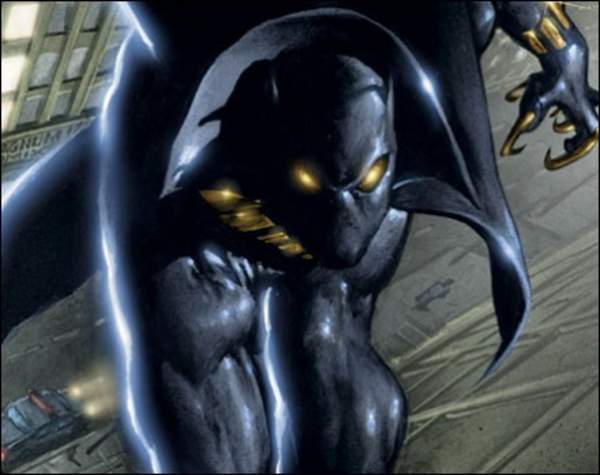
I make this claim lacking a fuller appreciation for what is being produced today by black American comic book writers and illustrators. But the damage wrought by racism and Jim Crow discrimination has been done, causing our black American children to follow hard after Spiderman rather than the Black Panther, a black African prince. This kind of behavior is equivalent to the black doll, white doll experiment. As you will recall, most of this experiment’s subjects, all black American children, preferred the white doll over the black one.
Hearing the results of this experiment still makes my skin crawl. Not out of a dislike for white Americans. I just think the cards have been stacked against us black Americans, causing many of us to hate all things black while loving all things white. This same phenomenon is also played out, for example, when we black American homeowners select a white contractor over a black one. We “know his (the white contractor’s) work ethic will be superior”, the completed project more fully coinciding with our expectations.
If you haven’t noticed, we black Americans have been crying out for more positive depictions of ourselves, our culture, for decades now. When the National Association for the Advancement of Colored People (NAACP) drew attention to this outcry in the late 1990s, many shows added black characters to their ensemble casts. Additionally, many traditional book publishers have added imprints whose products are targeted at diverse populations. This response was great, but have the developed characters had the kind of iconic appeal that rivals white characters like Superman and Spiderman. Better yet, are we black American writers demonstrating a capacity for developing characters and stories that resonate with the mainstream? Or have we conceded, reluctantly admitting that white American writers have a lock on great ideas?
I pray that this isn’t the case. I want my soon-to-be five-year-old son to feel good about the skin that he is in. That’s why I wrote and illustrated the first three books in my “IT’S GOOD TO BE GOLDEN” children’s book series (www.jefferyafaulkerson.com/products). And that is why they’re available for online purchase. But my characters are far from being iconic. Thus, I am depending on other gifted writers from the Black Diaspora to introduce the kind of black icons that young children can identify with. The lessons they learn about themselves and the things they have in common will go a long way in encouraging them to raise their standards for living and maintain the bond of peace.
What do you think? Are you developing black icons that resonate with today’s generation of children? I hope so.
I look forward to reading your responses.
Jeffery A. Faulkerson, MSSW
www.jefferyafaulkerson.com
We all know that Blade is a hybrid (half-human/half vampire), Storm a mutated weather witch, Spawn a demonic minion. But what we black American writers need to understand about these characters and others is no one outside the comic book reading community knew about them until after Hollywood decided to highlight their exploits in feature films. While it is refreshing to view movie trailers with more characters that look like us, I am disheartened by the lack of control that we black American writers have on the introduction of black comic book icons.
I make this claim lacking a fuller appreciation for what is being produced today by black American comic book writers and illustrators. But the damage wrought by racism and Jim Crow discrimination has been done, causing our black American children to follow hard after Spiderman rather than the Black Panther, a black African prince. This kind of behavior is equivalent to the black doll, white doll experiment. As you will recall, most of this experiment’s subjects, all black American children, preferred the white doll over the black one.
Hearing the results of this experiment still makes my skin crawl. Not out of a dislike for white Americans. I just think the cards have been stacked against us black Americans, causing many of us to hate all things black while loving all things white. This same phenomenon is also played out, for example, when we black American homeowners select a white contractor over a black one. We “know his (the white contractor’s) work ethic will be superior”, the completed project more fully coinciding with our expectations.
If you haven’t noticed, we black Americans have been crying out for more positive depictions of ourselves, our culture, for decades now. When the National Association for the Advancement of Colored People (NAACP) drew attention to this outcry in the late 1990s, many shows added black characters to their ensemble casts. Additionally, many traditional book publishers have added imprints whose products are targeted at diverse populations. This response was great, but have the developed characters had the kind of iconic appeal that rivals white characters like Superman and Spiderman. Better yet, are we black American writers demonstrating a capacity for developing characters and stories that resonate with the mainstream? Or have we conceded, reluctantly admitting that white American writers have a lock on great ideas?
I pray that this isn’t the case. I want my soon-to-be five-year-old son to feel good about the skin that he is in. That’s why I wrote and illustrated the first three books in my “IT’S GOOD TO BE GOLDEN” children’s book series (www.jefferyafaulkerson.com/products). And that is why they’re available for online purchase. But my characters are far from being iconic. Thus, I am depending on other gifted writers from the Black Diaspora to introduce the kind of black icons that young children can identify with. The lessons they learn about themselves and the things they have in common will go a long way in encouraging them to raise their standards for living and maintain the bond of peace.
What do you think? Are you developing black icons that resonate with today’s generation of children? I hope so.
I look forward to reading your responses.
Jeffery A. Faulkerson, MSSW
www.jefferyafaulkerson.com




I think you write splendidly..all I remember about this article is how well it is written!!! but that's because I am not interested in the subject in regard to comic strip heroes (no offense ,please)..but the writing is splendid so that it became enjoyable...what a gift!!