More than 15 years ago when Cheryl Carter's oldest child, her son Jarrett, was just starting school, she and her husband were committed to sending him to a good public school. The family had moved to Long Island, New York for that expressed purpose -- quality schools. But soon Cheryl Carter had an epiphany of sorts, which opened her to a whole new world: home schooling.
As a young boy, Jarrett was incredibly active. Carter said her son's teachers didn't know what to do to harness his energy, capture his attention, and tap into his imagination. As a mother, her instincts told her that without the right support, Jarrett could be turned off from school. The local public school wasn't failing her family yet, but she didn't want things to go that far. The job of inspiring Jarrett fell to her.
"I wanted to instill in him a joy for learning," she said.
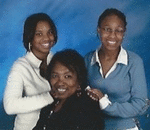
Jarrett, now 20 and a college junior, was just six when his mom began home schooling him. Then came his two sisters, Janae and Jolene. Neither of the girls ever attended traditional school. For the Carter family and a lot of other families like them, home schooling works.
According to the National Home Education Research Institute there are more than 2 million home schooled children in the United States. The institute also says what while home schooling was once considered a different type of experience, it's now considered a readily available option and in the mainstream.
Cheryl Carter said that when she first started, she didn't know many other families who home-schooled, never mind African-American families like hers who had made the same decision.
For some, the number of African-American home-schoolers may come as a surprise, but Dr. Brian Ray, president of the National Home Education Research Institute, said the rate of African-American home-schoolers is growing at the same rate as home-schoolers of other races, about 5 to 12 percent per year.
"When African-American families choose to home school, by and large, it's for the exact same reasons that anyone else home schools," Ray said.
Ray lists among the motivating reasons: Parents believing they can offer at least as good an education as a school; home schooling allows the family to spend more time together to build stronger relationships; and home school parents believe they can educate their children in a safer environment physically, psychologically, and emotionally given some of the dangers children are exposed to when they go to school.
Suze Dalencour, another New York-area parent, has also been home schooling for years. Dalencour has four children, two boys and two girls who range in age from 11to 22.
Dalencour said that while she's confident she made the right decision for her family, she faced lots of criticism after her decision to home school.
"As far as the reaction, yes, people thought that I was strange and some people thought I was harming my kids, and that they were not going to get enough socialization," she said.
Seventeen-year-old Janae Carter said that's one of the biggest misconceptions about home schooling.
"Everyone assumes that you have no friends," she said.
But that's not the case for the Carter children. They regularly see their friends whether it's their friends from church or those they made while pursuing their hobbies and other extracurricular interests. Janae and her younger sister Jolene both take dance classes, and Jolene also plays soccer.
"I like playing soccer because it allows me to be active and gives me a chance to get out of the house," Jolene said.
Their extracurricular activities and hobbies are the same as other kids, and participation is made easier by having a school day similar to that of traditional school. Janae and Jolene say they wake up around 7:00 each morning, and do school work from 8 a.m. to 2 or 3 p.m., but when they finish depends on how fast they work.
"I think one of the greatest benefits is working at your pace, and your own style," Jolene said. "I can work the curriculum around how I learn the best."
Despite the success of many home-schoolers like Jolene, many critics think there's no reason parents shouldn't be sending the kids to traditional schools.
Dr. Meca Williams-Johnson, an education researcher and professor at Georgia Southern University, says the criticism is rooted in history.
She notes that there is, "The historical backdrop and significance of ending segregation only to return to a segregated ideal of educating your own."
Dalencour says there are those who feel that she and other parents should have more faith in the public school system. She's not only African-American parent who made the decision to home school and then heard those sentiments expressed. Ray, of the National Home Education Research Institute, said he's heard from other parents about having to deal with that issue.
"African-American moms and dads say 56 years after Brown versus Board, who does everyone know is still at the bottom of the totem pole?" Ray said, referencing the achievement gap students of different races in American schools. "We don't really care anymore why. Race-bias in testing, or any other bias, or racism. These are our children and we're not going to wait around for 12 years."
Williams-Johnson says the parents she's talked to have said that frequently their children, but particularly young black boys are labeled early on in their schooling, and then sometimes placed into special education classes.
She said, "Some parents are saying they're going to segregate my kid anyway, so why not educate them at home."
Regardless of whether or not parents choose to home school because of lack of faith in public schools or just wanting more involvement in their child's education or development, the home school community is a strong one.
Locally, Cheryl Carter and Suze Dalencour participate in home school support groups; some refer to their groups as co-ops. Dalencour says her group of multi-cultural families meets once a month to offer one another support and provide one other with resources. Carter says among her group the parent educators have taken turns teaching subject areas where they have some added interest or expertise.
"We do have those collections of strengths that we can pull from," she said.
"It's one thing to be taught by someone who's been taught, it's another thing to be taught by someone who's passionate."
On a larger scale, the National Black Home Educators group, founded by Eric and Joyce Burges in 2000, hosts an annual conference each year which includes workshops for parents and for students, a talent show, and a graduation ceremony for students who have successfully completed their studies and are heading off to college.
"We do a lot of work to strengthen the whole family," said Joyce Burgess, who has home schooled all of her children.
Another unusual, but surmountable challenge for home-schoolers is the transition to college. The process of applying can be a little bit different for students without traditional class ranks or teacher recommendations.
Jolene, a high school senior, is currently beginning the application process. She's found that some schools require home-schooled students to take the SAT II subject tests, have different essay requirements, or different guidelines for letters of recommendations. But she says she's not worried about things. This past summer she got a taste of college while completing a pre-college program at Barnard, and she has an example and source of information in her big brother Jarrett.
Jarrett is now a Gates scholar at St. John's University. He says transitioning to college was "an easier experience than most would think it was."
He also says those years of working independently on his school assignments while being home-schooled and being graded by his mom, who the Carter kids say is a tougher grader, offers good preparation for college.
Looking back on his home school experience, Jarrett has some perspective. "Initially, I did think it was weird," he said. "But as time went along I got used to it, and it turned out to be a great experience."
Posted By:
Monday, September 27th 2010 at 7:14PM
You can also
click
here to view all posts by this author...