NY TIMES, April 21, 2011—For Lynn Nottage, the aha moment that led to “By the Way, Meet Vera Stark,” her new play about race, s*x, fame and the dream — and crushing reality — of Hollywood, was unexpected. She was watching “Baby Face,” a delectably sordid 1933 studio film about an Übermensch in silk stockings played by Barbara Stanwyck, who climbs to the top one bed at a time.
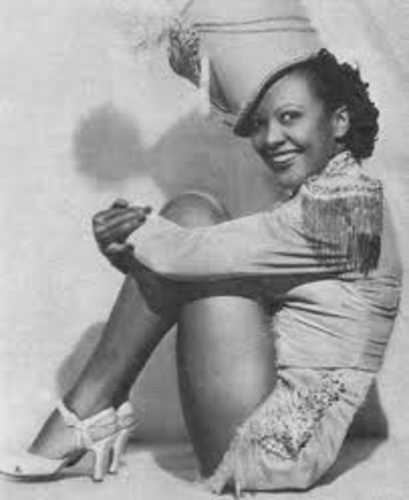
But it wasn’t the star who caught Ms. Nottage by surprise, it was the woman next to her: Theresa Harris, the African-American beauty with the honey voice and sly look who was holding her own against Stanwyck and taking up precious screen space.
This wasn’t one of those nearly invisible black actresses who filled Hollywood movies in the years before the civil rights era, the woman at the edge of the screen announcing visitors and taking hats. Harris’s character is a maid, but she’s also Stanwyck’s companion, and something of a friend.
Entranced by both the character and actress, Ms. Nottage started wondering about Harris — who she was and how she got to Hollywood and the types of films she had been able to make in that notoriously inhospitable town. “I was struck,” she said of the performance, “by how different it was from so many of the other representations of African-American women that I had seen from that period.”
Curious to know more, she set off on an intellectual investigation that became an aesthetic revelation, as she searched for Harris’s traces in the Hollywood histories of African-Americans, in biographies, online, on YouTube and DVD. She didn’t find much, save for movies like “The Flame of New Orleans,” a period confection directed by René Clair in which Harris somewhat reprises her role in “Baby Face,” but with more lines and real glamour shots.
With little to go on but the movies, Ms. Nottage began filling in the blanks with her imagination. The result is “By the Way,
Meet Vera Stark,” an imaginary history that, like other of Ms. Nottage’s plays, weaves the personal with the political. Now in previews at the Second Stage Theater, it opens May 9.
Ms. Nottage, 46, has a MacArthur “genius” grant and a Pulitzer for her play “Ruined,” about women in war-ravaged Congo. These bona fides suggest a level of intimidating gravitas, but this is also a woman who, I discovered when we met one afternoon in March in a Midtown apartment, greatly enjoys gabbing about old movies. She had just come from rehearsals for “Vera Stark,” which stars Sanaa Lathan, best known for movies like “Love and Basketball,” as Vera; Jo Bonney is the director. Ms. Nottage arrived with a small wheeled suitcase that she uses to haul around her scripts and a handful of DVDs for us to sample. As I fumbled with the player she talked about “Vera Stark” and how it had been inspired by watching Stanwyck and Harris.
Tellingly, Ms. Nottage couldn’t remember the name of Stanwyck’s character (Lily Powers), but she did remember Harris’s: Chico. It’s no wonder. From the moment Harris, whose character works in a speakeasy alongside Stanwyck’s, appears on-screen, leaning over a pile of dishes and singing “St. Louis Blues,” she draws your eyes to her. Your interest deepens soon after, when Lily’s abusive father fires Chico for breaking some dishes. “If Chico goes, I go,” Stanwyck snarls.
“I love that moment,” Ms. Nottage said, with a small laugh. “This is what first gave me pause, seeing that moment — wow, this is going to be a different experience.”
For a while it is. Because while Stanwyck is unquestionably the star, Harris has real screen time: she’s attractively lighted, and stands and sits side by side with Stanwyck like the intimates they convincingly play. The relationship shifts after Lily sleeps to the top and Chico starts wearing a maid’s uniform (if sometimes a white fur muff and stole). They can’t “occupy the same universe once Lily moves into society,” Ms. Nottage said.
Directed by Alfred E. Green in 1933, a year before the production code was strictly imposed, “Baby Face,” with its brazenly s*xual lead, was too racy to make it into theaters uncensored. Its offending sections were excised and remained unseen by general audiences until 2004 when a curator at the Library of Congress found an uncensored copy, adding another gem to the “precode” DVD catalog.
The film’s frank, even brutal portrayal of s*x is what knocked me out the first time I saw it. Here, after all, is a studio film about a s*xually abused young working-class woman (Lily) who, inspired by a lecture from a Nietzsche-reading cobbler, takes her revenge on men. What I didn’t see, however, and what Ms. Nottage showed me as we watched the film, was something nearly as startling: Theresa Harris.
Harris’s character isn’t merely an embellishment in “Baby Face”: she has important lines, a strong presence and — this is crucial given how black women could be made into grotesques and comically des*xualized — lovely, at times glamorous. The director wants us to see her as the beautiful woman she was, and I was taken aback that I hadn’t really noticed her before. Watching Harris, I realized that when I had looked at women’s pictures, those five-hankie weepies, the only women I had seen before were white. I’m not alone. Most academic books about women in film are really about white women in film.
These were the other women in women’s pictures: the black cooks, nurses and maids, maids, maids who, breaking out of the margins if only a little, joked with Mae West, fretted about Claudette Colbert and stood by white woman after white woman, scolding them and appealing to their better selves if every so often, like Chico, also playing their laughing co-conspirator. Sometimes they didn’t have names, and they didn’t necessarily make it into the credits.
Still, they were there. And they did what they could with what they were given, a strategy that Ms. Nottage illustrates when Vera tells a friend that the Southern epic she has her eye on doesn’t just have slaves — it has “slaves, with lines.”
“Vera Stark” opens in 1933 with its title character helping rehearse her employer, a white actress, Gloria Mitchell, who’s up for the role of “the beautiful octoroon prostitute” in the fictional “Belle of New Orleans.” Vera, an actress who works as a domestic, lands her first important role as the prostitute’s sister and “devoted servant and companion” and over time achieves such a level of success that later observers (seen intermittently) debate her legacy. “She was shackled to the stage and paraded like chattel,” one character says of Vera’s time at the Folies Bergère. “She was doing what she loved,” another shouts. The play suggests that both are right.
Ms. Nottage seems less interested in rescuing the African-American actresses who were her inspirations than in arguing for the complexity of their images. She sees films like “Baby Face” and movies made before the code was enforced as presenting a more realistic vision of race in America than many later films simply because they show blacks and whites existing alongside one another. “If that code hadn’t set in,” Ms. Nottage speculates, “the whole trajectory of Hollywood would have been different, and some would argue that race in America would be different because the representations of people of color and particularly of women would have been much more expansive.”
It didn’t happen that way, of course, and there was nothing that Harris — who died in 1985 but about whom little else has been written — and actresses like Fredi Washington and Nina Mae McKinney could do to stop history’s tide. Yet, like the quietly biting title of “By the Way, Meet Vera Stark” — with its suggestion of a life that’s seen as an afterthought — meaning can run deeper than its surfaces initially suggest. Look at an old Hollywood movie and you may see a woman playing a maid. Ms. Nottage wants us to look harder.
“As an actress, she was progressive,” she said of Harris. “She was asserting her presence in the films. I wouldn’t argue that it’s entirely directors. I would argue that there’s something this woman did that was unique — that demanded directors pay attention.”
 Posted By: Richard Kigel
Saturday, April 30th 2011 at 11:24AM
You can also
click
here to view all posts by this author...