Early Shemitic Presence in Egypt
The dean of Egyptian archaeologists, the revered James Henry Breasted, to whom Egyptology is everlastingly indebted for having spent the better part of a lifetime digging in the ruins and preserving inscriptions, took note early on of the profound impact the Shemitic peoples had on the evolution of Egyptian civilization. In 1905 Breasted wrote: " It was chiefly at the two northern corners of the Delta that outside influences and foreign elements, who were always sifting into the Nile valley, gained access to the country... The Shemitic immigration from Asia, examples of which are also observable in the [Egyptian] historic age, occurred in an epoch that lies below our earliest historical horizon."1
Sir Flinders Petrie, whose status in Egyptology is on a par with that of Breasted, was similarly impressed with the extent of Shemitic influence and was convinced of the fundamental Asian origin of Egyptian civilization. The region of the Nile delta (Biblical Goshen) was contiguous to Asia. Until the conquest of the area of the Lower Nile by an Egyptian chieftain of the Upper Nile and the establishment of the First Egyptian Dynasty, it was populated by peoples whose culture and technologies derived from the Canaanite and Mesopotamian milieu.
Since the time of the intrepid researchers such as Breasted and Petrie, certain influential archaeologists dismissed their observations as being unduly influenced by Biblical lore. But after a period of skepticism and rejection, new discoveries have consistently justified Petrie's and Breasted's observations.
"Many scholars today accept that at some time during the Pre-dynastic period a new group of people arrived in Egypt and their advent resulted in profound changes in many htmlects of the civilization," stated A. Rosalie David.2
Percy Handcock concurred, and added etymological evidence: "The Shemites swept over Egypt and the north coast of Africa, impressing their indelible and unmistakable stamp upon the foundation-structure of the Egyptian and Libyan languages."3.
Other scholars likewise took issue with the nay-sayers: Sir Alan Gardiner: "... the relationship with Shemitic [languages] is unmistakable;"4 Will Durant: "The further back we trace the Egyptian language the more affinities it reveals with the Shemitic languages of the Near East., the pictographic writings of the pre-dynastic Egyptians seems to have come in from Sumeria;5"; W. Wendorf summed up by stating that the early Pre-dynastic culture record the arrival of a new population in Egypt who brought with them the cultural base from which Egyptian civilization was to develop."6
Pre-dynastic Egyptians were confined to Upper Egypt, virtually isolated. They had no resources conducive to the development of more than a neolithic culture. The area was known as the "Red Land," distinguishing the predominately barren desert lands from the "Black Land," the fertile alluvium of the Delta region to the north.
The Delta was lush with foliage, a swampy quagmire, which, however, dried up sufficiently during a portion of the year to support herds of foraging animals. From time immemorial the area had been a vital, fecund reserve for the peoples of Southwest Asia. These Asians brought cattle and sheep and goats across the sands of the Sinai to graze in the Delta during the recurrent periods in which drought desiccated Canaan.
The wide sweep of the Delta was not merely a seasonally pastoral Eden; hillocks arising from the alluvial areas provided islands of permanently dry land where agricultural settlements were established by the Asiatics. These gezirat (Arabic for "turtlebacks") are sedimentary relics which proliferated in the Pleistone Age. Such settlements already existed thousands of years before Abraham is said to have arrived with his entourage and his herds of animals to await a better season for the completion of his aliya to Canaan.
Merimde beni-Salame was one such a community, situated 37 miles northwest of present-day Cairo.7 It is one of the earliest known farming villages in Lower Egypt, having been settled about 4880 BCE and remaining occupied thereafter for some 650 years.
The Merimdeans were radically different from the Pre-dynastic people of Upper Egypt in every respect - physically, culturally and technologically. Merimbe, wrote Michael Hoffman, "shows none of the distinctively Egyptian characteristics... Merimbe seems more like a village of sturdy yeoman farmers than a collection of peasants subject to the whims, avarice, and authority of a powerful man or government, although some cooperative efforts (if not centralization of food-producing tasks) are recalled by the threshing floors up to 13 feet in diameter."8 The Fayoum Basin, a natural oasis, likewise accommodated agricultural settlements going back to the fifth millennium BCE with many similarities to those on the hillocks of the Delta. Several sites north of the ancient Lake Moeris, now known as Lake Karoun, were explored by Gertrude Caton-Thompson and her geologist colleague Elinor Gardner in the winters of 1924-25 and 1925-26.
"Grains of emmer wheat and six-row barley filled many of the sunken silos that clustered on the high ground
that clustered on the high ground overlooking the small villages. Both of these plants are Middle Eastern domesticates."9
In Egypt’s Pre-Dynastic period (5000-3300 BCE) Shemitic progenitors of the Jews from southwestern Asia inhabited the Delta (Biblical Goshen) and the Fayoum in villages such as Merimde, Ma’adi, and el Omari. The Egyptians were then confined to Upper Egypt. Later, during the Second Intermediate Period (17th-15th c. BCE), coinciding with the time of the Biblical story of Joseph, a new influx of Shemitic peoples from Canaan (termed Aamu by the Egyptians) took place. The Shemites established villages such as Tanis, Avaris and el Yehudiya. The chieftains of these villages, termed the Hyk Khase by the Egyptians, elected a chief-of-chiefs, six of which chieftains successively ruled Egypt and Canaan. The major advances in Egyptian culture and technology took place during the two periods. The Bahr Youseeff ("The Canal of Joseph") and its tributaries was dug during the period, transforming Egyptian agronomy as well. The subsequent 18th Dynasty Egyptian "Warrior Pharoahs" attempted to obliterate all traces of the two centuries of "Hyksos" rule. Museums have little to exhibit of the period as a result, and therefore tend to ignore the great boost in Egyptian technology and culture brought about by the Shemites.
Between 5000 and 3500 BCE Asiatic settlements were established further up the Nile in enclaves along the river which were periodically flooded. Sun-dried bricks, a characteristic Mesopotamian building material, were first employed in Egypt during this period; the use of the distinctly Mesopotamian cylinder seal was introduced, and traces of writing appeared; they bore a marked resemblance to those of the Land of the Twin Rivers (Mesopotamia).
"The first attempts at a pictographic system of writing have also been traced... to the Jamdet Culture [of Mesopotamia]."10
During this period it is evident that Asiatic traders had already threaded their way past the indigenous Egyptians of Upper Egypt by boat and donkey to trade with the Nubians. The donkey was alien to Egypt. The Egyptians, in fact, had no pack animals during the entire Pre-dynastic period. The earliest remains of donkeys were found in various communities of Asiatic origins in the Delta. Donkeys were conspicuously present in Ma'adi, a village of Asiatics which was established south of present-day Cairo. Significant evidence of trade both with Asia and Nubia was found among the artifacts recovered from its ruins.
The Ma'adians were not only expert in agronomy and husbandry but were accomplished metallurgists and craftsmen. "A copper axe-head spoiled in casting and masses of copper ore indicate that copper was being processed at Ma'adi. Ma'adi is the oldest site in northern Egypt in which copper artifacts have been found."11
The people of Ma'adi were among the many communities of Asiatic peoples who had been active in northern Egypt for several millennia at the time it was invaded and destroyed. They suffered a cruel thanks for the technology, agronomic and industrial, that they had introduced into Egypt. "Ma'adi met a violent end as witnessed by widespread ash and human bones over the settlement. If so, then perhaps this was the 'final solution' arranged for the heterogenous society of Ma'adi by the victorious kings of the First Dynasty."12
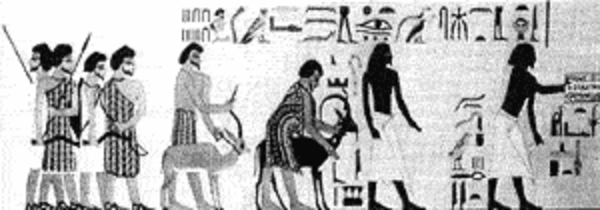
Eleven Egyptian dynasties passed, and Egypt remained in the Chalcolithic, or Copper/Stone Age while the peoples of Southeast Asia advanced into the Late Bronze Age. Intermittently, during peaceful periods, Shemitic traders found their way up the Nile to trade with the Nubians. The passage of such a caravan was recorded in full size by an Egyptian Baron, Knumhotpe, in his tomb at the end of the 19th century BCE. The 37 members of the group included a musician carrying a lyre, a musical instrument unknown in Egypt; one of the caravan's donkeys is depicted carrying a bellows, and another is depicted loaded with an anvil, bronze-working implements likewise unknown in Egypt at the time; one member is shown carrying a curvilineal, laminated bow and a quiver, again, items unknown in Egypt. The hieroglyphic inscription names the leader of the group "Abushei." Abushei is distinctly an Hebraic name; it was, for example, the name of King David's top general.
At the end of the twelfth dynasty, a propitious time of peace and accommodation with the Asiatics ensued The period coincides in time with the Biblical account of Joseph, and initiated what archaeologists term "The Second Intermediate Period" (roughly, 17th-15th centuries BCE). It was a period during which Egypt was ruled successively by six Shemitic (Canaanite or Aramaic) kings.
These Shemitic kings were referred to by the Egyptians as the Hyk Khase, or "rulers from a foreign hill country." The phrase "Hyk Khase" is commonly transformed into "Hyksos," a word which is not confined to the chieftains but is mistakenly applied to the Shemitic people (termed the Aamu by the Egyptians) from which they stemmed.13 Although the hegemony of these "Asiatics" included all Egypt, Canaan and extended into a major portion of Mesopotamia, they established no dynasties. They were elected by the village chieftains (the Hyk Khase) of the Aamu villages, and therefore can be properly designated as the chief-of-chiefs.
SHEMITIC ARTISAN/TRADERS IN EGYPT. Half of a depiction in the tomb of an Egyptian Baron, Knumhotpe, dated to 1892 BCE. The tools and musical instruments carried by the Shemites attest to a knowledge of metallurgy, weaving, dyeing and weaponry as yet unknown in Egypt. The curvilinear bow, the quiver, the lyre, were all new to the Egyptians at the time, as were the clothes fashioned on an upright loom.
The Hyk Khase worshiped a single God and made no statues of Him; they erected few gigantic monuments,14 self-glorifying statuary and self-serving temples such as those which so often drained Egypt of its resources of labor and material, for there were no godly kings among them. Many archaeologists, disappointed by the dearth of gargantuan toms and narcissistic statuary, dismally declare that during this period art declined. Museums petulantly concur, for lack of imposing mausoleums, mummies and exotic statuary of beastly idols to display. The lack of such artifacts cause museums to pass by the vibrant, prosperous and progressive two centuries of Egyptian history with scarcely a mention.
During the tenure of the Shemitic chieftains Egypt leaped forward into a new era, advancing enormously in every field of knowledge and endeavor. Wise men came and taught astronomy, and medicine, and mathematics. The great mathematical Rhind papyrus, now in the British Museum, was produced during this period. Thus, although the chieftains sculpted no great statues of themselves, nor fashioned idols of fabulous gods, the arts they infused into Egyptian culture were of a subtler nature, more durable than the stone of which the statues were carved, and benefitted all Egyptians.
The Egyptians had been sailing the Nile in Feluccas, simple boats which were handled adeptly on the river. These boats, however, could not be managed easily on the high seas, for they had no keel. The Aamus had long incorporated a keel, which stabilized their ships and made them more maneuverable, safer and seaworthy. Consequently, trade with the islands of the Mediterranean blossomed, and Egypt became a more important factor in the region's economy.
Mesopotamian standards of weights were introduced.15 The Aramaic language and writing, which had replaced Akkadian as the lingua franca of the Shemitic peoples, also became the language of international trade in Egypt as well.
The Hieroglyphics on the right half of the drawing in Knumhotpe’s tomb names the group leader Abushei, and identifies him as a Hyk Khase ("foreign chieftain"). Abushei is a Hebrew name, as, for example, that of David’s top general. The donkeys were new to Egypt, which had no draft animals at the time. The anvil and the bellows borne on the backs of the donkeys (left half) demonstrate that the group came from a Bronze Age culture. Upper Egypt was then in the Chalcolithic, or Copper-Stone Age.
A most important impact upon Egyptian economy and life was the engineering by the Shemites of an effective control of water resources. Legends, both Hebraic and Arabic, have it that it was indeed Joseph who was responsible for this great and everlasting contribution to Egypt. A canal was dug parallel to the Nile creating a twin to the Nile for half its Egyptian length. A network of canals branch off to irrigate the desert west of the Nile. The canal finally flowed into the El Fayoum, a basin cradled in a vast depression whose level lay below that of the Nile. Today, after more than 3000 years, the canal still functions vigorously, and irrigates more territory than does the Aswan dam; and it does so benignly, unlike the modern dam, which increases the salinity of the soil and prevents the flooding and silting of the arable land. The canal has always been, and is still today named the Bahr Youseff, the Canal of Joseph." It is so designated on contemporary maps of Mizraim, the land which we call Egypt.
Wheels and wheeled vehicles, and the horses and oxen to draw them, were unknown in Egypt until the time of the rule of the Semitic chieftains. Wheeled chariots, hitched to teams of Asiatic horses, were introduced for hunting and for war, and the potters of Egypt began to throw their ware upon swiftly whirling wheels with newly won ease.
Both husbandry and agronomy were lifted toward Mesopotamian levels by the Canaanites who populated the Delta during the Second Intermediate Period. A great beast was introduced: The humpbacked Brahman or Zebu ox, an Indian beast that had been bred by the Semites to be adapted to the climate of the area. The domesticated chicken, also of Indian origin, had been well known in Akkadia for a thousand years. The cackling hen amazed the Egyptian farmers by their productivity as, almost daily, they plunked down another egg. So astonishing was the prolific performance of these barnyard fowl that Thutmose III inscribed on stone his perplexity about, and admiration for this "foreign bird which gives birth every day."
The Shemites cultivated new fruits in Egypt - pomegranates, figs, olives, new grains and vegetables. Even the cornflower, a common Canaanite flower, became the favorite of Egyptian barons, and their tomb painters employed them lavishly.
Tools were refined and perfected. The Shemites taught the people of Egypt how to set the helve, or handle, into a socket instead of tying the head crudely onto it. The simple bows the Egyptians used were no more than bent branch. They were replaced by the superior bows of the Aamus, cunningly constructed of bone and wood laminated into a composite curve. The shape and composition of scimitars, swords and daggers were modified to make them more effective and durable.
More important than weapons was the introduction of abiding inventions of peaceful use: new spinning devices and the upright loom; new fibers and new fast dyes made fabrics more durable and colorful; and added another dimension to the quality of life. The introduction of the gentler arts likewise contributed to a richer Egyptian culture. A variety of new musical instruments, the lute, the lyre, the oboe, the tambourine and the harp, long played in the Mesopotamian milieu, now appear in Egypt. With the new music came new forms of dance, and its graceful images became forever inscribed into the graffiti of the nobles, princes and pharaohs of Egypt fro that time forward. The Egyptians got to learn new Shemitic games, and began to introduce them into their tombs to be able to amuse themselves into eternity. The astragal, a form of dice, made from the tarsal joint of a hoofed animal, were employed in such games as twenty squares, similar to the Indian parchesi, and in senet, a more ancient Mesopotamian game.
The Shemites acquainted the Egyptian with new metals and propelled Egyptian society and culture into the Bronze Age.
It is most ironic, that the new bronze weapons, the chariots and the curvilinear bows, were responsible for the demise of Aamu rule. At first, a campaign by an Egyptian baron, Sequernene, to overthrow Hyk Khase rule was ignominiously defeated. One of his sons, Kamose, pled in vain to the other noblemen of Upper Egypt for their support. Kamose himself bitterly inscribed their refusal in stone, quoting how his neighboring Egyptian lords had expressed their content with the prosperity they enjoyed and had refused to join the insurrection. Kamose raised a mercenary army from a tribe of outlaw Nubians, and was likewise defeated. Kamose's brother Ahmose, however, took up the cause, and succeeded where his father and brother had failed.
Ahmose I became pharaoh and the Shemitic rule of Egypt came to an end. The Aamu were expelled or enslaved, and progress came to a halt.
Posted By:
Sunday, August 21st 2011 at 7:28PM
You can also
click
here to view all posts by this author...