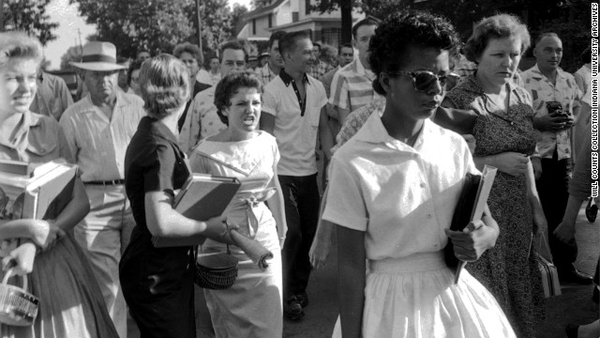
CNN, December 22, 2011 -- David Margolick’s latest book, “Elizabeth and Hazel: Two Women of Little Rock,” explores what happened to two teenagers captured in one of the civil rights movement’s most iconic photos.
Elizabeth Eckford was one of nine black teenagers to integrate Little Rock, Arkansas', Central High School in 1957, and the photo shows her walking a gauntlet of shouting, taunting white students and adults. In the photo, Hazel Bryan, now Hazel Bryan Massery, was the white girl caught in the midst of yelling a racial epithet. The moment depicted in that image continued to reverberate throughout both girls’ lives.
Eckford struggled with depression and anxiety throughout adulthood, once being diagnosed with post-traumatic stress disorder due to the near-constant bullying she experienced at Central High. She attended two colleges before depressive symptoms forced her to drop out. Bryan Massery transferred to another high school before dropping out to marry at 16. She was the mother of two children when she first called Eckford to apologize for what she'd done. Although the two women eventually reconciled and even became friends, the pain and guilt each experienced because of the events in the photo crushed their friendship, and they no longer speak to each other.
CNN: What motivated you to write this book?
Margolick: I was in Little Rock doing a piece, a [Bill] Clinton-related piece for Vanity Fair that didn’t pan out. While I was there, I went to Central High School, which had always been a legendary building for me. I was well aware of what had happened in Little Rock in 1957 … Central High School was a holy place for me, and I wanted to see it for myself. When I was there, I went to the visitors’ center across the street, which had just opened, and right when you got in you saw the famous picture.
It seeped into my consciousness the way it seeps into the consciousness of every historically curious person.
I can’t tell you [how old I was when I first saw the picture]. I could no more tell you than I could when I first saw the picture of the little boy in the Warsaw ghettowith his hands up. You just know you’re changed once you see it. These are images that haunt you for the rest of your life.
But what happened in the visitors' center was that very close to the picture, in the gift shop, was a poster of the grown-up pictures of these girls … I realized this was the same Elizabeth and Hazel, only they were grown up and they were friendly. The picture was taken in 1997, and I was there in 1999 … I thought, as any journalist would, how did we get from the first picture to the second? And why didn’t I know anything about it? How had these two archetypal racial antagonists buried the hatchet? How could that be? So that’s what made me curious enough to start looking into it.
CNN: What was it like reporting this story – were the two women and the people around them willing to talk?
Margolick: It was a delicate matter reporting the story, but not for the reasons that I anticipated. The two women were initially quite willing to talk. They met with me right away, and - but there were problems very quickly. When I met the two women, the bond that had developed very quickly between them in 1997, had begun to fray.
Hazel was wary of me and decided not to cooperate with me. Hazel felt that me and Elizabeth would gang up on her. For the first eight years that I worked on the story, she wouldn’t even talk to me.
When a version of the story appeared in Vanity Fair in 2007, an early version, and Hazel could see I bore her no ill will and was trying to be fair to her, then she agreed to see me. And from there I went back and forth between the two of them. They only live a few miles apart. Though they hadn’t talked to each other since 1997, they were talking to me.
I found that their families were not anxious to speak about it. Their children - I never spoke to Hazel’s children, she would never let me. She thought some of the ostracism that she had suffered for coming out and apologizing would spill over to their lives and hurt them, their businesses.
There were a lot of white people in Little Rock that thought Hazel had given them a bad name, that they had behaved completely appropriately in 1957 and never did anything to hurt the black people at the school, and here they were saddled with the image of Hazel in the picture. They were seen as racists, when all they did when the black children at Central were being harassed and humiliated, was look the other way. They think that they were good kids, and that the trouble inside Central to which Elizabeth and the others were subjected was the work of 200 troublemakers, and the other 1,800 of them were living as normal a life as possible in a school that was militarily occupied.
CNN: What do you find most tragic about this story?
Margolick: There are lots of tragic things here, lots of tragic dimensions to this story, but each has a positive side, too. This story is very mixed; it’s complicated. It’s a great tragedy that, because of her own demons and the abominable way she was treated, Elizabeth’s growth was stunted. Elizabeth could have been anything. She could have been a great lawyer or a history professor. So that’s a great tragedy. It’s a great tragedy that a childish mistake - Hazel has had to bear this cross for the last 55 years, and this picture will be on top of her obituary. It will be the only reason she’ll have an obituary in The New York Times.
It’s a tragedy that the despite the intents of these well-meaning people, they ended up incommunicado, despite the great bond of love between them even to this day.
That’s why I think the last chapter of this book will not be in my book. It may not be written yet.
CNN: From what I understand, Hazel’s life took an upward, or at least normal, curve, while Elizabeth struggled for decades after the day that picture was taken. What do you think accounts for the difference in the levels of their successes?
Margolick: I think it’s a matter of their mental makeup – I think that Elizabeth had a family history of depression that Hazel didn’t have to deal with. And Elizabeth had suffered much more egregiously than Hazel ever had, and that exacerbated whatever tendency Elizabeth had toward depression, whereas Hazel was just sort of a normal southern girl. Hazel wasn’t troubled at all until the picture began to torment her years later. And she was traumatized incrementally and episodically when the picture came up, but few people knew that she was the person in it. So it was a sort of private embarrassment she suffered. With Elizabeth, it was an ongoing affliction. And it wasn’t just the picture and wasn’t just her experiences at Central, it was everything thrown together. And the affliction was just constant and unrelenting for decades.
CNN: What’s the overarching lesson to be learned from Elizabeth and Hazel? Is there one?
Margolick: I guess it’s just that even for people with good intentions - the best of intentions - it’s very hard to overcome the history of racial tension in this country, and racial misunderstanding and racial division. Because both of these people mean well. And, as I said, underneath all the tension and anger and bitterness and resentment, there still exists a great bond between them. I know there does, because whenever they talk about each other, they tear up. They miss each other. And I think that compounds the tragedy that you were talking about before.
CNN: People want so badly for this story to have something like a happy ending. What does it say about America that this happy ending never materialized?
Margolick: I think it says something about American naivety that we think it should have materialized, and about American impatience over the fact that it hadn’t. This would be a much bigger story, a more newsworthy story, if it had materialized. Then Oprah would be talking about it again. And the fact that it hasn’t yet makes it less interesting to people, when that fact is, it should make it more interesting to people because it’s real.
So it’s very stirring – movies get made of unrealistic, completely implausible situations like 'The Help,' but not vexing real-world situations like this one. And that’s very sad. Revisionism is much more popular, much more marketable, than reality. You can walk out of the theater eating your popcorn and feeling happy. I wanted there to be a happy ending to this story, but I felt it wasn’t my role to stage manage a happy ending when there wasn’t. I didn’t even want to ask them to pose for a picture together. I did, but that was only at my photographer’s insistence, and only at the very end, when the book was almost completely done.
CNN: What did writing this book teach you about racism and race relations?
Margolick: It just reminded me of how complex they are, I guess, and how heavy the hand of history is on us still, and how omnipresent America’s racial legacy remains. There’s no such thing as 'post-racial,' and all these problems are still lurking. They’ve just gone a bit beneath the surface. They’re not as bad as they once were, but there’s still a long way to go. I write all my books trying to figure out the kind of person I am, how I would behave in those circumstances and these books give me a chance to ponder that.
CNN: The current generation of 15-year-olds is growing up in a more integrated society, in many ways. Do you think racial reconciliation of past and current racism will be any easier for them than it was for Elizabeth and Hazel?
Margolick: Oh, I think so. Even though the races are very much separated still, they are so much more mixed together than they were.Elizabeth told me she actually didn’t understand some of the white kids when she arrived at Central; they spoke with an accent she had never heard before. That would be inconceivable today. So things are starting from a much more advanced place, and the level of racial understanding is necessarily much, much higher, however far it still may have to go. And in a school that’s as heavily black as Central High School is now, the sort of harassment that the Little Rock Nine had to put up with would never be tolerated. It would be crazy even to attempt it.
CNN: Do you find that people of different races, ages, backgrounds react differently to the story?
Margolick: I’m not sure if I have enough of a cross-section of reactions, frankly. I think that blacks get this story more than whites do, and feel more drawn to it than whites do, in some instances. That certainly goes for some of the reviewers. But then I haven’t had any black reviewers, I’m just thinking, anecdotally. I so much want this book not to be read just by the usual white liberals. I don’t want to just round up the usual suspects for this book. I want blacks to read it too. I want white conservatives to read it, because I think that Hazel would really resonate with them. The thing that burns up some conservatives is that only liberals are [portrayed as] tolerant.
I’d like this story to be discussed on Fox as well as CNN, but I’d be satisfied with it on either. Instead of just on MSNBC.
CNN: Is there any other photo in American history that you’re dying to find out about?
Margolick: No, I don’t think I want to do another one of these. I think no picture better captures the racial divide in this country than this picture, and since the racial divide is such a large part of the American story, and since I’m so interested in that racial divide, there’s no other picture I want to write about. I was incredibly lucky to write about this one. I was incredibly lucky that no one had ever written about this picture.
 Posted By: Richard Kigel
Monday, December 26th 2011 at 1:31PM
You can also
click
here to view all posts by this author...