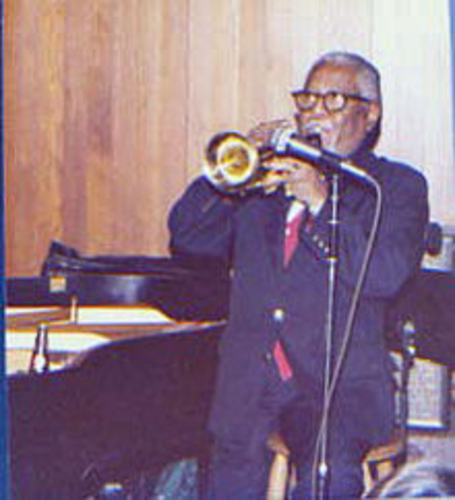
Roy David Eldridge (January 30, 1911 – February 26, 1989), nicknamed "Little Jazz" was an American jazz trumpet player. His sophisticated use of harmony, including the use of tritone substitutions, his virtuosic solos and his strong influence on Dizzy Gillespie mark him as one of the most exciting musicians of the swing era and a precursor of bebop.
Eldridge was born in Pittsburgh, Pennsylvania and originally played drums, trumpet and tuba. He led bands from his early years, moving to St. Louis, and then to New York. He absorbed the influence of saxophonists Benny Carter and Coleman Hawkins, setting himself the task of learning Hawkins 1926 solo on "The Stampede" in developing an equivalent trumpet style.[1]
Eldridge played in various bands in New York in the early 1930s, as well as making records and radio broadcasts under his own name. His rhythmic power to swing a band was a dynamic trademark of the jazz of the time. It has been said that "from the mid-Thirties onwards, he had superseded Louis Armstrong as the exemplar of modern 'hot' trumpet playing".[2]
Eldridge was very versatile on his horn, not only quick and articulate with the low to middle registers, but the high registers as well. The high register lines that Eldridge employed were one of many prominent features of his playing, another being blasts of rapid double-time notes followed by a return to standard time. These stylistic points were heavy influences on Dizzy Gillespie, who, along with Charlie Parker, brought bebop into existence. Eldridge participated in some of the early jam sessions at Minton's Playhouse. A careful listening to bebop standards, such as the song "Bebop", reveals how much Eldridge influenced this genre of jazz.
Courtesy Harlem World Magazine
January 7, 2012
 Posted By:
Saturday, January 7th 2012 at 9:30PM
You can also
click
here to view all posts by this author...