Home Invites Blogs Careers Chat Events Forums Groups Members News Photos Polls Singles Videos
Home > Blogs > Post Content

Should affirmative action still exist? Share your thoughts (2654 hits)


Before you share your thoughts let me share a few facts to help you along !


(CNN) - In 1961, President John F. Kennedy signed Executive Order 10925, ordering that federally funded projects "take affirmative action to ensure that applicants are employed, and employees are treated during employment, without regard to their race, creed, color, or national origin."

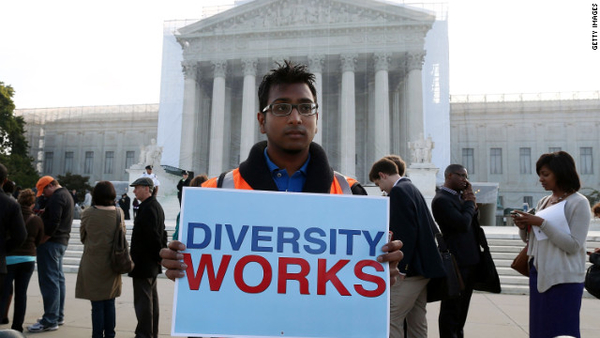
Five decades later, a young white woman and a Texas school's admissions policy stand central to a monumental Supreme Court case. The justices began hearing oral arguments Wednesday over the constitutionality of racial preferences in consideration of the students it accepts.

It could change how schools determine whom they let in and whom they keep out.

Justices to re-examine use of race in college admissions

Affirmative action began as a simple idea to expand equality and has morphed into a charged and divisive topic.

What is affirmative action, and how is it different from when it began?

Here are five things to know. What would you add? Let us know in the comments below.


1. Why it was started: The earliest implementation of affirmative action policies, before Kennedy coined the phrase, began under President Franklin Roosevelt in the second World War. He banned discrimination in the government and those involved in "war-related" work.

Later, President Lyndon B. Johnson expanded on Kennedy's order to include women and signed the Civil Rights Act into law. He explained the purpose of affirmative action in this speech to Howard University's 1965 graduating class:

"And this is the next and the more profound stage of the battle for civil rights. We seek not just freedom, but opportunity. We seek not just legal equity, but human ability; not just equality as a right and a theory, but equality as a fact and equality as a result.”

Less known, though, is that President Richard B. Nixon created goals and time frames around the legislation. "We would not impose quotas, but would require federal contractors to show affirmative action' to meet the goals of increasing minority employment," he wrote in his memoirs.

2) Why it is controversial: Quotas. The idea of a limited number of admissions or jobs for members of underrepresented groups and any type of preferential treatment runs counter to how we view our American dream, critics argue.

That idea became central in the Massachusetts Senate race between Scott Brown and Elizabeth Warren. Warren was accused of using her Native American ancestry for jobs but has denied doing so.

Is she or isn’t she Native American?

In 1978, the landmark Regents of California v. Allan Bakke case made racial quotas unconstitutional. Bakke, a white student, sued after twice being denied admission to medical school, challenging the special admissions used to admit minority groups.

3) How it's changed: While affirmative action is usually spoken of in general terms, there is no singular policy or implementation of the ways in which affirmative action take shape in government organizations, colleges and corporations varies.

Court cases continue to refine interpretations of how race is used at the university level. Some schools have experimented with a variety of ways of non-race-based models, like the Top 10 model that the University of Texas employs, to ensure the racial diversity of students.

4) How we feel about it: In a 2009 Pew poll, the majority of Americans supported affirmative action but strongly disagreed about minority preference. And while most African Americans (58%) and Hispanics (53%) agreed that minorities should get preferential treatment, only 22% of whites agreed.

5) Where it exists: Though quotas have been outlawed in the United States, the European Union has had a recent push to punish companies whose boards aren't composed of at least 40% women. And India, Brazil and Malaysia, among other countries, have laws and policies that address affirmative action in schools and throughout society.

Should affirmative action still exist? Share your thoughts

Posted By: DAVID JOHNSON
Sunday, October 14th 2012 at 8:23PM
You can also click here to view all posts by this author...

Report obscenity | post comment
Share |
Please Login To Post Comments...
Email:
Password:

 
Abigail Fisher argues that the University of Texas unconstitutionally considered race in admitting students, resulting in her exclusion. She sued the university, and on Wednesday, the highest court in the land began hearing the case, reigniting contentious debate on whether a policy of preferences does good or harm.

Should America consider new limits on racial preferences? Or ban them altogether?

Should we be chanting "Long live affirmative action"? Or cheering its death?

A few years ago, in a Supreme Court ruling on school desegregation, Chief Justice John Roberts wrote:

“The way to stop discrimination on the basis of race is to stop discriminating on the basis of race."

Simple enough to say, but, of course, a far more difficult notion to implement.

In any case, people from opposing corners came out slugging as the Supreme Court weighed the Texas case as Fisher, who'd been mum in the media, gave her first interview to The New York Times.

“I’m hoping that they’ll completely take race out of the issue in terms of admissions," she told the Times, "and that everyone will be able to get into any school that they want no matter what race they are but solely based on their merit and if they work hard for it.”

Gail Heriot, a member of the U.S. Commission on Civil Rights, told CNN that affirmative action is backfiring badly. Race preferences, she said, are doing more harm than good and suggests such policies result in fewer African-American professionals.

In an amicus brief supporting Fisher's petition, Heriot argued that affirmative action leads to minority students entering top schools, where their credentials put them at the bottom of the class.

Joshua Thompson of the conservative Pacific Legal Foundation, which also filed a legal brief in support of Fisher, said, "Using race in admissions decisions, to achieve diversity, amounts to stereotyping people by their race."

The authors of "Mismatch: How Affirmative Action Hurts Students It's Intended to Help, and Why Universities Won't Admit it," said that America ought to keep affirmative action but reform it. They pointed out two reforms in particular: Limit the overall size of racial preferences and mandate a thorough transparency at any university that wants to use them.

Ebony magazine cried foul with an opinion piece called "Affirmative Action vs. White Privilege: Abigail Fisher cries discrimination over a school that says she wouldn't have gotten into regardless of her race. What will the Supreme Court say?"

Guardian columnist Gary Younge argued that "the central barrier to meritocracy is not race but class, and that if entrance to higher education in America were only based on test scores and academic ability, the biggest losers, by far, would be wealthy white kids."

The biggest winners in affirmative action, said Chris Seck in the Harvard Law Record, are not minorities but whites.

"We have an ironic situation where institutions that claim to promote 'diversity,' despite their sincere intentions, appear to limit minorities to a minority of seats," Seck wrote. "Conversely, this results in an apparent entrenchment of white majorities."

Others argued affirmative action is an idea whose time has come and gone.

"Affirmative action today arises in a wholly different political context: Institutionalized segregation is a thing of the past," wrote Richard Epstein for the Hoover Institution's defining Ideas journal.
Sunday, October 14th 2012 at 9:24PM
DAVID JOHNSON
yyello •
"One of the main reasons we came to Duke University was to broaden our perspectives in the process of gaining a world-class education. "

But why do we assume that minorities are not broadening their perspectives by hanging out with people of the same racial background? Many of the minorities at this school may have never lived in an area where they had the opportunity to be around other people of the same race. Maybe they are gaining more perspective about cultural aspects of a racial community they have not previously been connected with. Would I, for example, as a non-white person, really be broadening my perspectives by hanging out with white people just because they are a different race than me, even though I spent the majority of my life in a city that is nearly 80% white and the majority of my friends prior to college were white? Would I really be "secluding [myself] in the comforts of what [I] know" by socializing with people that I had limited contact with prior to college, just because we may look similar to an outsider?

"Whether it is because of natural instincts or the comfort of belonging to a group of people with similar backgrounds and interests, there is an almost automatic connection among those people of the same race."

I would also like to add that, especially in a country as diverse as the U.S., race and a specific culture do not necessarily go hand-in-hand. Being the same race as someone else does not automatically mean that we share the same background or life experiences.

Sunday, October 14th 2012 at 9:27PM
DAVID JOHNSON
Please Login To Post Comments...

Email:
Password:

 
More From This Author
THE TRUTH ABOUT YOUR CHILD
Oprah sells ''Own'' network for pennies on the dollar - The Dr Boyce Breakdown
should marijuanas be legalized pros and cons
MALCOUM X !! ''SHUT EM DOWN PARADE'' REAL Gs live with Sa Neter T v and HOK, family
testing 1 2 3 can you hear me
should marijuanas be legalized pros and cons
REAL Gs TV ! SELF DESTRUCTION !! '''THE REMIX'''' ! 2019 BarelyTeens and Friends
Forward This Blog Entry!
Blogs Home

(Advertise Here)
Who's Online
>> more | invite 
Black America Resources
100 Black Men of America
www.100blackmen.org

Black America's Political Action Committee (BAMPAC)
www.bampac.org

Black America Study
www.blackamericastudy.com

Black America Web
www.blackamericaweb.com

CNN Black In America Special
www.cnn.com/blackinamerica

NUL State of Black America Report
www.nul.org

Most Popular Bloggers
agnes levine has logged 21601 blog subscribers!
reginald culpepper has logged 12319 blog subscribers!
miisrael bride has logged 8382 blog subscribers!
tanisha grant has logged 6346 blog subscribers!
rickey johnson has logged 5530 blog subscribers!
>> more | add 
Latest Jobs
Analyst and Power BI Developer with Front Range Community College in Westminster, CO.
Digital Communications Manager with FPWA in New York City, NY.
Manager of Edge Network (Information Technology Manager 2) with The State of Connecticut, Department of Administrative Services (DAS), Bureau of Information Technology Solutions (BITS) in Hartford, CT.
Human Resources Manager with Virginia Economic Development Partnership in Barhamsville, VA.
Facilities Security Officer with Virginia Economic Development Partnership in Barhamsville, VA.
>> more | add