By Glenn Burkins
October 16, 2012
Seventeen years ago today (Oct. 16), Nation of Islam leader Louis Farrakhan led what some say was the biggest gathering ever to assemble on the National Mall in Washington, D.C.
And while various groups dispute the actual size of the Million Man March – the U.S. Park Service said 400,000; organizers said closer to 2 million – few can doubt that something historic, and even surprising, happened that day in 1995.
For perhaps the only time in the history of the United States, large groups of African American males came together in unity from all over the nation to confess that they collectively had not been the family and community leaders they should have been -- and they pledged to do better.
With Farrakhan in town last weekend to commemorate the event, we asked five Qcity men whether or not they thought the Million Man March had left a lasting legacy in the black community. Here is what they said:
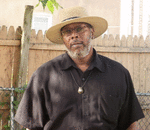
Malachi Greene, former Charlotte City Council member and community leader:
“I think that the legacy, if there is a legacy, is the pride that was generated by so many of us, and the recommitment of black males to our communities. I think the pride and commitment does remain. How we demonstrate our commitment and how we practice our commitment…sometimes I think you see a huge amount of improvement in the way we have performed, and in some ways you don’t. But I’m not so certain that that isn’t the way of all flesh. Certainly the condition of African Americans in this country has improved in my lifetime, and I see constant improvement. To quote the old phrase: ‘We ain’t where we ought to be, but we are so far from where we started.’ So I think the Million Man March was one of those signposts or guideposts in raising our consciousness. It allowed a huge number of us to recommit to the struggle that we all know is there but sometimes forget because we are trying to make a living or raise our families.”
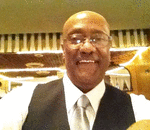
Victor Earl, executive director, Men Who Care Global:
“It has had a legacy. It sparked the 100 Black Men movement in various cities throughout the nation. They have been going out to African American young men and try to make them leaders and keep them on path. So it has had a lasting effect all these years later. Are we at a million? Probably not. But have we moved the needle? Yes, we have. It sparked a call to action that wasn’t there prior to the Million Man March.”
The Rev. Jerry Cannon, senior pastor, C.N. Jenkins Memorial Presbyterian Church:
“We hosted a service in Charlotte for the people who didn’t go, and that was just as significant. As you know, (the march) was kind of divisive in the community, and a lot of people didn’t want to follow the direction of Minister Farrakhan. But the message was cohesive, and it didn’t matter if you were Muslim or Christian. The issue was solidarity and also repentance and stepping up to the plate. So the legacy of that really lies with the men who attended and their willingness to share that story. I would say that, unfortunately, it hasn’t been told enough. We don’t have the testimonies. We don’t have the people who were there reminding us of the commitments made on that day… We really need to start hearing those testimonials. If you only have a T-shirt to prove it and nothing significantly changes in your modus operandi, then there is no legacy; it was only an event.”
Herb Gray, Charlotte business owner:
"I definitely think it has more of a legacy than not. The message of unity, the message of social responsibility, the message of trying to take financial responsibility for your family and for your kids is one that has, in my opinion…continued to spreads out today. It was the start of an agenda that said, 'Here are some things that would be great as a group for us to work on.' I think people have gone back to their communities and tried to enhance their communities by doing some of those things."
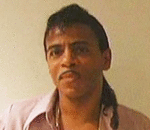
Reggie Singleton, health educator and mentor:
"I was 34 at the time, a father for the first time. I actually took a young man from the community with me. While I had been doing a lot of work through the community, I really became inspired from the speeches, from the brotherhood, from the solidarity that came from that march, and I developed a sense of urgency from it. When I left the march, I came back and became a big brother with Big Brothers/Big Sisters, and I mentored this boy until he graduated from school. Then in 1999, I decided that, rather than doing a lot of one-to-one intervention, I thought I could be more productive doing groups. That’s what inspired me to do the weekly manhood training groups. What we now have is the weekly Males Place manhood training program.
 Posted By: Siebra Muhammad
Tuesday, October 16th 2012 at 10:47AM
You can also
click
here to view all posts by this author...