“Education reformers such as Horace Mann of Massachusetts began calling for public education systems for all. Upon becoming the secretary of education in Massachusetts in 1837, Mann helped to create a statewide system of "common schools," which referred to the belief that everyone was entitled to the same content in education. These early efforts focused primarily on elementary education. The common-school movement began to catch on in the North. Connecticut adopted a similar system in 1849, and Massachusetts passed a compulsory attendance law in 1852.
It was not until after the Civil War and under Reconstruction governments, that the coalition of black and white Republicans in state legislatures established universal public education in the South. This was one of the major achievements of Reconstruction governments.[6] By 1870, every state provided free elementary education. Although in some states, education was first established as integrated, after white Democrats regained political power in the 1870s, they imposed segregation on all schools, and later on all public facilities. The South was struggling after the war, but as they had before the war, the wealthiest classes resisted taxes that would provide sufficient funding for education.
“The preparation of the voter so that he might express his opinion by means of the ballot, thus insuring political liberty, was one of the main goals of Jefferson's plan for education which asserted four basic principles:
1. "that democracy cannot long exist without enlightenment.
2. that it cannot function without wise and honest officials.
3. that talent and virtue, needed in a free society, should be educated regardless of wealth, birth or other accidental condition.
4. that the children of the poor must be thus educated at common expense." (as cited in Padover, 1952, p. 43)
Jefferson felt so strongly about education that he, as a strict constitutional constructionist, submitted to congress an amendment to the constitution to legalize federal support for education in his State of the Union Address, December 2, 1806. "Education is here placed among the articles of public care. . . " (Honeywell, 1964, p. 63).
Every government degenerates when trusted to the rulers of the people alone. The people themselves are its only safe depositories. And to render even them safe, their minds must be improved to a certain degree. . . . An amendment to our constitution must here come in aid of the public education. The influence over government must be shared among all people. (as cited in Padover, 1939, p. 87)”
In accepting the understanding that the American educational system is less than 300 hundred years old, adopted from English traditions and limited in its depth of global intellect, leaves the diversity of knowledge wanting in regards to pedagogy of people of African descent. White farmers did not welcome it especially, who saw Africans as free labor and a possible problem in allowing them to be recognized as equals academically and economically.
The eventual freedom of African people resulted in White politicians in the South creating methods of psychological and mental control through the churches and schools.
“On June 24, 1789, at the Feast of Saint John the Baptist, one of the most important days in the Masonic calendar, the Reverend John Marrant, chaplain of Boston's African Lodge no. 459 of Freemasons, delivered a momentous sermon at Mr. Vinal's school in the South End before an audience of black and white Masons as well as non-Masons. Marrant's oration occupies a preeminent place in the history of Freemasonry among African Americans. It was the first printed formal address before the first African Lodge and among the first printed works by an African American in the late eighteenth century. Marrant's oration broached racial prejudice and slavery in America and condemned them as the antithesis of the fellowship and benevolence Freemasons cherished. More significantly, the sermon identified and extolled the meaningfulness of the African Lodge's founding and the relationship it bore to the deepest virtues and origins of not only Freemasonry but also Christianity as well—virtues and origins that Marrant would clarify in novel contexts. Though Freemasonry commonly eschewed religious sectarianism, Marrant chose to embed it in the distinctive doctrines of benevolence advanced by proponents of neo-Edwardsian New Divinity. Though he abominated the gross exploitation of people of African descent throughout the Atlantic world, his oration was ultimately much more praise for the novel and providential founding of African Lodge no. 459 than protest against slavery and racial proscription.
Historians often fail to recognize that the Prince Hall Masons make up the oldest enduring black institution in America. Black Freemasonry in America began in 1775 when Prince Hall and several other Boston free blacks were initiated into a military lodge of Irish soldiers then stationed with British forces in the occupied city. After British troops evacuated Boston in March 1776, Hall and his brothers remained without an official lodge charter. Their warrant entitled them only to meet, march in public processions, and bury their dead, not to initiate new members. The black Masons finally received a charter from the Grand Lodge of England in May 1787 and were entered as African Lodge no. 459 on its rolls. Freemasonry quickly spread among black males in Boston and within the next several years into other urban centers along the northeastern seaboard, especially Providence and Philadelphia. Members of African Lodge no. 459 overstepped the authority granted in their charter by chartering new lodges in these cities. Such extralegal practices coupled with the lodge having been chartered through England led many white Masons by the early nineteenth century to consider the African Lodge clandestine, or illegitimate, particularly in light of the exclusive sovereignty claimed by the newly independent white Grand Lodge in Massachusetts. According to The Constitutions of the Free-Masons, only a grand lodge, not a local lodge, could charter new lodges.”
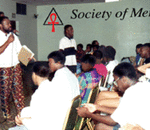
Black Masonic Lodges knew the importance of educating one another in order to become true citizens in America as well as having full knowledge of their history. They knew from a ancient perspective that Africans are from a glorious past and made sure that one of their purpose was to ensure that those in positions of authority were conscious and aware of this great legacy.
In their efforts to enlighten one another, basic conditions had to be established in order to build a society that would safe guard the black community. Self-knowledge was more important than what whites were willing to provide and collective cooperation was the edict for strength and survival.
Below are some of the areas in which I believe were the basic tenants necessary for plotting a course for reconstruction of the African mind.
1. Know Thyself
A. Laws of the Opposites as a universal force. ( - + )
B. History of Family (Mother – Father)
C. Why did you choose to be here? (in this life)
D. What do you want and how will you get it? (career goal)
E. Who have you chosen as your mentor(s)?
F. Control of Though, Control of Actions, Steadfast in Purpose.
2. Preparation for Adulthood
A. Commitment
B. Responsibility
C. Empowerment
D. Excellence
E. Dignity
3. Rites of Passage
4. Placed into Position of Higher Learning
 Posted By: Dr. Okpara Nosakhere
Thursday, November 20th 2008 at 8:18PM
You can also
click
here to view all posts by this author...