If some of you think I can’t relate to what disadvantaged students go through on a daily basis, you’re wrong. I used to be an economically disadvantaged, black American student myself.
I know what it’s like to enter an empty apartment after school, knowing that your single-parent mother is away doing all she can to keep a roof over your head, clothes on your back.
I know what it’s like to duck behind the backseat of a taxicab as a young child because you don’t want your friends to know that your mother doesn’t own a car.
I know what it’s like to almost give up on your dream of going to college because many of the people in your neighborhood never managed to graduate from high school.
Believe me. I can relate.
Recently, I read an article in Education Week (June 11, 2008) that quoted a study by noted Stanford University psychologist William Damon that was published in a book titled The Path to Purpose: Helping Our Children Find Their Calling in Life. The study’s results, which were inferred from five-year survey data collected from 1,200 young people between the ages of 12 and 26, indicated that a majority of youths lack a direction in life (p. 1).
“There have always been kids that drift,” Damon reportedly said in an interview with Education Week correspondent Debra Viadero (p. 1). “But I do think we have a special problem today in the numbers of kids and the kind of trouble they’re having in finding a sense of direction.”
Viadero reports that Damon told her that:
“One-fifth of the survey participants said they had found something meaningful to which they wanted to dedicate their lives – whether that meant raising a family, pursuing a career that mattered to them, starting a business, or choosing a religion."
At the other extreme, Viadero writes that a quarter of the young people were identified as “disengaged,” meaning they expressed no particular wider purpose for their lives and were not involved in activities that might help them find one (Education Week, pp. 1, 12).
Sandwiched between the purposeful and disengaged were the dabblers and the dreamers. Dabblers are “youths who may have tried a number of potentially purposeful pursuits but who have yet to find reason to commit to any of them” (Education Week, p. 12). Dreamers, on the other hand, are “those (youths) who can imagine themselves doing great things in the world but who have yet to do anything to pursue their ideas in a practical way” (Education Week, p. 12).
As you read this book, it is my hope that you will be enlightened to the fact that you don’t have to go through life being disengaged from your true calling. You must realize that graduating from high school and college are worthy goals, but they are nothing more than staging areas, places where you more officially declare your independence from your parents.
What I realized at an early age is that I did not have to accept my mother’s condition as my own. I could do great things as long as I did what my father Edward Allan Faulkerson admonished. Even though we didn’t live in the same household, my father always offered sound advice. During our moments together, he would take me down the memory lane of his past, directing my attention to some of his poor choices, many of which he regretted making because they slowed the ascent of his flight. I sensed that he sincerely wanted me to make the most out of my life.
Couple this advice with the kind that I received from my mother Mary Catherine Dulaney, as well as Wallace Ross, my mother’s longtime friend, and you have the ingredients that were mixed together to help me develop a preference for excellence over mediocrity.
But I am a black American, descended from a long line of black Americans who overcame institutionalized slavery and oppression so that future generations of black Americans could pursue their hopes and dreams. My exploration of this legacy has shown me that if one of us fails, we all fail. Conversely, if one of us succeeds, we all succeed. Thus, when I write or speak about prosperity, I write and speak about the time, talents and treasures that are selflessly shared between members of the collective, or group. And when we start sharing these gifts amongst ourselves instead of hoarding them for use during individual pursuits, members of other racial/ethnic groups will have no choice but to take notice.
However, I am also mindful of the bond that we black Americans share with other members of the human family. As members of this human family, we must peacefully work in concert with other racial/ethnic groups so that future generations of human beings will have a world that they can call their own. What this will require from black Americans is a willingness to forgive Whites for the way they have mistreated and marginalized Blacks in this nation and around the world. More importantly, it requires that we solidify the authenticity of these relationships and commit ourselves to the collective pursuit of prosperity.
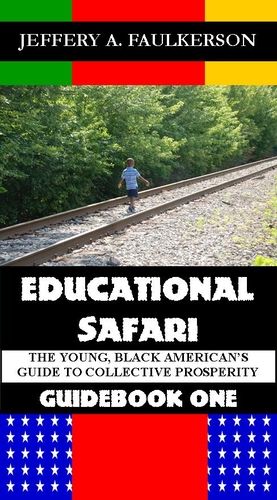
Much of what I offer in Educational Safari: The Young, Black American’s Guide to Collective Prosperity is pulled from my religious convictions as a born-again Christian. I personally believe our existence on this planet, as well as God gifting human males and human females with the supernatural ability to create other human beings in his image, should serve as a constant reminder that the essence of an omnipotent God flows through each of us. And like it or not, our hips are attached to hips belonging to our white siblings, as well as those belonging to other siblings of color. The relevance of this truth has caused me to re-evaluate my thinking about human relations and take more proactive approaches to:
• Determine if I have The Drive to Thrive.
• Reclaim my righteous mind.
• Establish goals that coincide with God’s will.
• Develop a vision for the kind of life God wants me to lead.
• Map out objectives for achieving my goals.
• Surround myself with like-minded individuals.
• Evaluate the seeds of God’s labor.
• Instill an appreciation for this process in my child’s life.
As you read through the pages of these four guidebooks, I pray that you will gain an appreciation for these proactive approaches as well. An appreciation for these approaches lets you know just how amazing this journey called life is, and you gain a better understanding of who you are and why you are here. And as black Americans, long considered the brunt of the majority group’s disdain, you begin to understand why it is so important for us black Americans to work with like-minded Americans of all hues to build upon the gains of the Civil Rights Movement of the 1950s and ‘60s.
Human beings were not placed on this planet for one racial/ethnic group to be pitted against another one. God placed us here to be reflections of him. Because we are created in his image, we are all equal, none greater than the other. So now is the time for us black Americans to push our bitterness aside and become leaders in the quest to restore the human family to its original state. We are one body, one human race, and it is imperative that the members of this body work in unison to bring glory to God through our righteous words and deeds.
Welcome to my Educational Safari, the lessons that I have learned during the first 41 years of my life. Join me now as I show you how to 1) determine if you have the Drive to Thrive and 2) reclaim your righteous mind.
FROM "EDUCATIONAL SAFARI: The Young, Black American's Guide to Collective Prosperity" (Guidebook One) by Jeffery A. Faulkerson, MSSW
Available for online purchase at
http://stores.lulu.com/store.php?fAcctID=1...
Posted By: J. A. Faulkerson
Monday, August 3rd 2009 at 8:31AM
You can also
click
here to view all posts by this author...