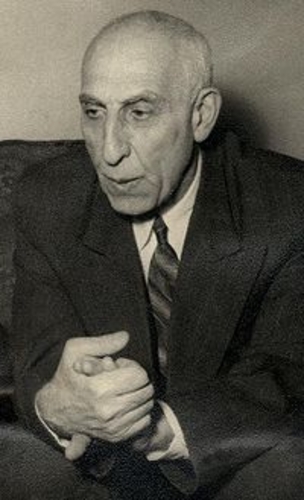
"The 1953 Iranian coup d'état, on August 19, 1953 (and called the 28 Mordad coup d'état in Iran), was the overthrow of the democratically-elected government of Iranian Prime Minister Mohammad Mosaddegh by the United States' Central Intelligence Agency. The crushing of Iran's democratically elected government launched 25 years of dictatorship under Mohammad-Rezâ Shâh Pahlavi, who relied heavily on U.S.-trained secret police SAVAK and U.S.-supplied weapons to hold on to power until he was overthrown in February 1979. 'For many Iranians, the coup demonstrated duplicity by the United States, which presented itself as a defender of freedom but did not hesitate to use underhanded methods to overthrow a democratically elected government to suit its own economic and strategic interests', the Agence France-Presse reported."
"In 1951 with near unanimous support of Iran's parliament, Mosaddegh nationalized the British-owned Anglo-Iranian Oil Company (AIOC). "The 1933 agreement under which it was operating was widely regarded as exploitative and an infringement on Iran's sovereignty.[5][6] Iran's oil was the British government's single largest overseas investment.[7] Moreover, the AIOC had consistently violated the terms of the 1933 agreement and was reluctant to renegotiate, even as Iran's movement for nationalization grew in the late 1940s.[8] Even though AIOC was highly profitable, 'its Iranian workers were poorly paid and lived in squalid conditions.' The AIOC, which was 51 percent owned by the British government, bankrolled disruptive tribal elements in Iran, some politicians and clergy with the purpose of bringing down the government. Iranians blamed Britain for most of its problems and public support for nationalization was strong. Despite Mosaddegh's popular support, Britain was unwilling to negotiate its single most valuable foreign asset, and instigated a military blockade of Iran and worldwide boycott of Iranian oil to pressure Iran economically. Initially, Britain mobilized its military to seize control of the Abadan oil refinery, the world's largest, but Prime Minister Attlee opted instead to tighten the economic boycott. With a change to more conservative governments in both Britain and the United States, Churchill and Dwight D. Eisenhower decided to overthrow Iran's government."
"The U.S. spy agency tried to persuade Shah Mohammad Reza Pahlavi to dismiss Mosaddegh, and at first he refused. The Central Intelligence Agency pressured the weak monarch while bribing street thugs, clergy, politicians and Iranian army officers to take part in a propaganda campaign against Mosaddegh and his government. At first, the coup appeared to fail when, on the night of August 15–16, 1953, Imperial Guard Colonel Nematollah Nassiri was arrested while attempting to arrest Mosaddegh. The Shah fled the country the next day. On August 19, a pro-Shah mob, paid by the CIA, marched on Mosaddegh's residence. Mosaddegh was arrested, tried and convicted of treason by the Shah's military court. On December 21, 1953, he was sentenced to solitary confinement in a jail cell in Central Teheran for three years, then placed under house arrest for the remainder of his life."
"Mosaddegh's supporters were rounded up, imprisoned, tortured, or executed. The minister of Foreign Affairs and the closest associate of Mosaddegh, Hossein Fatemi, was executed on Oct. 29, 1953 by order of the Shah's military court. [18] "The triumphant Shah (Pahlavi) ordered the execution of several dozen military officers and student leaders who had been closely associated with Mohammad Mossadegh... Soon afterward and with help from the CIA and the Israeli intelligence agency, Mossad, the shah created a secret police force called Savak, which became infamous for its brutality."
"In the wake of the coup, Britain and the U.S. selected Fazlollah Zahedi to be the next prime minister of a military government. Pahlevi made the appointment but dismissed him two years later. Pahlevi ruled as an authoritarian monarch for the next 26 years, until he was overthrown in a popular revolt in 1979. The tangible benefits the United States reaped from overthrowing Iran's elected government was a share of Iran's oil wealth. Washington supplied arms to the unpopular ruler, Pahlavi, and the CIA trained SAVAK, his repressive police. In Foreign Policy magazine, former CIA agent Richard Cottam wrote that "The shah's defense program, his industrial and economic transactions, and his oil policy were all considered by most Iranians to be faithful executions of American instructions."
"The coup is widely believed to have significantly contributed to the 1979 Iranian Revolution, which deposed the Shah and replaced the pro-Western royal dictatorship with the anti-Western Islamic Republic of Iran."
A point of reference:
"The Anglo-Persian Oil Company (APOC) was founded in 1908 following the discovery of a large oil field in Masjed Soleiman, Iran. It was the first company to extract oil from the Middle East. In 1935 APOC was renamed the Anglo-Iranian Oil Company (AIOC) and in 1954 became the British Petroleum Company (BP), one of the antecedents of the modern BP Plc."
Yesterday I heard republican House Minority Leader John Boehner declare that the US taxpayers are going to have to pay for the cleanup of the Gulf. When questioned about it, just so as to be sure, he reiterated that statement. And it made me think about the history of oil and how it has shaped borders and nations in the world.
The US, at the behest of BP and the British government, and with the help of the Israelis, engineered a coup against a democratically elected Iranian government. Elected Iranian leaders were arrested tried and some were executed. Our end in this was oil wealth. So was that of the British. That the Iranian government is at odds with Israel and the US is not just about religion; there is a history there, of the US and Israel meddling in the affairs of Iran. The irony is that, the US calls itself the world's democracy, and yet it supports dictators and suppression of democracy when it gets in the way of wealth.
When Boehner spoke up, he was only being consistent with this history of skullduggery for money and power. Why else would he think otherwise?
Posted By:
Friday, June 11th 2010 at 4:56PM
You can also
click
here to view all posts by this author...