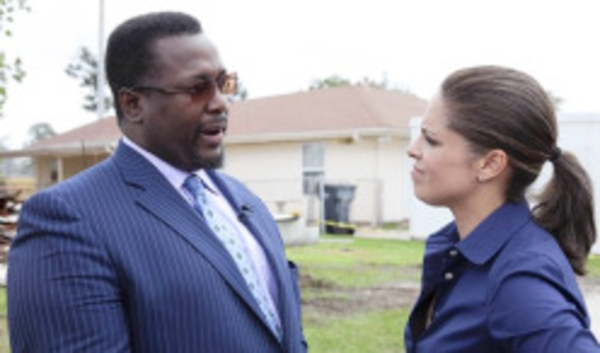
Actor Wendell Pierce is most widely known for the roles he's played — from Detective Bunk Moreland on the Baltimore-based drama "The Wire" to New Orleans musician Antoine Batiste in HBO's "Treme."
But this weekend, he's featured in a TV documentary that shows him working behind the scenes in what looks like it could be an impossible and thankless real-life job. It's the one, though, that he describes as his "true labor of love and pride."
"New Orleans Rising," which airs at 8 p.m. Sunday, chronicles the efforts of Pierce as president of a community development association to resurrect one of the nation's proudest postwar African-American communities after it was left for dead by Hurricane Katrina. The powerful CNN production reported by Soledad O'Brien is one of the finest of many films, documentaries and reports that will be hitting the airwaves in coming days as television marks the fifth anniversary of the storm. Pierce also appears in another outstanding work, Spike Lee's "If God Is Willing and Da Creek Don't Rise," which debuts at 9 p.m. Monday on HBO.
The Katrina coverage in coming days ranges from multi-part documentaries like Lee's to multi-night-and-day network news broadcasts anchored out of New Orleans — as TV once again plays the role of national historian in shaping our shared memory of landmark events. As producers, directors and executives choose what to leave in and what to leave out, they decide to a large extent what we as a nation will remember — or forget.
There are strong story lines and discussions about disparities based on race, the failure of the Army Corps of Engineers and the breakdown of local authority in New Orleans — particularly the police. But the most dominant narrative of the Katrina productions is one of rebuilding, reinvention and rebirth.
That's an upbeat story we Americans like to tell about ourselves. But it happens to be an accurate and true one in the wake of Katrina. And none of the five-years-after sagas is more resonant in that regard than Pierce's story of rebuilding the historically black community of Pontchartrain Park.
This is no figurehead job; Pierce is shown working as a real developer — organizing, lobbying, bidding, politicking at City Hall, arranging bank loans and helping to restore old and build new homes.
"I got my parents back into their home a year after the storm — and that's kind of the thing that inspired me to take on this job," Pierce says, acknowledging the enormity of trying to restore, rebuild or replace 350 houses, as well as trying to convince many elderly residents to return to those homes.
"That's when I realized that if I could do this for my parents, then maybe we could do this on a larger scale. My parents' experience, and our experience as a family of getting back into Pontchartrain Park — I wanted to replicate that for others."
Pierce does not try to hide the emotion in his voice when he talks about the day the first prefabricated model home arrived in his neighborhood last year.
"You know, my father when he first bought his home in the '50s, he was there the day they delivered his home and he watched them put it up," Pierce says.
"And it was so great 55 years later to have my parents there the day the model homes arrived and for them to see the workers putting them up. It was profoundly moving, a metaphor for what we're doing in the neighborhood that we had some of the original stakeholders and pioneers there to see their neighborhood coming back, especially at a time in their lives when they don't have the wherewithal."
A bit of Pierce's personal story was movingly told in Lee's 2006 HBO documentary "When the Levees Broke." But Lee did not focus on the remarkable history of Pontchartrain Park, which was set up by New Orleans' white power elite to keep blacks out of the white suburbs. It was intended to be a housing version of Southern schools that were purported to be "separate but equal."
Only the black "pioneers" made the neighborhood into something wonderful.
"These young black parents and young black families in the 1950s said we're going to turn something ugly into something beautiful and turn it into one of the most idyllic places to live and have it be a destination neighborhood. And they did," Pierce says. "At the height of Jim Crow, they created this bucolic neighborhood that became an incubator for talent. And you can just see the talent that came out of neighborhood."
In addition to Pierce, the roster of those who grew up in the community includes jazz musician Terence Blanchard, former mayors of New Orleans Ernest and Marc Morial, and Lisa Jackson, head of the Environmental Protection Agency.
"And it's not just the name people like that, but also those men and women who became doctors and lawyers. I always knew we would have the talent within our ranks to do it ourselves, and that's what we're demonstrating right now with stories like this. That's why it was so important to rebuild and not let this legacy be lost after Katrina."
Pierce, who bought one of the community's model homes and will soon be moving into it, describes himself as "Pontchartrain to the core." But if he had a second home, it would be Baltimore where he lived during the filming of "The Wire," he says.
"I love Baltimore, man," says Pierce. "Baltimore reminds me of New Orleans. There's the spirit of the people. It's a port city. There's a love of music. The markets remind me of the markets we have here in New Orleans. And there's a similar work ethic. They also have the same kinds of class tensions, the white flight to the suburbs. But then you also have the bar on every corner, and a church on every other. And I love it. Tell everybody in Baltimore I said hello — and that Bunk misses Baltimore."
 Posted By: DAVID JOHNSON
Sunday, August 22nd 2010 at 8:04PM
You can also
click
here to view all posts by this author...