THE STORY GOES THAT ON NOVEMBER 5, 1781, JOHN HANSON OF MARYLAND, A MAN OF AFRICAN DESCENT, WAS ELECTED AS FIRST PRESIDENT OF THE CONTINENTAL CONGRESS UNDER THE ARTICLES OF CONFEDERATION, MAKING HIM THE FIRST U.S. PRESIDENT.
Some historical inquiry shows this to be an “Urban Legend”. It is easy to see where the confusion lies.
1. There were TWO John Hansons in American history—one man was white and the other was black.
2. The Articles of Confederation did not form a new and independent nation. It was an alliance agreement, much like the present day NATO pact which links member nations and joins them in some mutual policies. But each of the signing colonies had its own government, currency and laws. There was no such thing as the United States until the U.S. Constitution was ratified in 1787.
Here is the text to an article “Black History Urban Legends” by Audrey Peterson, Friday, March 6th, 2009:
BLACK HISTORY URGBAN LEGENDS, Friday, March 6th, 2009
We’ve received many queries about the historical accuracy of stories that have circulated in our communities for years. One is that a black man named John Hanson was the first president of the United States. I wrote about this tale in an editor’s letter in the Fall 2001 issue of American Legacy, but because I’ve had more queries about it lately, I thought I’d address it again here.
The story goes that on November 5, 1781, a John Hanson of African descent was elected the first president of the Continental Congress under the Articles of Confederation, the precursor to our present Constitution. This is a type of historical urban legend that has been circulating for years and is incorrect. The John Hanson who became the first president of the Continental Congress was a white man of European descent. The black John Hanson was a senator of Liberia in the mid-nineteenth century.
It would be easy to confuse the two John Hansons: They have the same name, and information on both of them can be found at places such as the Library of Congress, the Smithsonian Institution, and the National Archives. A quick search on any of these organization’s Web sites yields information on, and pictures of, both men. Mixing up the two files could produce the first black president of the United States.
But here’s where logic steps in: No matter how African-Americans and their part in U.S. history have been ignored in the past (and this has been ,and still is lamentably true in many cases), something as important as a black man becoming the head of a fledgling United States would have made it into the history books.
There isn’t a conspiracy big enough to have hidden that fact.
In addition, the same person could hardly have been head of state in one country and then senator in another nearly 70 years later, and even if such a thing could have happened and been kept secret, why would white America, in 1781, have allowed a black man to head the government?
Hanson's grandfather, another John Hanson, was an early English immigrant to Maryland; as was common at the time, he worked as an indentured servant on his arrival in the New World. In 1661, his first master, William Plumley, sold his contract to Edward Keene and recorded the contract with the court of Calvert County, Maryland; similar court records were also used to transfer title to land and slaves. But, in six years, the immigrant John had worked his way out of debt, and a few years afterwards had purchased his own small farm. There is no record that the grandfather was black, but if indentured servitude was confused with chattel slavery, it is easy to see where this belief would have appeared.
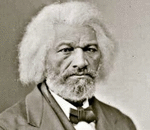
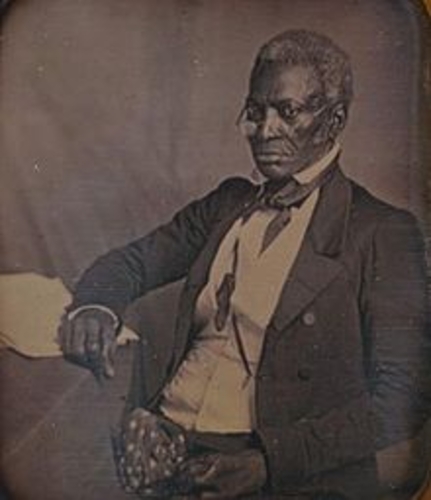
Internet sites promoting the hoax use an 1856 daguerreotype of the black Senator John Hanson of Liberia to support the claim even though photography had not yet been invented when the earlier John Hanson was living.
In view of the recent inauguration of our forty-fourth President, who without a doubt is African-American, it seemed that an attempt to finally put the story of John Hanson to rest would help us proudly trade a mythical black first president for a very real first black commander in chief.
Was John Hanson the first President of the United States?
When we think of the President of the United States, many people do not realize that we are actually referring to presidents elected under the U.S. Constitution. Everybody knows that the first president in that sense was George Washington. But in fact the Articles of Confederation, the predecessor to the Constitution, also called for a president– albeit one with greatly diminished powers. Eight men were appointed to serve one-year terms as president under the Articles of Confederation. The first was John Hanson, in 1781. His exact title was the “President of the United States in Congress Assembled.”
The new country was actually formed on March 1, 1781 with the adoption of The Articles of Confederation. This document was actually proposed on June 11, 1776, but not agreed upon by Congress until November 15, 1777. Maryland refused to sign this document until Virginia and New York ceded their western lands (Maryland was afraid that these states would gain too much power in the new government from such large amounts of land). Once the signing took place in 1781, a President was needed to run the country. John Hanson was chosen unanimously by Congress (which included George Washington). In fact, all the other potential candidates refused to run against him, as he was a major player in the Revolution and an extremely influential member of Congress.
As the first President, Hanson had quite the shoes to fill. No one had ever been President and the role was poorly defined. His actions in office would set precedent for all future Presidents. He took office just as the Revolutionary War ended. Almost immediately, the troops demanded to be paid. As would be expected after any long war, there were no funds to meet the salaries. As a result, the soldiers threatened to overthrow the new government and put Washington on the throne as a monarch. All the members of Congress ran for their lives, leaving Hanson running the government. He somehow managed to calm the troops and hold the country together. If he had failed, the government would have fallen almost immediately and everyone would have been bowing to King Washington.
Hanson, as President, ordered all foreign troops off American soil, as well as the removal of all foreign flags. This was quite a feat, considering the fact that so many European countries had a stake in the United States since the days following Columbus. Hanson established the Great Seal of the United States, which all Presidents have since been required to use on all official documents. President Hanson also established the first Treasury Department, the first Secretary of War, and the first Foreign Affairs Department. Lastly, he declared that the fourth Thursday of every November was to be Thanksgiving Day, which is still true today.
The Articles of Confederation only allowed a President to serve a one-year term during any three-year period, so Hanson actually accomplished quite a bit in such little time. He served in that office from November 5, 1781 until November 3, 1782. He was the first President to serve a full term after the full ratification of the Articles of Confederation – and like so many of the Southern and New England Founders, he was strongly opposed to the Constitution when it was first discussed. He remained a confirmed anti-federalist until his untimely death.
Six other presidents were elected after him - Elias Boudinot (1783), Thomas Mifflin (1784), Richard Henry Lee (1785), Nathan Gorman (1786), Arthur St. Clair (1787), and Cyrus Griffin (1788) - all prior to Washington taking office. Why don't we ever hear about the first seven Presidents of the United States? It's quite simple - The Articles of Confederation didn't work well. The individual states had too much power and nothing could be agreed upon. A new doctrine needed to be written - something we know as the Constitution.
George Washington was definitely not the first President of the United States. He was the first President of the United States under the Constitution we follow today. And the first seven Presidents are forgotten in history.
For confirmation, visit:
http://www.snopes.com/history/american/han...
 Posted By: Richard Kigel
Saturday, November 27th 2010 at 2:57PM
You can also
click
here to view all posts by this author...