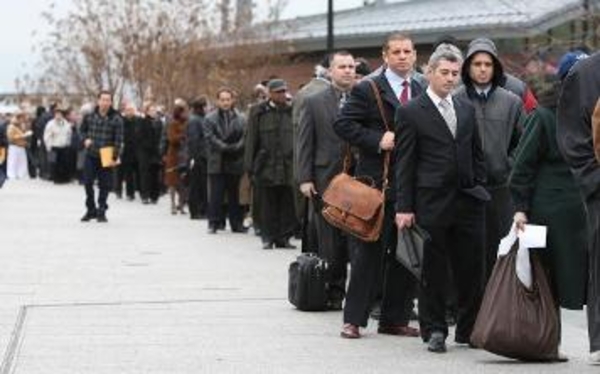
The recent unemployment data issued by the Bureau of Labor Statistics was met with some degree of optimism by the Obama Administration. The discussion centered around the fact that the unemployment rate for the nation dropped to 9.4 percent, it's lowest since May of 2009. Good news, right? Well, it's very good news if you're white.
A closer analysis of the data reveals some interesting and disturbing trends. First, white males were the greatest and primary beneficiaries of the dip in unemployment, as their rate declined from 9.1 percent to 8.5 percent, the steepest drop among men or women of black or white ethnicities. White women also saw a significant decline in their unemployment rate, from 7.5 percent to 7.3 percent (they already had the lowest unemployment rate of men or women from both ethnicities).
That's not all. Even though blacks and whites both saw a decline in their unemployment rates, whites saw a dip that was three times greater than that for African Americans. The overall white unemployment rate dropped from 8.9 percent to 8.5 percent, while the black unemployment rate dropped slightly from 16 percent to 15.8 percent. The raw differences are only double when compared directly, but are far more significant when considering the fact that white unemployment was already a little more than half of that for black Americans. Therefore, the absolute value of the difference is double for whites, but becomes three times greater than blacks when considering the relative change. The point is that (as President Obama so famously put it) the "rising tide" is not raising all ships, and the gap is actually growing.
As of November, 2010, black unemployment was 80 percent higher than white unemployment. After December, the gap rose to a scaled differential of 86 percent. The white/black unemployment gap grew for both black men and black women. For men it grew the most: In November, black men had an unemployment rate that was 82 percent higher than whites (16.6 percent to 9.1 percent), and as of December, there was a scaled differential of 94 percent (16.5 percent to 8.5 percent).
For black women, the gap between black and white females grew from 75 percent last month (13.1 percent to 7.5 percent) to 81 percent this month (13.2 percent to 7.3 percent). So, the racial unemployment gap grew for both genders, with black men getting the worst of the divide.
The only group of African Americans that saw a significant scaled decline in their unemployment rate were black teens, who saw a drop from 46.3 percent to 44.2 percent unemployment. The gap between black and white teens narrowed, from 119 percent to a 96 percent difference. The improvements for black teens are tempered by the fact that black teenagers continue to have the highest unemployment rate of any subgroup of the population, and they are also the greatest victims of racial disparities in unemployment data. So, at best, we can say that a horrible situation was made slightly less horrible than it was before.
As I prepare to speak with NPR tomorrow and Rev. Al Sharpton about these data and my open letter to President Obama just a few months ago, a few thoughts come to mind. This must be the year that our elected officials are continuously reminded of the fact that dealing with unemployment for the entire nation is not the same as dealing with economic inequality. While I am not always in complete sync with my respected colleague Michael Eric Dyson, who gave Obama a C- on black issues, I am certainly inclined to agree with Professor Dyson on the fact that neither the president nor any of the Chicago cronies he's hired in Washington are in a position to care in the least bit about the urban poor. Obama's decision to hire Bill Daley as his Chief of Staff speaks to the reality that neither this White House nor this Congress seems concerned about dealing with economic inequality in America.
Unless the day comes where targeted policies are created to close the employment and wealth gaps, we are going to continue to live in a world where African Americans are asked to remain silent about double-digit employment, while White Americans are privileged enough to yell and scream about seven percent joblessness. Perhaps it's time for us to wake up and smell the disparity.
 Posted By: DAVID JOHNSON
Sunday, January 9th 2011 at 10:35PM
You can also
click
here to view all posts by this author...