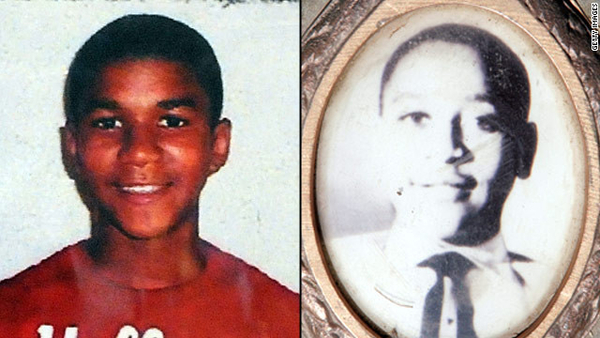
Look and you make the call Both were African-American teenagers who left home and never came back. Both forced the nation to talk about unwritten racial codes. Both didn’t live to see what symbols they became.
Trayvon Martin and Emmett Till.
They died 57 years apart, but their names and legacies may be forever merged. Some are saying Martin, a 17-year-old black teenager who was shot to death by a white Hispanic neighborhood watchman is on the verge of becoming this generation’s Emmett Till.
Thousands of angry Americans – of various races - have taken to Facebook and news sites and the streets to compare Martin’s fate to Till, the 14-year-old black boy who was murdered in Mississippi in 1955 for allegedly violating an unwritten Southern racial code by whistling at a white women.
Washington Post writer Eugene Robinson invoked Till in Martin’s case to say black men still wear a “bull’s-eye” throughout their lives.
Though he stopped short of comparing Martin’s case to Till’s, calling such comparison “facile … a disservice to history and to the memory of both young men.” But, he added, “it is ridiculous to imply that nothing has changed.”
Is the comparison fair?
Mark Naison, an African-American Studies and History professor at Fordham University in New York puts it this way: “Emmett Till broke the code of his time by speaking in a suggestive, teasing way to a white women - Martin by wearing a hoodie and walking at night through a white neighborhood. The reason for the second death is every bit as outrageous as the reason for the first.”
Martin died February 26, while walking to his father’s home. Police say he was shot by a neighborhood watch volunteer in Sanford, Florida, who said he was acting in self-defense. Martin was unarmed, carrying a bag of Skittles candy and an iced tea, according to police.
A lawyer for George Zimmerman, the neighborhood volunteer, says his client is not a racist, is of mixed race himself, and had mentored two children of a black woman. Now, a month after Martin died, Zimmerman still has not been arrested.
Martin’s death has re-ignited debate over the public perception of black men.
“I don’t think anyone doubts that if the race of those two were reversed that the perpetrator would be arrested,” says Chris Johnson, one of the creators of “The Question Bridge,” an interactive exhibition that focused on black men, “the most opaque and feared demographic in America,” according to organizers.
“The Question Bridge” exhibition toured the country this year, showing videos of black men posing and answering questions of black men from different generations. Johnson said it was designed to shed many of the labels attached to black men - such as "criminal" - by getting them to talk openly about them.
The questions were abstract, but Martin’s case made it more personal, Johnson says: It shows many black men are still feared and shackled by stereotypes, just as they were in Till’s time.
Even so, much has changed since the 1950s.
Till was visiting relatives in Money, Mississippi, when he allegedly flirted with a white woman in a store. He was abducted at night from his great uncle’s home, tortured and murdered. His body was dumped in a river.
Two white men were arrested, and indicted by a Grand Jury.
A relative of Till identified the two men in court as the men who kidnapped his nephew. The jury deliberated 67 minutes before acquitting the two, who were photographed grinning and laughing in court.
Till’s death drew people’s attention to a prejudiced and corrupt legal system in the Jim Crow South. Martin’s death is drawing people’s attention to the conduct of Florida police and the state's gun laws, says Randolph McLaughlin, a New York attorney and professor at Pace Law School in New York.
“Just as in Emmett Till’s case, nothing was done by local authorities,” he says. “It was fine to lynch a black kid then. It’s fine to kill a black kid now.”
Till’s mother took advantage of an emerging technology – television – to mobilize the nation on behalf of her son. She also insisted that photos of her son’s deformed corpse be made public.
Till’s mother’s decision to go to the media galvanized the nation, says David Aretha, author of “The Murder of Emmett Till.”
“When Emmett’s coffin arrived via train in Chicago, she touched the box and fell to the ground. As five men lifted the wrapped body out of the box, she wailed ‘Oh, God. Oh, God. My only boy,’” Aretha says.
Television cameras recorded the heartbreaking scene.
When Aretha heard about the death of Trayvon Martin, he says he thought about the similarities to Till’s death.
“The murders themselves were appalling, but what really angered the general public was the injustice - highly questionable laws and customs that allowed for whites to freely murder blacks in the Jim Crow South and for someone to almost randomly shoot anyone in the Martin case,” Aretha says.
Still, there are some significant differences between Till and Martin.
Till violated the racial codes of the South by his swagger and talking to a white woman, says James Peterson, an African-American studies professor at Lehigh University in Pennsylvania.
Martin didn’t do anything, Peterson believes.
“Trayvon Martin was literally walking to his father’s house,” Peterson says. “This is racial profiling and vigilante justice gone wrong.”
Blacks had little political power in 1955 - couldn’t even vote in many parts of the South. Today, of course . The president of the United States is black, as well as the nation’s attorney general, Peterson notes.
At a news briefing, the president expressed sympathy for Martin’s family, and added a personal note:.
“If I had a son, he’d look like Trayvon,” Obama said.
Till’s case had unexpected political consequences, Aretha says.
“The Till case, without question, fueled the emerging civil rights movement,” Aretha says. “… Someone asked Rosa Parks why she didn’t get up [from her bus seat] when she was threatened [with arrest for disobeying a law that required blacks to give up their seats to white people.] She said she thought about Emmett Till and couldn’t go back anymore. We will see if the murder of Trayvon Martin sparks another kind of social movement.”
http://inamerica.blogs.cnn.com/2012/03/24/...
 Posted By: DAVID JOHNSON
Tuesday, March 27th 2012 at 2:46AM
You can also
click
here to view all posts by this author...