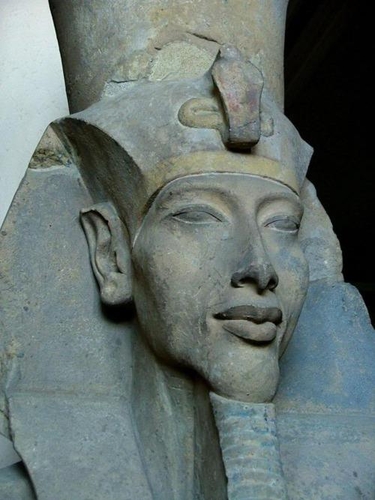
been born between 1362 BC and 1379 BC, where he became the 10th pharaoh of the 18th Dynasty around 1352 BC. Primarily known as Amenhotep IV until he changed his name to Akhenaten/Akenhaten. Many people also considered him as “The Heretic Pharaoh” – because he branched out new religion and art that left a remarkable imprint on the Egyptian society. Previous pharaohs maintained stability and peace in Egypt under diplomatic circumstances until Akhenaten stepped into power!
Akhenaton: "Father of Monotheism"
...O living Aton, thou wert the first to live ... Thou hast made the earth according to thy will alone: Mankind, cattle, and all other beasts, everything on earth that walketh on feet.
And everything lifted on their wings in flight; ... Each one has his sustenance, and his time is reckoned... Akhenaton
When one studies Black history, it is easy to see why Western Academicians go to such great lengths to suppress, distort, appropriate or ignore it. The global presence of Black people, their magnificent monuments, vast empires, infinite creativity and giant personalities are overwhelming to contemplate. So much so, that when the truth is revealed, many people simply cannot accept it. They charge Africentric scholars with exaggerating the facts, espousing "Black superiority" or teaching "feel good" history." None of this is true, of course, but it reflects how difficult it is to convince some people, who are programmed to accept the past and present "inferiority" of the Black race, to open up and objectively examine the historical record for themselves.
The 18th Dynasty of Ancient Egypt was one of the "unbelieveable" chapters in Black history. We visited this period in June when MAAT profiled Thutmose III, the great Egyptian pharaoh and general. This month MAAT returns to the 18th Dynasty to focus on another remarkable Egyptian ruler, Akhenaton.
Akhenaton has been called one of the most extraordinary men to ever rule a nation. "Living centuries before King David," states historian J. A. Rogers, "he wrote psalms as beautiful as those of the Judean monarch. Thirteen hundred years before Christ, he preached and lived a gospel of perfect love, brotherhood and truth. Two thousand years before Muhammad, he taught the doctrine of the One God. Three Thousand years before Darwin, he sensed the unity that runs through all living things."1
Scholars are not agreed, however, as to whether Akhenaton was a positive or negative force in Egyptian history. As author Lestor Brooks notes: "For everyone who calls him [Akhenaton] Great, there is another who denounces him as hopelessly impractical or incompetent. The man inspired -- and continues to inspire -- serious works of philosophy, religion, history, poetry, drama, fiction and fantasy."2
Whether he is viewed as a positive or negative ruler may be open to dispute, but Akhenaton was unquestionably one of the most controversial of ancient Egypt's many pharaohs. Most of the controversy centers around his sweeping religious reforms. He appeared as a prophet of love at a time when Egypt, the greatest power on earth, had grown decadent in her wealth and might. He eschewed the military pursuits of his predecessors and focused his people on the spiritual values of life.
In an astonishing move, that enraged the powerful priesthood and shocked the Egyptian masses, Akhenaton elevated the minor worship of the Aton to a state religion, and demanded that all of the old Egyptian gods be cast aside. The Aton, a universal god who embraced all peoples, places and nations, and whose High Priest was the Pharaoh himself, was thenceforth to be the sole object of Egyptian veneration. Throughout the land, the temples of the traditional gods were shut down or destroyed. The names of various gods, particularly Amun, were removed from temples, tombs and other monuments; and even the plural word "gods" was often expunged from public records.
In keeping with his religious beliefs, this zealous pharaoh even changed his own name from Amenhotep, which means "Amun is content", to Akhenaton, which is translated as "He who is beneficial to Aton." He then transferred the Egyptian capitol from the ancient city of Thebes to a virgin site two hundred miles to the north called Akhetaton, meaning "horizon of Aton." Here the pharaoh built beautiful, unroffed temples into which the rays of the sun god, Aton, could freely penetrate.
Akhenaton also revolutionized Egyptian literature. His writings focused on universal humanism; thus, in his famous "Hymn to the Sun," Akhenaton depicts the god Aton as a "beneficent father of all men,"3 rather than the traditional god who was "a triumphant conqueror, crushing all peoples and driving them, laden with tribute, before Pharaoh's chariot."4
A number of scholars believe that the ancient writings of Akhenaton and some of the other Egyptian pharaohs were lifted bodily from their original texts and incorporated into the Bible. An example of this is found in a comparison of the following excerpt from one of Akhenaton's Aton hymns with Psalms 104.
Akhenaton's Hymn
When thou settest in the western
horizon of heaven
The world is in darkness like the dead...
Every lion cometh forth from his den,
The serpents they sting. Darkness reigns...
Bright is the earth when thou riseth in the
horizon...
The Two Lands are in daily festival,
Awake and standing upon their feet...
Then in all the world they do their work.
How manifold are they works!
They are hidden from before us.
O thou sole god, whose power no other
possesses.
Though didst create the earth according
to thy desire, being alone:
Man, all cattle, large and small;
All that are upon the earth.
Compare the above with Psalm 104:
Thought makest darkess and it is night,
Wherein all the beasts of the forest
do creep forth;
The young lions roar after their prey;
they seek their meat from God...
The sun ariseth, they get them away
And lay them down in their dens.
Man goeth forth unto his work
And to his labor until the
evening...
O Lord, how manifold are
thy works!
In wisdom hast thou made
them all;
The earth is full of thy
creatures.5
Akhenaton also changed Egyptian art. According to Edward F. Wente, Professor of Egyptology at the Oriental Institute of the University of Chicago, the new art was "fostered as expressive of the life-sustaining power of the [god] Aton."6 This style portrayed everything in more realistic form. Even scenes of the royal family in various poses are depicted in intimate detail.
The features of Akhenaton and those of the other members of his family were unquestionably African. According to Wente, the pharaoh himself possessed "an elongated skull, protruding jaw, thick lips, slouching posture, and bulging stomach..."7 "Judged by prevailing standard," adds J.A. Rogers, "Akhenaton was not handsome. His skull ... is what some scientists call that of a typical Negro. The jaw is exceedingly prognathous. His lips, as seen in profile, are so thick that they seem swollen. His father Amenophis [Amenhotep III] was Negroid; and his mother, Tiye, was a full-blooded African. That his wife Nefertiti was a Negro cannot be denied."8 Egyptologist William Osburn has also written of the physical features of Akhenaton: "The dusky complexion, high cheekbones, projecting jaws and thick lips call forcibly to mind the features of the true Negro. The same affinity is likewise suggested by the thin neck and extreme prominence of the abdomen and hips..."9
As time passed, during Akhenaton's reign the Egyptians showed signs of discontent with their pharaoh of love. Foreign tribute fell off as the empire diminished in size. The priesthood grew weary of its narrow role in the new theology and the people longed to return to the traditional gods. Despite this, Akhenaton continued a policy of pacificism fostered by monotheistic religion until his death in 1362 B.C.
As devout and peace-loving as the King, was Nefertiti, his lovely queen. Little is known of the origin of this beloved beauty. Some believe that she was the daughter of the Pharaoh Amenhotep III and Queen Tiye, and therefore the full sister of Akenaton; others have speculated that she was a Mitanni beauty who, having first been a part of the harem of Amenhotep III, was later married to his son Akhenaton. Still others insist that Nefertiti was the daughter of Ay, the brother of Queen Tiye, who followed one of Akhenton's successor's, King Tutankhaumun, to the throne.
In the early days of the rule of Akhenaton, he and Nefertiti were inseparable. Contemporary artists depict them in tender domestic scenes enjoying dinner, paying homage to the Aton and relaxing with their daughters. Akhenaton's great love for Nefertiti is reflected in a stone love-letter that he apparently wrote to his wife:
The heiress, great in favor, lady of
grace, sweet love, Mistress of the
South and North, fair of face, gay
with the two plumes, beloved of the
living Aten [the King], the Chief
Wife of the King whom he loves,
Lady of the Two Lands, great of love,
Nefertiti, living for ever and ever.10
To Akhenaton and Nefertiti were born several daughters, but no sons. Some scholars believe, however, that the young Smenkhare, coregent with Akhenaton for a short period, and Tutankhamun, successor to both Akhenaton and Smenkhare, were the elder pharaoh's sons by lesser wives. Other have written believe that Akhenaton, Smenkhare and Tutankhamun were all brothers.
In spite of their widely depicted intimate relationship, Akhenaton and Nefertiti were apparently separated during the latter part of their reign. She ceased sharing the palace with him, but continued to rule in her own right in a small court on the outskirts of Akhetaton.
It also appears that Smenkhare, Akhenaton's young brother, died mysteriously as he was being groomed to inherit the throne. Following Smenkhare's death and that of Akhenaton, the kingship passed to Tutankhamon, the youngest of the three brothers. He ascended the throne at the age of 8 or 9, married his niece Ankhensenamon, and ruled Egypt until he was apparently assassinated about a decade later.
Akhenaton, the 9th pharaoh of the 18th Dynasty, was one of the most remarkable rulers of antiquity. In a few short years, he changed the religion, literature, art and the capitol of the greatest nation on earth. As we look back on his life and times, we may state, without exaggeration, that Akhenaton was the world's first revolutionary king.
 Posted By: DAVID JOHNSON
Monday, August 13th 2012 at 9:02PM
You can also
click
here to view all posts by this author...