Supreme Court Case ruling may inspire HBCUs to recruit more black students
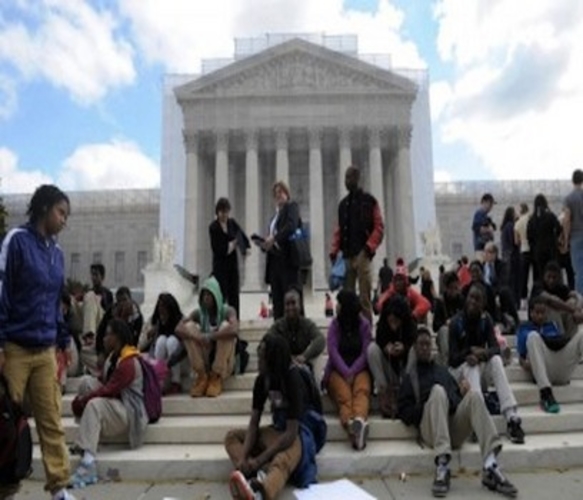
Wednesday’s oral arguments in the Fisher v. University of Texas at Austin case has suggested a notion of potentially overruling the admission policies for universities and colleges to be race-conscious in achieving a “critical mass” for diversity, as envisioned in the 2003 landmark case Grutter v. Bollinger. The Supreme Court ruling holds stakes higher than ever for black students, as the abolishment of affirmative action could lessen their chances of admission into selective colleges and universities. Yet, for Historically Black Colleges and Universities, admission rates could by default be on the threshold, as the black student proportion at traditional schools are expected to decline without the legally appointed system that accounted for the rising efforts of diversity at most colleges and universities. During this post-segregation era, the regression of affirmative action has provided a glimpse of hope for HBCUs to retain its most marketable niche, high-achieving black students.
Starting in 1837, the first black institution Cheyney University was founded by Richard Humphreys, a Quaker philanthropist who sought out to create educational opportunity for blacks during a time when they were denied civil rights. Since its inception, 105 Historically Black Colleges and Universities have emerged as higher educational facilities, strictly set out to fill the educational gap for black students. Under Congress’ definition in Title III of the Higher Education Act of 1965, HBCUs were afforded more resources and financial assistance in order to continue their efforts on providing a college education for black students, which they were denied at traditional schools.
These schools began to breed some of the nation’s first black lawyers, politicians and leaders. With esteemed alumni such as U.S. Supreme Court Justice Thurgood Marshall and Political Activist Martin Luther King Jr., HBCUs began to brand themselves as top-notch institutions, capable of equipping powerful, black figures. As a result, the HBCU student body attracted over 90 percent of black students in America. Today, the HBCU student body accounts for less than 12 percent of blacks in America primarily because of their competition with traditional schools.
After the noteworthy Brown v. Board of Education court case, which ruled in favor of integrated schools, the market of higher education took a drastic turn as prestigious schools began to vigorously recruit high-achieving black students. For HBCUs, their masses of high-achieving, competitive black students were dispersed among traditional schools, who have accredited their black student body as an effort for achieving diversity and race equality, as demanded in Brown v. Board of Education. Not only did traditional schools meet their race quota, but they also were deemed as viable sources for black students, as they introduced their black students to the benefits of fully funded institutions with numerous resources and easily accessible opportunities.
Today, scholars have continued to question the relevance of HBCUs as they no longer are the only option for black students. However, with the loss of affirmative action, HBCUs could hold onto their initial brand as premium institutions tailored for black success. With the 1996 California ballot, which barred race-consideration in the admission process for higher education systems of UCLA and UC Berkeley, the number of black student representation dropped to more than 50 percent. The less black student representation transferred down into the decreasing number of black students applying to these universities.
The 1996 California ballot aftermath has set a barometer for the potential outcome of the Fisher v. University of Texas at Austin case where there is a strong possibility for black student representation to drop at traditional white schools. Pending the Supreme Court ruling, will Historically Black Colleges and Universities capitalize on black enrollment or will traditional schools become a preferred choice for black students regardless?
The Supreme Court will make a final decision on affirmative action for Fisher v. University of Texas at Austin case late June 2013.
 Posted By: DAVID JOHNSON
Thursday, October 11th 2012 at 8:00PM
You can also
click
here to view all posts by this author...