Home > Blogs > Post Content
|
|
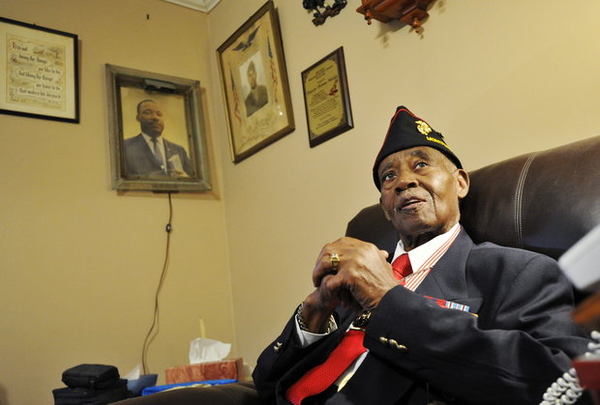
When he got his draft card in 1943, Thomas Mosley faced the same fears and uncertainty as thousands of other men across the country. He would be leaving home for the first time in time his life and could soon be sent to an unknown place with bullets flying at him. But he had an additional challenge most of the others didn’t. Mosley was among the first black men to serve in the Marines, in a unit known today as the Montford Point Marines. They trained at Montford Point, a segregated camp next to Camp Lejeune, N.C. They were so little trusted they couldn’t set foot on Camp Lejeune unless they were escorted by a white officer. But despite the discrimination they faced, Mosley said they were determined to succeed. “We were supposed to be citizens and not have different policies for people, but these men were determined to be free, and whatever conditions they were in, they still joined in and did whatever job they had to do,” Mosley said as he sat in his Macon home last week with his Congressional Gold Medal hung around his neck. He was among about 400 Montford Point Marines to receive the honor in June in recognition of their ground-breaking service. Like the better-known Tuskegee Airmen and Buffalo Soldiers, they helped pave the way for the eventual full integration of the military. Mosley is one of two Montford Point Marines known to be living in Macon. The other is Frank Johnson, often called the “mayor of Unionville” for his activism in the neighborhood. Johnson suffered a stroke in 2000 and now lives in a nursing home. Melvin D. Ragin, who served in the Marine Corps from 1962 to 1988, is president of the local Montford Point Marine Association Chapter 35. The organization strives to educate people about the service of those trained at Montford Point from 1942 until 1949, soon after President Harry Truman in 1948 ordered the full integration of the military and the camp was closed. “They are my heroes,” Ragin said. “I spent 26 years in the Marine Corps, and I wouldn’t have been able to do that if it not been for these guys. Because of the standard they set, we were able to be fully integrated into the Marine Corps.” Mosley trained to handle ammunition. He never saw combat, but he did contribute to the war effort. He was stationed near Pearl Harbor and loaded ammunition onto ships. He also unloaded injured soldiers returning from the Pacific Theater. In boot camp, he had black drill instructors, but afterward he served under white officers. Most of them did not want the duty of commanding black troops. After the war, however, those same officers came to their defense when some people wanted to boot blacks from the Marines entirely. “Some of the white officers said, ‘These are some of the finest Marines I’ve ever served with,’ ” Mosley said. He was told he would be part of the force that would invade Japan, and was packed and ready to go when the U.S. dropped two nuclear bombs, forcing the Japanese to surrender. Mosley said he regretted the loss of civilian life, but the nuclear bombing may have saved his. “It did spare a lot of time and even death on both sides of the military,” he said. He left the Marines in 1946 and became an aircraft mechanic. In 1965, he took a job at Robins Air Force Base and retired in 1984. Ragin said all Montford Point Marines he has met, including Mosely and Johnson, have gone on to be dedicated community servants. Johnson’s wife, Dorothy P. Johnson, said her husband’s service in the Marines had everything to do with that. “He said the Marines made him what he is,” she said. The military has long been recognized for being ahead of its time on integration and equal opportunity. When he served in Vietnam, Ragin saw firsthand how racial differences erode when bullets start flying. “When you are dependent on somebody for your life, it doesn’t matter what color somebody is,” he said. “Combat makes good buddies of anybody if you are on his side.”
 Posted By: DAVID JOHNSON
Wednesday, November 14th 2012 at 11:39PM
You can also
click
here to view all posts by this author...
|
|
|
here is my story ,,,,the blog king ;;;
I am a native NEW YORKER BORN AND RAISED IN HARLEM NEW YORK,,,,,,,,,,,,,,,,,,, New York New York big city of dreams ,,,,,Yea DREAMS of getting the hell out of Harlem,,,, dreams of leaving the drug infested streets dreams of changing the shooting gallery's/drug dens into schools but me I did not want to be a drug dealer or a dope fen I wanted to be a part of something different so I enrolled in the marines !
I could not get in the air force so the marines took me in ,,,,shot in the ass and off to boot camp what a trip !
TALK ABOUT RACISM marines was not for blacks at that time and they let you know they diden't want ''*****s' in the marines whites did not want to see a 6..3 black boy from New York in there camp ,,,brothers was coming back from the war beat down shot up hook on the morphine pack USA issued only to get hooked on that china white heroine USA issued I was there I seen it all !
I wanted to get the hell out of Harlem and the marines seem to be my only hope I was sent to boot camp Marine Corps Recruit Depot, Parris Island, SC 12 weeks of training first aide, leadership, core rules, martial arts,back then hazing was nothing but a race war between blacks and whites ,I want to give up and leave many times and they dident care another ***** gone but I thought about the streets of HARLEM and that was enough to fight on !
around week 7 they gave me the sweet m16 riffle and my life changed I had a new leaf on life it was something in the pulling that trigger and hitting the target that brought new life to me ,they taught me how to fire and look through the target
strength training was nothing after that I was growing and becoming a man a marine **** I got gun ho big headed a fighting marine you dident have to be book smart but you did have to have a lot of heart ,courage you know a no fear mind set
week 8 ,9 10 i was going through Basic Warrior Training called line A OR A LINE
then it was time for the make it or brake it test ,,time to put all that training on the line and see what you was really made of ,,it was time for the Crucible the final test in training,I had to put all the skills and knowledge in this last task 2 days 8 hours in the field a 50 mile march through the woods with typical combat situations very little food and about 4 -6 hrs sleep !
I was giving 4 MRE and offer we went ,,everything was team work team work team work if you dident have help in the task you could not make it i mean from carrying the wounded to fire fights to infiltrating the other-side Some of the challenges encountered during the Crucible was team and individual obstacle courses, day and night assault courses, land navigation courses, individual rushes up steep hills, large-scale martial arts challenges, and countless patrols to and from each of these. Often, these challenges are made even more difficult by the additions of limitations or handicaps, such as the requirement to carry several ammunition drums, not touching portions of an obstacle painted red to indicate simulated booby traps, and evacuating team members with simulated wounds.
On the final day of the Crucible, recruits are awoken and begin their final march (including "The Reaper" a forced march up a steeply inclined hill to the top of Edson's Ridge on the west coast). Immediately following this, recruits are offered the "Warrior's Breakfast", thats it right there I made it THE Warrior's Breakfast is when all the racism is gone all the fear is gone ,and friendships are started bonds are created we made now we get to eat as much as we want , even of previously forbidden foods you name it ,even ice cream and then you think everyone wants to go to sleep hell i was gunnnnnhoooo for at least 5,8 hours because I made it ,i was a marine and I made out the hood I was no longer a boy from from HARLEM i was a man am UNITED STATES MARINE !
the Eagle, Globe, and Anchor ceremony, where the recruits receive the eponymous emblem, and thereby cease to be recruits, finally becoming Marines
Wednesday, November 14th 2012 at 11:43PM
DAVID JOHNSON
|
|
|
Blacks had been barred from the Marine Corps until 1942, after President Franklin D. Roosevelt signed an executive order to change that, ignoring the objections of Marine leadership, who said African-Americans could not meet the corps’ high standards.
They were soon proved wrong by the thousands of blacks who, like the Buffalo Soldiers and Tuskegee Airmen, enlisted, endured and excelled in the years to come. They trained at a segregated camp in Montford Point, N.C., served in segregated units and became known as the Montford Point Marines. Most, like Lane, served in the Pacific during the final years of World War II.
About 20,000 Marines passed through Montford Point until 1949, when it was closed and the Marine Corps was fully integrated. They included Lane and at least three others from Westchester County: Lawrence H. Alexander Jr., 87, who lives in Mount Vernon; Frederick C. Branch, a Mamaroneck High School graduate who, in 1945, became the first black commissioned officer in the Marine Corps and died in 2005; and Mount Vernon native Howard L. McCoy, who served as that city’s first African-American police chief from 1977 until his retirement in 1992. He died in 2003.
In June, Lane, Alexander and 400 other surviving Montford Point Marines were awarded the Congressional Gold Medal, the nation’s highest civilian honor, at a ceremony in Washington as guests of the Marine Corp
Wednesday, November 14th 2012 at 11:52PM
DAVID JOHNSON
|
|
|
During World War I 370,000 African Americans labored, fought, and died to make the world safe for a democracy that refused them equal citizenship at home. The irony was made more bitter as black troops struggled with the racist policies of the American military itself. The overwhelming majority were assigned to labor companies; those selected for combat were under-trained, poorly equipped, ad commanded by white officers who insisted on black inferiority. Still, African Americans performed admirably under fire: the 369th Infantry regiment was in continuous combat loner than any other American unit, and was the first Allied regiment to cross the Rhine in the offensive against Germany.The Unknown Soldiers, the only full-scale examination of the subject, chronicles the rigid segregation; the limited opportunities for advancement; the inadequate training, food, medical attention, housing, and clothing; the verbal harassment and physical abuse, including lynchings; the ingratitude, unemployment, and unprecedented racial violence that greeted their return. The Unknown Soldiers is an unforgettable, searing study of those wartime experiences that forced African Americans to realize that equality and justice could never be earned in Jim Crow America, but only wrested from its strangling grip.
Wednesday, November 14th 2012 at 11:56PM
DAVID JOHNSON
|
|
|
Fighting for Respect: African-American Soldiers in WWI
by Jami Bryan, Managing Editor, On Point
Article originally appeared in On Point, an Army Historical Foundation publication
As the people of the United States watched World War I ignite across Europe, African American citizens saw an opportunity to win the respect of their white neighbors. America was a segregated society and African Americans were considered, at best, second class citizens. Yet despite that, there were many African American men willing to serve in the nation’s military, but even as it became apparent that the United States would enter the war in Europe, blacks were still being turned away from military service.
When the United States declared war against Germany in April of 1917, War Department planners quickly realized that the standing Army of 126,000 men would not be enough to ensure victory overseas. The standard volunteer system proved to be inadequate in raising an Army, so on 18 May 1917 Congress passed the Selective Service Act requiring all male citizens between the ages of 21 and 31 to register for the draft. Even before the act was passed, African American males from all over the country eagerly joined the war effort. They viewed the conflict as an opportunity to prove their loyalty, patriotism, and worthiness for equal treatment in the United States.
Following the Civil War, the Army disbanded volunteer “colored” regiments, and established six Regular Army regiments of black troops with white officers. In 1869, the infantry regiments were reorganized into the 24th and 25th Infantry. The two cavalry regiments, the 9th and 10th, were retained. These regiments were posted in the West and Southwest where they were heavily engaged in the Indian War. During the Spanish-American War, all four regiments saw service.
When World War I broke out, there were four all-black regiments: the 9th and 10th Cavalry and the 24th and 25th Infantry. The men in these units were considered heroes in their communities. Within one week of Wilson’s declaration of war, the War Department had to stop accepting black volunteers because the quotas for African Americans were filled.
When it came to the draft, however, there was a reversal in usual discriminatory policy. Draft boards were comprised entirely of white men. Although there were no specific segregation provisions outlined in the draft legislation, blacks were told to tear off one corner of their registration cards so they could easily be identified and inducted separately. Now instead of turning blacks away, the draft boards were doing all they could to bring them into service, southern draft boards in particular. One Georgia county exemption board discharged forty-four percent of white registrants on physical grounds and exempted only three percent of black registrants based on the same requirements. It was fairly common for southern postal workers to deliberately withhold the registration cards of eligible black men and have them arrested for being draft dodgers. African American men who owned their own farms and had families were often drafted before single white employees of large planters. Although comprising just ten percent of the entire United States population, blacks supplied thirteen percent of inductees.
While still discriminatory, the Army was far more progressive in race relations than the other branches of the military. Blacks could not serve in the Marines, and could only serve limited and menial positions in the Navy and the Coast Guard. By the end of World War I, African Americans served in cavalry, infantry, signal, medical, engineer, and artillery units, as well as serving as chaplains, surveyors, truck drivers, chemists, and intelligence officers.
Although technically eligible for many positions in the Army, very few blacks got the opportunity to serve in combat units. Most were limited to labor battalions. The combat elements of the U.S. Army were kept completely segregated. The four established all-black Regular Army regiments were not used in overseas combat roles but instead were diffused throughout American held territory. There was such a backlash from the African American community, however, that the War Department finally created the 92d and 93d Divisions, both primarily black combat units, in 1917.
With the creation of African American units also came the demand for African-American officers. The War Department thought the soldiers would be more likely to follow men of their own color, thereby reducing the risk of any sort of uprising. Most leaders of the African American community agreed, and it was decided that the Army would create a segregated, but supposedly equal, officer training camp. In May 1917, Fort Des Moines opened its doors to black officer-trainees. Approximately 1,250 men attended the camp in Des Moines, Iowa.
Two hundred fifty of those men were already noncommissioned officers, and the rest were civilians. The average man attending the camp only had to have a high school education, and only twelve percent scored above average in the classification tests given by the Army.
Run by then LTC Charles C. Ballou, the fort’s staff of twelve West Point graduates, and a few noncommissioned officers from the four original all-black regiments put the candidates through a rigorous training routine. They practiced drilling with and without arms, signaling, physical training, memorizing the organization of the regiment, reading maps, and training on the rifle and bayonet. However, as Ballou noted after the war, the men doing the training did not take the job very seriously, and seemed to consider the school, and the candidates, a waste of time. Consequently, the War Department determined that the instruction at Fort Des Moines was poor and inadequate. Also adding to the poor training was the fact that no one knew exactly what to expect in France, so it was difficult to train as precisely as was needed.
On 15 October 1917, 639 African-American men received their commissions as either captain or first or second lieutenant, and were assigned to infantry, artillery, and engineer units with the 92d Division. This was to be the first and only class to graduate from Fort Des Moines; the War Department shut it down soon after their departure. Future black candidates attended either special traning camps in Puerto Rico (from which 433 officers graduated), the Philippines, Hawaii, and Panama, or regular officer training facilities in the United States .
The Army had no written policy on what to do if an officer training camp became integrated, so each camp was allowed to decide for itself the manner in which the integration was executed. Some were completely segregated and others allowed for blacks and whites to train together. Over 700 additional black officers graduated from these camps, bringing the total number to 1,353.
Although African Americans were earning higher positions in the Army, that did not necessarily mean they were getting equal treatment. Black draftees were treated with extreme hostility when they arrived for training. White men refused to salute black officers and black officers were often barred from the officer’s clubs and quarters. The War Department rarely interceded, and discrimination was usually overlooked or sometimes condoned. Because many Southern civilians protested having blacks from other states inhabit nearby training camps, the War Department stipulated that no more than one-fourth of the trainees in any Army camp in the U.S. could be African American.
Even when integrated into fairly progressive camps, black soldiers were often treated badly and sometimes went for long periods without proper clothing. There were also reports of blacks receiving old Civil War uniforms and being forced to sleep outside in pitched tents instead of warmer, sturdier barracks. Some were forced to eat outside in the winter months, while others went without a change of clothes for months at a time. Not all black soldiers suffered treatment like this, however, as those who were lucky enough to train at newly erected National Army cantonments lived in comfortable barracks and had sanitary latrines, hot food, and plenty of clothes.
The first black troops sent overseas belonged to service units. Because the work that these units did was absolutely invaluable to the war effort, commanders promised special privileges in return for high-yield results. With such motivation, the soldiers would often work for twenty-four hours straight unloading ships and transporting men and materiel to and from various bases, ports, and railroad depots. As the war continued and soldiers took to the battlefields, black labor units became responsible for digging trenches, removing unexploded shells from fields, clearing disabled equipment and barbed wire, and burying soldiers killed in action. Despite all the hard and essential work they provided, African American stevedores received the worst treatment of all black troops serving in World War I.
Although not nearly as respected as any of the white soldiers involved in the war effort, African American combat troops, in many respects, were much better off than the laborers. The two combat divisions--the 92d and 93d Divisions--had two completely different experiences while fighting the Great War.
The 92d Division was created in October 1917 and put under the command of BG Charles C. Ballou, who had organized the first African American officer candidate school. Organized in a manner similar to the other American divisions, the 92d was made up of four infantry regiments, three field artillery regiments, a trench mortar battery, three machine gun battalions, a signal battalion, an engineer regiment, an engineer train, and various support units.
Although in no case did a black officer command a white officer, most of the officers (up to the rank of first lieutenant) in the unit were African American. Unlike just about every other American unit training to go into battle, soldiers from the 92d were forced to train separately while in the United States. The War Department, fearing racial uprisings, was willing to sacrifice the unit’s ability to develop cohesion and pride. The lack of a strong bond between the men was one of the factors that led to the unit’s poor performance in the Meuse-Argonne campaign.
The personal animosity between LTG Robert Bullard, commander of the American Second Army, and BG Ballou was another problem. Bullard was not only a staunch racist, but he also had a rivalry going with BG Ballou. In order to make both Ballou and the black soldiers appear completely incompetent, Bullard spread misinformation about the successes and failures of the 92d.
Even COL Allen J. Greer, Ballou’s chief of staff, was in on the plan to sabotage the reputation of his African American unit, and helped put a negative twist on stories from the front lines. Regardless of how well the 92d Division actually did on the battlefield, it was virtually impossible to overcome the slander from prejudiced officers.
Following some initial successes in Lorraine in mid-August, on 20 September 1918, the 92d was ordered to proceed to the Argonne Forest in preparation for the Meuse-Argonne offensive. The division reached the front lines just before the first assault. The 368th Infantry Regiment immediately received orders to fill a gap between the American 77th Division and the French 37th Division. However, due to their lack of training with the French, shortages of equipment, and unfamiliarity with the terrain, the regiment did not successfully complete this important assignment. The failure to accomplish this crucial mission blemished the 92d’s combat record, and it was often used by military authorities for more than thirty years to prove the inadequacy of African American soldiers in combat.
After the disaster in the Argonne, the entire division was sent to a relatively quiet area of the front in the Marbache sector. Their primary mission was nevertheless a dangerous one: harass the enemy with frequent patrols. The danger of the assignment was reflected in the 462 casualties sustained in just the first month of patrolling. Although American commanders were dissatisfied with the unit’s performance, the French obviously had a different opinion--they decorated members of the 365th Infantry and 350th Machine Gun Battalion for their aggressiveness and bravery.
By late 1918, the German Army was in full retreat, the Allied Commander in Chief, Field Marshal Ferdinand Foch, wanted to apply heavy pressure for a decisive breakthrough and defeat. The 92d was ordered to take the heights east of Champney, France, on 10 November 1918. Although only lasting one day, the attack was fierce and bloody, costing the division over 500 casualties.
As the 92d Division struggled to clear its reputation, the 93d Division had a much more successful experience. Commanded by BG Roy Hoffman, the 93d Division was also organized in December 1917. Unlike other American infantry divisions, the 93d was limited to four infantry regiments, three of which were comprised of National Guard units from New York, Illinois, Ohio, Maryland, Connecticut, Massachusetts, the District of Columbia, and Tennessee. Being made up of mostly draftees and National Guardsmen, the 93d lacked any sort of consistency in its experience or composition. The unit also lacked its full number of combat units and support elements, and as a result never attained full divisional strength. Seeming to have odds stacked against it, the 93d fared remarkably well when faced with battle.
The situation was desperate in France, and with exhausted and dwindling armies, the French begged the United States for men. GEN John Pershing, commander of the American Expeditionary Force, promised them four American regiments. He decided to give them the regiments of the 93d Division since the French, who had used French colonial troops from Senegal, had experience in employing black soldiers in combat. The first African American combat troops to set foot on French soil belonged to the 93d Division. Armed, organized, and equipped as a French unit, the 93d quickly adjusted to their new assignment. Although experiencing some difficulties like language problems, the black soldiers were treated as equals.
The 369th Infantry was the first regiment of the 93d Division to reach France. They arrived in the port city of Brest in December 1917. On 10 March, after three months of duty with the Services of Supply, the 369th received orders to join the French 16th Division in Givry en Argonne for additional training. After three weeks the regiment was sent to the front lines in a region just west of the Argonne Forest. For nearly a month they held their position against German assaults, and after only a brief break from the front, the 369th was placed once again in the middle of the German offensive, this time at Minacourt, France. From 18 July to 6 August 1918, the 369th Infantry, now proudly nicknamed the “Harlem Hellfighters,” proved their tenacity once again by helping the French 161st Division drive the Germans from their trenches during the Aisne-Marne counter-offensive.
In this three-week period, the Germans were making many small night raids into Allied territory. During one of these raids, a member of the 369th Infantry, CPL Henry Johnson, fought off an entire German raiding party using only a pistol and a knife. Killing four of the Germans and wounding many more, his actions allowed an wounded comrade to escape capture and led to the seizure of a stockpile of German arms. Johnson and his comrade were wounded and both received the French Croix de Guerre for their gallantry. Johnson was also promoted to sergeant.
From 26 September to 5 October, the 369th participated in the Meuse-Argonne offensive, and continued to fight well throughout the remainder of the war. The regiment fought in the front lines for a total of 191 days, five days longer than any other regiment in the AEF. France awarded the entire unit the Croix de Guerre, along with presenting 171 individual awards for exceptional gallantry in action.
Although the 369th won much of the glory for the 93d Division, the 370th, 371st, and 372d Regiments, eached assigned to different French divisions, also proved themselves worthy of acclaim at the front. The 370th fought hard in both the Meuse-Argonne and Oise-Aisne campaigns. Seventy-one members of the regiment received the French Croix de Guerre, and another twenty-one soldiers received the Distinguished Service Cross (DSC). Company C, 371st Infantry, earned the Croix de Guerre with Palm. The 371st Regiment spent more than three months on the front lines in the Verdun area, and for its extraordinary service in the Champagne offensive, the entire regiment was awarded the Croix de Guerre with Palm. In addition, three of the 371st’s officers were awarded the French Legion of Honor, 123 men won the Croix de Guerre, and twenty-six earned the DSC.
The 372d Infantry also performed admirably during the American assault in Champagne, and afterwards assisted in the capture of Monthois. It was there the regiment faced strong resistance and numerous counterattacks, resulting in many instances of hand-to-hand combat. In less than two weeks of front line service, the 372d suffered 600 casualties. The regiment earned a unit Croix de Guerre with Palm, and in addition, forty-three officers, fourteen noncommissioned officers, and 116 privates received either the Croix de Guerre or the DSC.
On 11 November 1918 at 1100, the armistice between the Allies and Central Powers went into effect. Like all other American soldiers, the African American troops reveled in celebration and took justifiable pride the great victory they helped achieve. It was not without great cost: the 92d Division suffered 1,647 battle causualties and the 93d Division suffered 3,534. Expecting to come home heroes, black soldiers received a rude awakening upon their return. Back home, many whites feared that African Americans would return demanding equality and would try to attain it by employing their military training. As the troops returned, there was an increase of racial tension. During the summer and fall of 1919, anti-black race riots erupted in twenty-six cities across America. The lynching of blacks also increased from fifty-eight in 1918 to seventy-seven in 1919. At least ten of those victims were war veterans, and some were lynched while in uniform.
Despite this treatment, African American men continued to enlist in the military, including veterans of World War I that came home to such violence and ingratitude. They served their county in the brief period of peace after the World War I, and many went on to fight in World War II. It was not until the 1948 that President Harry S Truman issued an executive order to desegregate the military, although it took the Korean War to fully integrate the Army. African Americans finally began to receive the equal treatment their predecessors had earned in combat in France during World War I, and as far back as the American Revolution.
Wednesday, November 14th 2012 at 11:57PM
DAVID JOHNSON
|
|
|
WASHINGTON -- The first black Marines landed in the U.S. Capitol on Wednesday to receive the Congressional Gold Medal for their World War II service in the face of discrimination.
The Montford Point Marines, named after the segregated North Carolina camp where they trained, and their surviving family members received the nation’s highest civilian honor during an emotional ceremony in the Capitol visitor center’s Emancipation Hall.
"I don’t think we imagined that anything like this would ever happen in our lifetime,’’ William McDowell, representing the Montford Point Marines, told the crowd, his voice breaking with emotion.
Lawmakers from both parties saluted the pioneers before a crowd that included current and former Marines, including Marine Corps Commandant Gen. James Amos.
In supporting the congressional legislation to award the medal, Amos earlier wrote Congress that the Montford Point Marines "served with distinction in three of the bloodiest battles in the Pacific -- Saipan, Iwo Jima, and Okinawa," and that they "defended a society that enjoyed freedoms they did not share" and "contributed, in large measure, to President Truman's decision to order the desegregation of the Armed Forces in 1948."
The Montford Point Marines who attended the ceremony are due to receive bronze replicas of the medal Thursday at a parade hosted by the Marine Corps commandant at Marine Barracks Washington, according to Sen. Kay Hagan (D-N.C.), a sponsor of the legislation to award the medal.
"This is a proud victory for the Montford Point Marines, as this gold medal will forever anchor their role in the history of our nation’s great military,” said Rep. Corrine Brown (D-Fla.), the lead House sponsor of the legislation.
Senate Minority Leader Mitch McConnell (R-Ky.) said the Montford Point Marines "secured a permanent place of honor in our national memory. For doing so in the face of mistreatment and injustice, we owe them an even greater measure of respect and gratitude.’’
The roughly 400 Montford Point Marines who attended the ceremony -- out of about 20,000 African Americans who trained at Camp Montford Point -- are among groups of aging World War II veterans that lawmakers are seeking to honor.
The Senate recently voted to award a Congressional Gold Medal to the volunteer pilots in the Civil Air Patrol who patrolled the U.S. coastline in search of German U-boats, and legislation has been introduced to award gold medals to the First Special Service Force, a U.S.-Canadian commando unit depicted in the movie "The Devil’s Brigade," and to troops who defended Bataan, Philippines, during World War II.
Congress has awarded gold medals to the Tuskegee Airmen; Navajo Code Talkers; Women Airforce Service Pilots, or WASPs; and Japanese American members of the 100th Infantry Battalion, 442nd Regimental Combat Team, and the Military Intelligence Service.
Wednesday, November 14th 2012 at 11:59PM
DAVID JOHNSON
|
 |
AND, I CHANT (PRAY) TO SEE ON THE SITE THE HONOR OUR PRESIDENT BHO PLACED ON THESE MEN WHEN HE INVITED THEM TO D.C. (SMILE)
Thursday, April 10th 2014 at 6:47PM
ROBINSON IRMA
|
|
|
Monfort Point is a sleppy little fishng town not too far from my home toown Jacksonville...now here is where you see the anve and th eamrines working to gather...a sight one will never forget is to dee ships upon ship rising off in a destance like theyere coming off from the curve of the earth...asd pretty as seeing the thunder birds in the sky as they do their manivores. (smile)
NOt a real base to da in a sense just for docking ships mostly. (smile) there are many different names of bases attached to the 2nd marine division. (smile)
Thursday, April 10th 2014 at 6:47PM
ROBINSON IRMA
|
|
|
My cousin in law , Rev Dennis Michell was there and it was a glorous moment for th efamily as one of the Montford Poiint marines. When he retired his family moved to just out side of Dallas Tx.(smile)
Thursday, April 10th 2014 at 6:47PM
ROBINSON IRMA
|
|
|
Charmell, my grandfather as so many others cme to work building camp Lejeune, I was born 15 miles away, my second child wa born on that base and here I am living near an airforce base...some how some way I have been near a military base all of my life. (smile)
I am forever teasing my baby daughter on will she ever be able to explain and get her father's forgiveness for going into the navy...the Marines pay the Navy's slalry and they never let them for get it...these branches seem destined to not like each other as a given. something I will never under stand. (smile)
Thursday, April 10th 2014 at 6:47PM
ROBINSON IRMA
|
|
|
...but, I guess all branches of the military work to gather...my oldest daughter that was born in Hawaii was born in an army hospital there. (smile) My father in law was in the army air corps and when they became just the air force, he went into the airforce...and, how we ended here near the airforce base. (smile)
Thursday, April 10th 2014 at 6:47PM
ROBINSON IRMA
|
Blogs Home
|
|
|