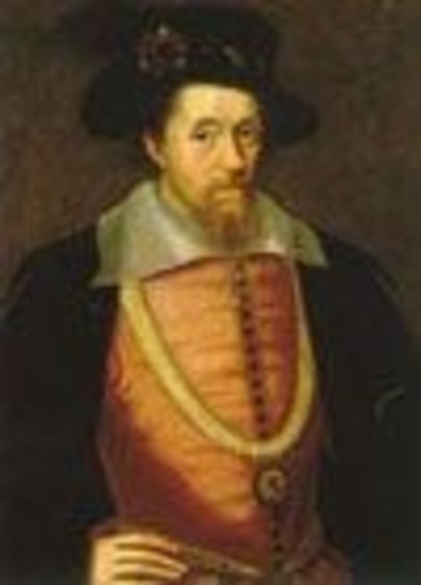
With the death of Queen Elizabeth I, Prince James VI of Scotland became King James I of England. The Protestant clergy approached the new King in 1604 and announced their desire for a new translation to replace the Bishop's Bible first printed in 1568. They knew that the Geneva Version had won the hearts of the people because of its excellent scholarship, accuracy, and exhaustive commentary. However, they did not want the controversial marginal notes (proclaiming the Pope an Anti-Christ, etc.) Essentially, the leaders of the church desired a Bible for the people, with scriptural references only for word clarification or cross-references.
This "translation to end all translations" (for a while at least) was the result of the combined effort of about fifty scholars. They took into consideration: The Tyndale New Testament, The Coverdale Bible, The Matthews Bible, The Great Bible, The Geneva Bible, and even the Rheims New Testament. The great revision of the Bishop's Bible had begun. From 1605 to 1606 the scholars engaged in private research. From 1607 to 1609 the work was assembled. In 1610 the work went to press, and in 1611 the first of the huge (16 inch tall) pulpit folios known today as "The 1611 King James Bible" came off the printing press. A typographical discrepancy in Ruth 3:15 rendered a pronoun "He" instead of "She" in that verse in some printings. This caused some of the 1611 First Editions to be known by collectors as "He" Bibles, and others as"She" Bibles. Starting just one year after the huge 1611 pulpit-size King James Bibles were printed and chained to every church pulpit in England; printing then began on the earliest normal-size printings of the King James Bible. These were produced so individuals could have their own personal copy of the Bible.

The Anglican Church’s King James Bible took decades to overcome the more popular Protestant Church’s Geneva Bible. One of the greatest ironies of history, is that many Protestant Christian churches today embrace the King James Bible exclusively as the “only” legitimate English language translation… yet it is not even a Protestant translation! It was printed to compete with the Protestant Geneva Bible, by authorities who throughout most of history were hostile to Protestants… and killed them. While many Protestants are quick to assign the full blame of persecution to the Roman Catholic Church, it should be noted that even after England broke from Roman Catholicism in the 1500’s, the Church of England (The Anglican Church) continued to persecute Protestants throughout the 1600’s. One famous example of this is John Bunyan, who while in prison for the crime of preaching the Gospel, wrote one of Christian history’s greatest books, Pilgrim’s Progress. Throughout the 1600’s, as the Puritans and the Pilgrims fled the religious persecution of England to cross the Atlantic and start a new free nation in America, they took with them their precious Geneva Bible, and rejected the King’s Bible. America was founded upon the Geneva Bible, not the King James Bible.
Protestants today are largely unaware of their own history, and unaware of the Geneva Bible (which is textually 95% the same as the King James Version, but 50 years older than the King James Version, and not influenced by the Roman Catholic Rheims New Testament that the King James translators admittedly took into consideration). Nevertheless, the King James Bible turned out to be an excellent and accurate translation, and it became the most printed book in the history of the world, and the only book with one billion copies in print. In fact, for over 250 years...until the appearance of the English Revised Version of 1881-1885...the King James Version reigned without much of a rival. One little-known fact, is that for the past 200 years, all King James Bibles published in America are actually the 1769 Baskerville spelling and wording revision of the 1611. The original “1611” preface is deceivingly included by the publishers, and no mention of the fact that it is really the 1769 version is to be found, because that might hurt sales. The only way to obtain a true, unaltered, 1611 version is to either purchase an original pre-1769 printing of the King James Bible, or a less costly facsimile reproduction of the original 1611 King James Bible.

Although the first Bible printed in America was done in the native Algonquin Indian Language by John Eliot in 1663; the first English language Bible to be printed in America by Robert Aitken in 1782 was a King James Version. Robert Aitken’s 1782 Bible was also the only Bible ever authorized by the United States Congress. He was commended by President George Washington for providing Americans with Bibles during the embargo of imported English goods due to the Revolutionary War. In 1808, Robert’s daughter, Jane Aitken, would become the first woman to ever print a Bible… and to do so in America, of course. In 1791, Isaac Collins vastly improved upon the quality and size of the typesetting of American Bibles and produced the first "Family Bible" printed in America... also a King James Version. Also in 1791, Isaiah Thomas published the first Illustrated Bible printed in America...in the King James Version. For more information on the earliest Bibles printed in America from the 1600’s through the early 1800’s, you may wish to review our more detailed discussion of The Bibles of Colonial America.
www.truthaccordingtoscripture.com/...history/history-of-the-english-bible.p...
This video is an hour-long presentation on the history of the English Bible. The viewer will meet most of the historical figures responsible for bringing us the Bible ...
 Posted By: Steve Williams
Tuesday, January 20th 2015 at 7:19AM
You can also
click
here to view all posts by this author...