![]()
The living tradition
A. HAMPATÉ BÂ
Writing is o n e thing a n d knowledge is another. Writing is t h e photograph of knowledge but is not knowledge itself. Knowledge is a light that is in man. It is the heritage o f all that our ancestors have known, and it is in the germ they transmit to us, just as the baobab-tree is potentially in its seed.
1
When we speak of African tradition or history we mean oral tradition; and no attempt at penetrating the history and spirit o f the African peoples is valid unless it relies on that heritage of knowledge of every kind patiently transmitted from mouth to ear, from master to disciple, down through the ages. This heritage is not yet lost, but lies there in the memory of the last generation of great depositories, of whom it can be said: 'they are the living memory of Africa'.
In the modern nations, where what is written has precedence over what is spoken, where the book is the principal vehicle of the cultural heritage, there has been a long-standing notion that peoples without writing are peoples without culture. This quite unwarranted opinion has happily begun to wear off since the last two wars, thanks to the work done b y certain great ethnologists of every nation. Today the innovative and courageous action of Unesco is raising the veil still further from the treasures o f knowledge transmitted b y oral tradition, treasures which belong t o t h e cultural patrimony o f all mankind.
For some scholars, the whole problem is whether we can place the same trust in the oral as in the written when it comes to evidence of things past. In my view, that is not the right way to put the problem. Written or oral evidence is in the end only human evidence and it is worth what the man is worth.
Does not what is said give birth to what is written, both over the centuries and in the individual himself? The world's earliest archives or libraries were
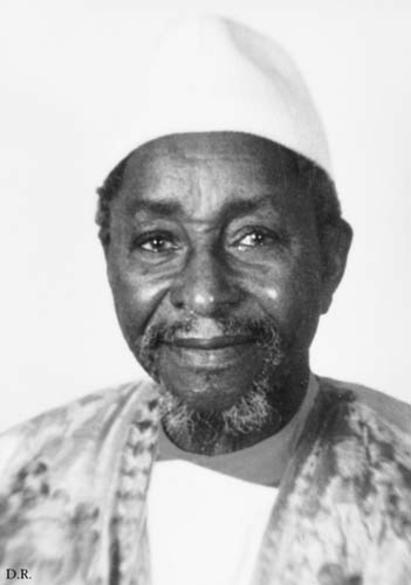
i. Tierno Bokar Salif (d. 1940) spent his life in Bandiagara (Mali). Grand Master of the Muslim Order of Tijâniyya, he was also a traditionalist in African matters. Cf. A. Hampaté Bâ and M . Cardaire, 1957.
Tierno Bokar
![]()
the brains of men. Before he puts his thoughts on paper the writer or the scholar has a private dialogue with himself. Before he writes a story down a man reminds himself of the facts as they were told to him, or as he tells them to himself if it is his own experience.
Nothing proves a priori that writing gives a more faithful account of a reality than oral evidence handed down from generation to generation. The chronicles of modern wars serve to show that, as is said (in Africa), each party or nation 'sees high noon from its own doorway' - through the prism of its own passions or mentality or interests, or eagerness to justify its point of view. Moreover, written documents were not themselves always secure against deliberate forgeries or unintentional alterations at the hands of successive copyists - phenomena which inter alia gave rise to the controversies over 'Holy Writ'.
What is involved, therefore, behind the evidence itself, is the actual value of the man who is giving the evidence, the value of the chain of transmission he is part of, the trustworthiness of the individual and collective memory, and the price attached to the truth in a given society. In short: the bond between man and the spoken word.
Now it is in oral societies that the function of the memory is most highly developed and, furthermore, the bond between man and the word is strongest. Where writing does not exist, man is bound to the word he utters. He is committed by it. He is his word and his word bears witness to what he is. The very cohesion of society depends on the value of and respect for the spoken word. By contrast, with the encroachment of writing we see writing gradually replace the spoken word, become the sole proof and the sole resort; we see the signature become the sole recognized commitment, while the deep sacred bond that used to unite man and word disappears, to be replaced by conventional university degrees.
In African traditions - at least the ones I know, which pertain to the whole savannah zone south of the Sahara - the spoken word had, beyond its fundamental moral value, a sacred character associated with its divine origin and with the occult forces deposited in it. Superlative agent in magic, grand vector of 'ethereal' forces, it wasnot to be treated lightly.
Many religious, magical or social factors, then, combined to preserve the faithfulness of oral transmission. I think I should give the reader a brief account of these, the better to place African oral tradition in its context, and as it were illuminate it from within.
If a true African traditionalist were asked, 'What is oral tradition?' he would probably be nonplussed. H e might perhaps reply, after a lengthy silence: 'It is total knowledge', a n d say n o more.
What does the term oral tradition cover, then? What realities does it convey, what knowledge does it transmit, what sciences does it teach, and who are its transmitters?
Contrary to what some may think, African oral tradition is not limited to stories and legends or even to mythological and historical tales, and the man
167
The living tradition
![]()
whom the French call a 'griot' - a wandering minstrel/poet - is far from being its one and only qualified guardian and transmitter.
Oral tradition is the great school of life, all aspects of which are covered and affected by it. It may seem chaos to those who do not penetrate its secret; it may baffle the Cartesian mind accustomed to dividing everything up into clear-cut categories. In oral tradition, in fact, spiritual and material are not dissociated.
Passing from th e esoteric to th e exoteric, oral tradition is able to p u t itself within men's reach, speak to them according to their understanding, unveil itself in accordance with their aptitudes. It is at once religion, knowledge, natural science, apprenticeship in a craft, history, entertainment, recreation, since any point of detail can always take us all the way back to primordial unity.
Based on initiation and experience, oral tradition engages man in his total being, and therefore we can say it has served to create a particular type of man, to sculpt the African soul.
Linked with the everyday behaviour of man and community, African culture is not, then, something abstract that can be isolated from life. It involves a particular vision of the world, or rather a particular presence in the world - a world conceived o f as a whole in which all things are linked together and interact.
Oral tradition is based upon a certain conception of man, of man's place and role within the universe. T o situate it the better in its total context before studying it in its various aspects, we must therefore go back to the very mystery of the creation of man and the primordial inauguration of the Word: the mystery which the Word teaches, and in which it originates.
 Posted By: Steve Williams
Tuesday, January 20th 2015 at 10:06PM
You can also
click
here to view all posts by this author...