
Second Annual Electoral Reform Symposium
|
|||||||||||
|

Press Enter to search or select a section to narrow results

|
|||||||||||
|
Share This Article
Thanks Joe. I was in California in 2012 and know just what you mean. Not only did neither candidate campaign there but the election was called before they'd even counted our votes. I will check out the link.
Please log in to post comments.
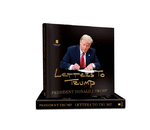
LETTERS TO TRUMP
Why was the public not told when they were discovered in November?

McCarthy thanks Trump after House speaker vote: 'He was with me from the beginning'
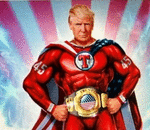
Donald Trump's 'Digital Trading Cards' Sold Out In One Day — Netting $4.4 Million

AFPAC II (2021) Nick Fuentes Full Speech

Ousted Twitter counsel Jim Baker vetted 'Twitter Files' without Elon Musk's knowledge, Matt Taibbi reveals
In the meantime, you can read up on the National Popular Vote bill.
Presidential elections don't have to continue to be dominated by and determined by a handful of swing states besieged with attention, while most of the country is politically irrelevant.
In 2012, more than 99% of presidential campaign attention (ad spending and visits) was invested on voters in just the only ten competitive states. There are only expected to be 7 remaining swing states in 2016.
Issues of importance to non-battleground states are of so little interest to presidential candidates that they don’t even bother to poll them.
Over 87% of both Romney and Obama campaign offices were in just the 12 swing states. The few campaign offices in the 38 remaining states were for fund-raising, volunteer phone calls, and arranging travel to battleground states.
“Battleground” states receive 7% more federal grants than “spectator” states, twice as many presidential disaster declarations, more Superfund enforcement exemptions, and more No Child Left Behind law exemptions.
The National Popular Vote bill would guarantee the Presidency to the candidate who receives the most popular votes in all 50 states and DC.
The bill ensures that every vote, in every state, will matter equally in every presidential election.
The bill has passed a total of 33 legislative chambers in 22 rural, small, medium, large, Democratic, Republican and purple states with 250 electoral votes
The bill has been enacted by 11 jurisdictions possessing 165 electoral votes—61% of the 270 electoral votes necessary to activate it.
see http://www.NationalPopularVote.com