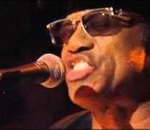
Remembering Donny Hathaway This Christmas
Donny Edward Hathaway (October 1, 1945 – January 13, 1979) was an African-American soul musician. He contracted with Atlantic Records in 1969, and with his first single "The Ghetto, Part I" (1970), Rolling Stone magazine "marked him as a major new force in soul music."[1] His collaborations with Roberta Flack scored #1 on the charts and won him the Grammy Award for Best Pop Performance by a Duo or Group with Vocal for the duet "Where Is the Love" in 1973. On January 13, 1979, his body was found outside the luxury hotel Ess*x House in New York City; his death was ruled a suicide.
Early career
Hathaway, the son of Drusella Huntley, was born in Chicago. He lived with his grandmother, Martha Pitts, also known as Martha Crumwell, in St. Louis' Carr Square housing project. Hathaway began singing in a church choir with his grandmother, a professional gospel singer, at the age of 3. He also played the ukulele and, fascinated by Liberace, began studying piano as a child. Hathaway began singing professionally as "Donny Pitts, The Nation's Youngest Gospel Singer". By the time he was a student at Vashon High School in St. Louis, he was known as a piano prodigy, which earned him a fine-arts scholarship to Howard University in 1964 where he was initiated into Alpha Phi Alpha Fraternity into the Beta chapter in Spring of 1965. He attended Howard for three years and performed with The Ric Powell Trio, a jazz trio. Hathaway received so many job offers that he left Howard without a degree during 1967.
Career
At first, Hathaway worked as songwriter, session musician and producer. Working first at Chicago's Twinight Records, he later did the arrangements for The Unifics ("Court of Love" and "The Beginning Of My End") and participated in projects by The Staple Singers, Jerry Butler and Aretha Franklin, as well as with Curtis Mayfield. After becoming a "house producer" for Mayfield's label, Curtom Records, he started recording there as a member of The Mayfield Singers. He recorded his first single under his own name in 1969, a duet with singer June Conquest called "I Thank You Baby". They also recorded the duet "Just Another Reason", released as b-side of a reissue of that first single...
Health challenges
During the best part of his career, Hathaway began to suffer from severe bouts of depression. It was found that he was suffering from paranoid schizophrenia and was known to have taken up to 14 pills two to three times per day to control this disease. This condition wreaked havoc on his life and required several hospitalizations.
The effects of Hathaway's melancholia also drove a wedge into Flack and Hathaway's friendship; they did not reconcile for several years, and did not release additional music until the 1978 release of "The Closer I Get To You". The single became a popular and R&B hit, and Flack and Hathaway resumed studio recording to compose a second album of duets thereafter.
Death
On January 13, 1979, Hathaway was found dead on the sidewalk in front of the Ess*x House in New York City, where he had been living. His body did not have any indication of struggle, and the glass from the window in Hathaway's room had been removed; investigators determined Hathaway had committed suicide.[4] Friends, fans, and the media were mystified at his death, since his career and his partnership with Flack were improving. Flack was devastated by his death, and included the few duet tracks they had finished on her next album. The Reverend Jesse Jackson conducted Hathaway's funeral, which was attended by many notable people, including Flack and Stevie Wonder. He was buried in Lake Charles Cemetery in Bel-Nor, Missouri.
Legacy
Hathaway's Donny Hathaway Live, which featured noted R&B musicians Willie Weeks (bass guitar) and Cornell Dupree (guitar), has been cited as an influence by numerous artists including Alicia Keys, George Benson, India.Arie and Stevie Wonder, Brian McKnight, Anthony Hamilton, and Frank McComb are among the contemporary artists whose work echoes Hathaway's. His use of the Rhodes Piano on his early Atco R&B recordings has also influenced many Neo Soul artists & producers. http://en.wikipedia.org/wiki/Donny_Hathawa...
http://www.youtube.com/watch?v=f0SwaSv76_w ---Donny Hathaway singing This Christmas
Early career
Hathaway, the son of Drusella Huntley, was born in Chicago. He lived with his grandmother, Martha Pitts, also known as Martha Crumwell, in St. Louis' Carr Square housing project. Hathaway began singing in a church choir with his grandmother, a professional gospel singer, at the age of 3. He also played the ukulele and, fascinated by Liberace, began studying piano as a child. Hathaway began singing professionally as "Donny Pitts, The Nation's Youngest Gospel Singer". By the time he was a student at Vashon High School in St. Louis, he was known as a piano prodigy, which earned him a fine-arts scholarship to Howard University in 1964 where he was initiated into Alpha Phi Alpha Fraternity into the Beta chapter in Spring of 1965. He attended Howard for three years and performed with The Ric Powell Trio, a jazz trio. Hathaway received so many job offers that he left Howard without a degree during 1967.
Career
At first, Hathaway worked as songwriter, session musician and producer. Working first at Chicago's Twinight Records, he later did the arrangements for The Unifics ("Court of Love" and "The Beginning Of My End") and participated in projects by The Staple Singers, Jerry Butler and Aretha Franklin, as well as with Curtis Mayfield. After becoming a "house producer" for Mayfield's label, Curtom Records, he started recording there as a member of The Mayfield Singers. He recorded his first single under his own name in 1969, a duet with singer June Conquest called "I Thank You Baby". They also recorded the duet "Just Another Reason", released as b-side of a reissue of that first single...
Health challenges
During the best part of his career, Hathaway began to suffer from severe bouts of depression. It was found that he was suffering from paranoid schizophrenia and was known to have taken up to 14 pills two to three times per day to control this disease. This condition wreaked havoc on his life and required several hospitalizations.
The effects of Hathaway's melancholia also drove a wedge into Flack and Hathaway's friendship; they did not reconcile for several years, and did not release additional music until the 1978 release of "The Closer I Get To You". The single became a popular and R&B hit, and Flack and Hathaway resumed studio recording to compose a second album of duets thereafter.
Death
On January 13, 1979, Hathaway was found dead on the sidewalk in front of the Ess*x House in New York City, where he had been living. His body did not have any indication of struggle, and the glass from the window in Hathaway's room had been removed; investigators determined Hathaway had committed suicide.[4] Friends, fans, and the media were mystified at his death, since his career and his partnership with Flack were improving. Flack was devastated by his death, and included the few duet tracks they had finished on her next album. The Reverend Jesse Jackson conducted Hathaway's funeral, which was attended by many notable people, including Flack and Stevie Wonder. He was buried in Lake Charles Cemetery in Bel-Nor, Missouri.
Legacy
Hathaway's Donny Hathaway Live, which featured noted R&B musicians Willie Weeks (bass guitar) and Cornell Dupree (guitar), has been cited as an influence by numerous artists including Alicia Keys, George Benson, India.Arie and Stevie Wonder, Brian McKnight, Anthony Hamilton, and Frank McComb are among the contemporary artists whose work echoes Hathaway's. His use of the Rhodes Piano on his early Atco R&B recordings has also influenced many Neo Soul artists & producers. http://en.wikipedia.org/wiki/Donny_Hathawa...
http://www.youtube.com/watch?v=f0SwaSv76_w ---Donny Hathaway singing This Christmas