
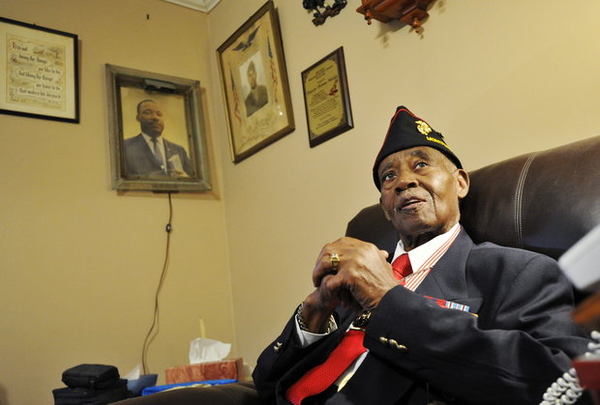
black Marines,,,,talks about being one of first
When he got his draft card in 1943, Thomas Mosley faced the same fears and uncertainty as thousands of other men across the country.
He would be leaving home for the first time in time his life and could soon be sent to an unknown place with bullets flying at him. But he had an additional challenge most of the others didn’t.
Mosley was among the first black men to serve in the Marines, in a unit known today as the Montford Point Marines. They trained at Montford Point, a segregated camp next to Camp Lejeune, N.C. They were so little trusted they couldn’t set foot on Camp Lejeune unless they were escorted by a white officer.
But despite the discrimination they faced, Mosley said they were determined to succeed.
“We were supposed to be citizens and not have different policies for people, but these men were determined to be free, and whatever conditions they were in, they still joined in and did whatever job they had to do,” Mosley said as he sat in his Macon home last week with his Congressional Gold Medal hung around his neck.
He was among about 400 Montford Point Marines to receive the honor in June in recognition of their ground-breaking service. Like the better-known Tuskegee Airmen and Buffalo Soldiers, they helped pave the way for the eventual full integration of the military.
Mosley is one of two Montford Point Marines known to be living in Macon. The other is Frank Johnson, often called the “mayor of Unionville” for his activism in the neighborhood. Johnson suffered a stroke in 2000 and now lives in a nursing home.
Melvin D. Ragin, who served in the Marine Corps from 1962 to 1988, is president of the local Montford Point Marine Association Chapter 35. The organization strives to educate people about the service of those trained at Montford Point from 1942 until 1949, soon after President Harry Truman in 1948 ordered the full integration of the military and the camp was closed.
“They are my heroes,” Ragin said. “I spent 26 years in the Marine Corps, and I wouldn’t have been able to do that if it not been for these guys. Because of the standard they set, we were able to be fully integrated into the Marine Corps.”
Mosley trained to handle ammunition. He never saw combat, but he did contribute to the war effort. He was stationed near Pearl Harbor and loaded ammunition onto ships. He also unloaded injured soldiers returning from the Pacific Theater.
In boot camp, he had black drill instructors, but afterward he served under white officers. Most of them did not want the duty of commanding black troops.
After the war, however, those same officers came to their defense when some people wanted to boot blacks from the Marines entirely.
“Some of the white officers said, ‘These are some of the finest Marines I’ve ever served with,’ ” Mosley said.
He was told he would be part of the force that would invade Japan, and was packed and ready to go when the U.S. dropped two nuclear bombs, forcing the Japanese to surrender.
Mosley said he regretted the loss of civilian life, but the nuclear bombing may have saved his.
“It did spare a lot of time and even death on both sides of the military,” he said.
He left the Marines in 1946 and became an aircraft mechanic. In 1965, he took a job at Robins Air Force Base and retired in 1984.
Ragin said all Montford Point Marines he has met, including Mosely and Johnson, have gone on to be dedicated community servants.
Johnson’s wife, Dorothy P. Johnson, said her husband’s service in the Marines had everything to do with that.
“He said the Marines made him what he is,” she said.
The military has long been recognized for being ahead of its time on integration and equal opportunity. When he served in Vietnam, Ragin saw firsthand how racial differences erode when bullets start flying.
“When you are dependent on somebody for your life, it doesn’t matter what color somebody is,” he said. “Combat makes good buddies of anybody if you are on his side.”
He would be leaving home for the first time in time his life and could soon be sent to an unknown place with bullets flying at him. But he had an additional challenge most of the others didn’t.
Mosley was among the first black men to serve in the Marines, in a unit known today as the Montford Point Marines. They trained at Montford Point, a segregated camp next to Camp Lejeune, N.C. They were so little trusted they couldn’t set foot on Camp Lejeune unless they were escorted by a white officer.
But despite the discrimination they faced, Mosley said they were determined to succeed.
“We were supposed to be citizens and not have different policies for people, but these men were determined to be free, and whatever conditions they were in, they still joined in and did whatever job they had to do,” Mosley said as he sat in his Macon home last week with his Congressional Gold Medal hung around his neck.
He was among about 400 Montford Point Marines to receive the honor in June in recognition of their ground-breaking service. Like the better-known Tuskegee Airmen and Buffalo Soldiers, they helped pave the way for the eventual full integration of the military.
Mosley is one of two Montford Point Marines known to be living in Macon. The other is Frank Johnson, often called the “mayor of Unionville” for his activism in the neighborhood. Johnson suffered a stroke in 2000 and now lives in a nursing home.
Melvin D. Ragin, who served in the Marine Corps from 1962 to 1988, is president of the local Montford Point Marine Association Chapter 35. The organization strives to educate people about the service of those trained at Montford Point from 1942 until 1949, soon after President Harry Truman in 1948 ordered the full integration of the military and the camp was closed.
“They are my heroes,” Ragin said. “I spent 26 years in the Marine Corps, and I wouldn’t have been able to do that if it not been for these guys. Because of the standard they set, we were able to be fully integrated into the Marine Corps.”
Mosley trained to handle ammunition. He never saw combat, but he did contribute to the war effort. He was stationed near Pearl Harbor and loaded ammunition onto ships. He also unloaded injured soldiers returning from the Pacific Theater.
In boot camp, he had black drill instructors, but afterward he served under white officers. Most of them did not want the duty of commanding black troops.
After the war, however, those same officers came to their defense when some people wanted to boot blacks from the Marines entirely.
“Some of the white officers said, ‘These are some of the finest Marines I’ve ever served with,’ ” Mosley said.
He was told he would be part of the force that would invade Japan, and was packed and ready to go when the U.S. dropped two nuclear bombs, forcing the Japanese to surrender.
Mosley said he regretted the loss of civilian life, but the nuclear bombing may have saved his.
“It did spare a lot of time and even death on both sides of the military,” he said.
He left the Marines in 1946 and became an aircraft mechanic. In 1965, he took a job at Robins Air Force Base and retired in 1984.
Ragin said all Montford Point Marines he has met, including Mosely and Johnson, have gone on to be dedicated community servants.
Johnson’s wife, Dorothy P. Johnson, said her husband’s service in the Marines had everything to do with that.
“He said the Marines made him what he is,” she said.
The military has long been recognized for being ahead of its time on integration and equal opportunity. When he served in Vietnam, Ragin saw firsthand how racial differences erode when bullets start flying.
“When you are dependent on somebody for your life, it doesn’t matter what color somebody is,” he said. “Combat makes good buddies of anybody if you are on his side.”





here is my story ,,,,the blog king ;;;
I am a native NEW YORKER BORN AND RAISED IN HARLEM NEW YORK,,,,,,,,,,,,,,,,,,, New York New York big city of dreams ,,,,,Yea DREAMS of getting the hell out of Harlem,,,, dreams of leaving the drug infested streets dreams of changing the shooting gallery's/drug dens into schools but me I did not want to be a drug dealer or a dope fen I wanted to be a part of something different so I enrolled in the marines !
I could not get in the air force so the marines took me in ,,,,shot in the ass and off to boot camp what a trip !
TALK ABOUT RACISM marines was not for blacks at that time and they let you know they diden't want ''*****s' in the marines whites did not want to see a 6..3 black boy from New York in there camp ,,,brothers was coming back from the war beat down shot up hook on the morphine pack USA issued only to get hooked on that china white heroine USA issued I was there I seen it all !
I wanted to get the hell out of Harlem and the marines seem to be my only hope I was sent to boot camp Marine Corps Recruit Depot, Parris Island, SC 12 weeks of training first aide, leadership, core rules, martial arts,back then hazing was nothing but a race war between blacks and whites ,I want to give up and leave many times and they dident care another ***** gone but I thought about the streets of HARLEM and that was enough to fight on !
around week 7 they gave me the sweet m16 riffle and my life changed I had a new leaf on life it was something in the pulling that trigger and hitting the target that brought new life to me ,they taught me how to fire and look through the target
strength training was nothing after that I was growing and becoming a man a marine **** I got gun ho big headed a fighting marine you dident have to be book smart but you did have to have a lot of heart ,courage you know a no fear mind set
week 8 ,9 10 i was going through Basic Warrior Training called line A OR A LINE
then it was time for the make it or brake it test ,,time to put all that training on the line and see what you was really made of ,,it was time for the Crucible the final test in training,I had to put all the skills and knowledge in this last task 2 days 8 hours in the field a 50 mile march through the woods with typical combat situations very little food and about 4 -6 hrs sleep !
I was giving 4 MRE and offer we went ,,everything was team work team work team work if you dident have help in the task you could not make it i mean from carrying the wounded to fire fights to infiltrating the other-side Some of the challenges encountered during the Crucible was team and individual obstacle courses, day and night assault courses, land navigation courses, individual rushes up steep hills, large-scale martial arts challenges, and countless patrols to and from each of these. Often, these challenges are made even more difficult by the additions of limitations or handicaps, such as the requirement to carry several ammunition drums, not touching portions of an obstacle painted red to indicate simulated booby traps, and evacuating team members with simulated wounds.
On the final day of the Crucible, recruits are awoken and begin their final march (including "The Reaper" a forced march up a steeply inclined hill to the top of Edson's Ridge on the west coast). Immediately following this, recruits are offered the "Warrior's Breakfast", thats it right there I made it THE Warrior's Breakfast is when all the racism is gone all the fear is gone ,and friendships are started bonds are created we made now we get to eat as much as we want , even of previously forbidden foods you name it ,even ice cream and then you think everyone wants to go to sleep hell i was gunnnnnhoooo for at least 5,8 hours because I made it ,i was a marine and I made out the hood I was no longer a boy from from HARLEM i was a man am UNITED STATES MARINE !
the Eagle, Globe, and Anchor ceremony, where the recruits receive the eponymous emblem, and thereby cease to be recruits, finally becoming Marines