
Economy and Crime Spur New Puerto Rican Exodus

SAN JUAN, P.R. — Alexis Sotomayor has many reasons to stay in Puerto Rico: his two children; his mother and their gossip sessions over plates of fried rice; and the balm of salt and sun that leavens his life on the island. But the artisanal soap business that Mr. Sotomayor built is barely hanging on amid rising costs and taxes, and sales that have sunk by 40 percent in five years. Crime is rampant; his girlfriend was nearly carjacked at gunpoint recently. So last month he boarded a flight to Orlando, Fla., to interview for a job at a rum distillery in the hope of joining the ever-growing Puerto Rican diaspora.
Puerto Rico’s slow-motion economic crisis skidded to a new low last week when both Standard & Poor’s and Moody’s downgraded its debt to junk status, brushing aside a series of austerity measures taken by the new governor, including increasing taxes and rebalancing pensions. But that is only the latest in a sharp decline leading to widespread fears about Puerto Rico’s future. In the past eight years, Puerto Rico’s ticker tape of woes has stretched unabated: $70 billion in debt, a 15.4 percent unemployment rate, a soaring cost of living, pervasive crime, crumbling schools and a worrisome exodus of professionals and middle-class Puerto Ricans who have moved to places like Florida and Texas.
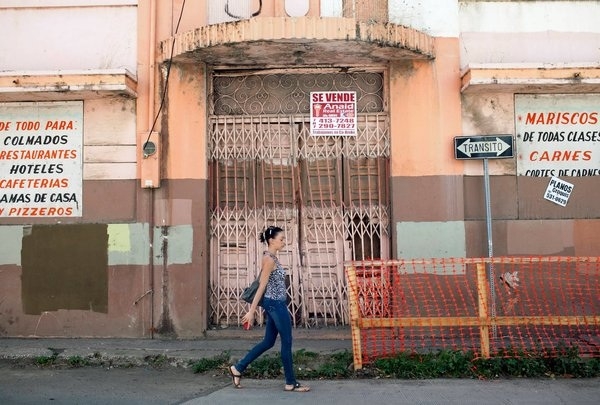
Launch media viewer blog pic of woman walking past a closed restaurant in Ponce. Alvin Baez/Reuters
The situation has grown so dire that this tropical island, known for its breathtaking beaches, salsero vibe and tax breaks, is now mentioned in the same breath as Detroit, with one significant difference. Puerto Rico, a United States territory of 3.6 million people that is treated in large part like a state, cannot declare bankruptcy.
From bottom to top, Puerto Ricans are watching it unfold with a mixture of disbelief and stoicism. Schools sit shuttered either because of disrepair or because of a dwindling number of students. In this typically convivial capital, communities have erected gates and bars to help thwart carjackers and home invaders. Illegal drugs, including high-level narcotrafficking, are one of the few growth industries. “Today, Puerto Ricans with jobs are moving to the U.S.,” said Orlando Sotomayor, an economist at the University of Puerto Rico and the brother of Alexis. “Even people in their 40s and 50s, college professors with complete job security, are doing so. Some are starting all over. The phenomenon is highly uncommon and underscores the lack of hope that the ship can or will be righted.”
The current exodus rivals the one in the 1950s, when job shortages on the island forced farmers and rural residents to find factory work in cities like New York and Boston. Today, it is doctors, teachers, engineers, nurses, professors who are leaving Puerto Rico behind. Just about everyone in Puerto Rico has a relative who left recently for Florida, New York, Texas or Virginia, among others. But the decision is never easy. Fathers leave behind children. Houses must be rented or sold at a loss in a glutted market. Businesses must be shut. And English must be polished, or in some cases learned, in a hurry. For many, the high rate of violent crime has been the capper. There were 1,136 murders in 2011, a record and far higher than the mainland’s rate. It fell to 883 homicides last year, a point of pride for the governor.
http://www.nytimes.com/2014/02/09/us/econo...
Puerto Rico’s slow-motion economic crisis skidded to a new low last week when both Standard & Poor’s and Moody’s downgraded its debt to junk status, brushing aside a series of austerity measures taken by the new governor, including increasing taxes and rebalancing pensions. But that is only the latest in a sharp decline leading to widespread fears about Puerto Rico’s future. In the past eight years, Puerto Rico’s ticker tape of woes has stretched unabated: $70 billion in debt, a 15.4 percent unemployment rate, a soaring cost of living, pervasive crime, crumbling schools and a worrisome exodus of professionals and middle-class Puerto Ricans who have moved to places like Florida and Texas.
Launch media viewer blog pic of woman walking past a closed restaurant in Ponce. Alvin Baez/Reuters
The situation has grown so dire that this tropical island, known for its breathtaking beaches, salsero vibe and tax breaks, is now mentioned in the same breath as Detroit, with one significant difference. Puerto Rico, a United States territory of 3.6 million people that is treated in large part like a state, cannot declare bankruptcy.
From bottom to top, Puerto Ricans are watching it unfold with a mixture of disbelief and stoicism. Schools sit shuttered either because of disrepair or because of a dwindling number of students. In this typically convivial capital, communities have erected gates and bars to help thwart carjackers and home invaders. Illegal drugs, including high-level narcotrafficking, are one of the few growth industries. “Today, Puerto Ricans with jobs are moving to the U.S.,” said Orlando Sotomayor, an economist at the University of Puerto Rico and the brother of Alexis. “Even people in their 40s and 50s, college professors with complete job security, are doing so. Some are starting all over. The phenomenon is highly uncommon and underscores the lack of hope that the ship can or will be righted.”
The current exodus rivals the one in the 1950s, when job shortages on the island forced farmers and rural residents to find factory work in cities like New York and Boston. Today, it is doctors, teachers, engineers, nurses, professors who are leaving Puerto Rico behind. Just about everyone in Puerto Rico has a relative who left recently for Florida, New York, Texas or Virginia, among others. But the decision is never easy. Fathers leave behind children. Houses must be rented or sold at a loss in a glutted market. Businesses must be shut. And English must be polished, or in some cases learned, in a hurry. For many, the high rate of violent crime has been the capper. There were 1,136 murders in 2011, a record and far higher than the mainland’s rate. It fell to 883 homicides last year, a point of pride for the governor.
http://www.nytimes.com/2014/02/09/us/econo...



..."The origins of the crisis, though, stretch back more than a decade. Tax incentives have long been a draw for corporations seeking to do business in Puerto Rico, and the island in turn has benefited from its ability to offer such breaks, in large part structuring its economy around them.
Tax laws were once abundantly generous, which fueled the spread of factories that made textiles and pharmaceuticals, among other things. That came to a crash in 2006, after the 10-year phaseout of a subsidy that provided American firms operating in Puerto Rico with tax-free income. Changes to the global economy and the worldwide recession exacerbated the situation. Since 1996, factory jobs on the island spiraled from 160,000 to 75,000."...