

Nigeria Develops Experimental Drug For Treatment of Ebola – Agency { Yeah.... they have the talent#1 Economy }
Topic: Ebola Outbreak in West Africa
MOSCOW, August 15 (RIA Novosti) – A Nigerian scientist has developed an experimental drug for treating the Ebola virus disease, NAN news agency reported citing Minister for Health Onyebuchi Chukwu.
Chukwu told a news conference that the drug is called Nanosilver and it would be used to treat the eight Nigerians who have tested positive for Ebola.
The World Health Organization said Tuesday that it is ethical to use experimental drugs to treat patients infected with the deadly Ebola virus.
The West African outbreak of the Ebola virus disease, which has no known cure, was declared an international public health emergency by the UN a week ago.
© REUTERS Umaru Fofana
Factbox: Deadly Ebola Virus
According to the WHO, the current Ebola outbreak has already claimed 1,069 lives in the West Africa countries. A total of 1,975 cases have been confirmed.
The worst Ebola outbreak in history started in February in Guinea and then spread to Nigeria, Liberia and Sierra Leone.
Ebola hemorrhagic fever has a fatality rate of nearly 90 percent. The Ebola virus is transmitted through direct contact with the blood or bodily fluids of the infected. Symptoms of the disease include sudden onset of fever, weakness, muscle pain, headache and sore throat followed by vomiting, diarrhea, rash, kidney and liver problems, and in some cases, both internal and external bleeding.
MOSCOW, August 15 (RIA Novosti) – A Nigerian scientist has developed an experimental drug for treating the Ebola virus disease, NAN news agency reported citing Minister for Health Onyebuchi Chukwu.
Chukwu told a news conference that the drug is called Nanosilver and it would be used to treat the eight Nigerians who have tested positive for Ebola.
The World Health Organization said Tuesday that it is ethical to use experimental drugs to treat patients infected with the deadly Ebola virus.
The West African outbreak of the Ebola virus disease, which has no known cure, was declared an international public health emergency by the UN a week ago.
© REUTERS Umaru Fofana
Factbox: Deadly Ebola Virus
According to the WHO, the current Ebola outbreak has already claimed 1,069 lives in the West Africa countries. A total of 1,975 cases have been confirmed.
The worst Ebola outbreak in history started in February in Guinea and then spread to Nigeria, Liberia and Sierra Leone.
Ebola hemorrhagic fever has a fatality rate of nearly 90 percent. The Ebola virus is transmitted through direct contact with the blood or bodily fluids of the infected. Symptoms of the disease include sudden onset of fever, weakness, muscle pain, headache and sore throat followed by vomiting, diarrhea, rash, kidney and liver problems, and in some cases, both internal and external bleeding.








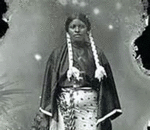
History is very important as many of the so-called black americans came from the lands of the Great Songhai Empire of West Africa extending north to Mali down to Gabon on the coast.
history
Egyptian Jews began trading with tribes in the northern part of Mali as long ago as biblical times and pushed further and further into the foreboding Sahara throughout the centuries. In the eighth century A.D. the Rhadanites (multi-lingual Jewish traders) settled in Timbuktu and used it as a base from which they could solidify their trade routes through the desert. In the 14th and 15th centuries Jews fleeing Spanish persecution settled in Timbuktu. Members of the Kehath (Ka'ti) family founded three villages that still exist near Timbuktu -- Kirshamba, Haybomo, and Kongougara. In 1492, King Askia Muhammed took power in Timbuktu and threatened Jews who did not convert to Islam with execution. Some Jews fled, some converted, some remained in Mali and faced centuries of persecution and the occasional massacre. By the 20th century there were no practicing Jews in Mali.
However, in the 1990s Malian Jewry has begun to experience a revival. Ismael Diadie Haidara, a historian from Timbuktu, has been at the forefront of the movement to explore Mali’s Jewish past. In 1993 Haidara established Zakhor (the Timbuktu Association for Friendship with the Jewish World) as an informal association of Malian descendants of Jews. Zakhor’s members hope to teach their children about their Jewish heritage, learn and use Hebrew as a second language and publish histories of their ancestry. In Timbuktu alone there are almost a thousand descendants of Jews who have become interested in exploring their identity.
Finally, the vast majority of Hebrews migrated into Western Africa/Sudan, along the Western Coast of Africa and sojourned there for over fifteen hundred years (70 AD - 1619 AD). The Hebrews became a dominant factor in establishing many of the cultures throughout Western Africa, including the following countries:
In Ghana, the Hebrews were identified as the Ashantee
In Mali, the indigenous people were identifed as the Mandinka, however, they were not Hebrews
In Songhay, the city of Timbuktu, which was a great center of education and commerce and many of the indigenous people were Hebrews
Guinea, which was Known as the Gold Coast, also had a significant numbers of Hebrews.
According to the writings of Eldad the Danite, a famous Algerian Jewish author of the ninth century, Ghana was a Hebrew nation which followed the Law of Moses. The people of Ghana traced their roots to Jews of the First Diaspora of 600 BC, who were forcibly expelled from Israel by the Assyrians. In support of this, Eldad reported that the Ghanans possessed the Torah, which was compiled before the Diaspora, but not the Talmud, which was compiled in Jerusalem and Babylon much later, during the early centuries of the Christian era.
Iberian Jews of Yoruba Nationality
The Bnai Ephraim (“Children of Ephraim”) from Nigeria, live among the Yoruba nationalities. Their oral history tells that the Bnai Ephraim people came from Morocco after the Jews were banished from the Iberian Pennisula sometime after 1492.
They speak a dialect that is a mixture of Moroccan Arabic, Yoruba, and Aramaic. They are known by the Yoruba people as the “Emo Yo Quaim”, or “strange people”. Unlike other African Israelite communities in Nigeria, the Bnai Ephraim have the Torah, portions of which they keep in their sanctuaries.
The Bnai Ephraim provides a living and irrefutable proof of this barely known history of mass Jewish re-settlement in West Africa, between 1492 and 1692, a 200 year non-stop return of Jews to Africa. This set of Moorish refugees are not to be confused with more ancient Hebrew and Canaanite tribes that had been living in Nigeria and other African countries for thousands of years.
The following is a partial list of the various tribes throughout north, south, east and west Africa who are descendants of the Hebrew Israelite nation:
1) Beta Israel/Falasha- Ethiopia 2) Abayudaya-Uganda 3) Tutsi- Rwanda 4) Rusape- Zimbabwe 5) Lemba- South Africa
6) Sefwi Wiawso- Ghana 7) Ashanti- Ghana Ga- Ghana 9) Ewe- Ghana 10) B’nai Ephraim(sons of Ephraim)- Yoruba, Nigeria
11) Lam-Lam- Timbuktu 12) Katsena- Nigeria 13)Zafin Ibrahim- Malagasy Republic 14) Ibo- Nigeria