

The Bantu Branch of ‘Africans’ are Hebrew Israelites PART I of II
In this post I would like to establish the fact that the ‘Bantu’ branch of Africans, generally concentrated in Sub-Saharan part of the continent, and their related family branches are actually descendants of the Hebrew Israelites. Identifying the Bantu as the descendants of the Israelites extremely important. Having the understanding that the Bantu are Israelites is integral in order to gain a broader and more accurate comprehension of who the Israelites are, where their descendants are located, and what contributions they have made to the world.
Many of us are already very familiar with the Zondervan’s Bible Dictionary’s Ham (son of Noah), definition. Those who are not, please become soon familiar with it. However, again, for those of use who are already familiar with the Zondervan’s Bible Dictionary definition of Ham, we know that by it [the definition of Ham] we know that the Negroes are not Ham’s (true African) descendants.
In fact, the historical mythology and traditions of the Yoruba people themselves speak of their origins outside of Africa in the Near East (Shemitic) region. Dierk Lange, Prof. Dr. Emeritus, of Bayreuth University in Germany, has performed extensive research concerning many West African groups and their origins in the Near East. In the abstract to one of his many essays, “Dierk Lange: Origin of the Yoruba and “The Lost Tribes of Israel”,” Dierk confirms the traditions of a Levantine (Israelite) origin of the Yoruba Nigerians.
“On the basis of comparative studies between the dynastic tradition of the Oyo-Yoruba and ancient Near Eastern history, the present article argues that Yoruba traditions of provenance, claiming immigration from the Near East, are basically correct. According to Ọyo-Yoruba tradition, the ancestral Yoruba saw the Assyrian conquests of the Israelite kingdom from the ninth and the eighth centuries B.C. from the perspective of the Israelites. After the fall of Samaria in 722 B.C.., they were deported to eastern Syria and adopted the ruling Assyrian kings as their own.” – Origin of the Yoruba and “The Lost Tribes of Israel”, By Dierk Lange
Dierk continues in the same article, stating that the Yoruba, although thought to be of local (African) origins actually migrated to the west coast of Africa from far away (the Mediterranean, the Middle East, and/or Egypt/Nubia). The Yoruba preserved evidence of their ancient Near Eastern (Israelite) ancestral origins despite other cultural influences and traditions superseding their own in Africa over time.
“According to the present opinion, the Yoruba are of local origin [African/Hamite], but this opinion reflects the great influence of post colonialism on African historiography rather than sober text-critical research. It involves the fallacious dismissal of the major traditions of provenance suggesting an origin of the ancestral Yoruba in the Near East. In fact, before the rise of academic African historiography in connection with the independence of African states around 1960, scholars relied more directly on the available traditions of Yoruba origin and they did some comparative research between Yoruba, ancient Mediterranean and Israelite cultures. On the basis of this evidence they suggested that the Yoruba immigrated from far away: either from Phoenicia, the Mediterranean world, Egypt, or Nubia (Biobaku 1955: 8–13; Lange 1995: 40–48). If any of these suppositions could be shown to be true and present opinion to be ideologically biased, it would mean that a culture of the ancient world survived in sub-Saharan Africa, which in the area of origin was superseded by subsequent sweeping developments such as Hellenization, Christianization and Islamization (Lange 1995, 1997, 1999).”
READ MORE: https://arianasiresearch.wordpress.com/201...
Many of us are already very familiar with the Zondervan’s Bible Dictionary’s Ham (son of Noah), definition. Those who are not, please become soon familiar with it. However, again, for those of use who are already familiar with the Zondervan’s Bible Dictionary definition of Ham, we know that by it [the definition of Ham] we know that the Negroes are not Ham’s (true African) descendants.
In fact, the historical mythology and traditions of the Yoruba people themselves speak of their origins outside of Africa in the Near East (Shemitic) region. Dierk Lange, Prof. Dr. Emeritus, of Bayreuth University in Germany, has performed extensive research concerning many West African groups and their origins in the Near East. In the abstract to one of his many essays, “Dierk Lange: Origin of the Yoruba and “The Lost Tribes of Israel”,” Dierk confirms the traditions of a Levantine (Israelite) origin of the Yoruba Nigerians.
“On the basis of comparative studies between the dynastic tradition of the Oyo-Yoruba and ancient Near Eastern history, the present article argues that Yoruba traditions of provenance, claiming immigration from the Near East, are basically correct. According to Ọyo-Yoruba tradition, the ancestral Yoruba saw the Assyrian conquests of the Israelite kingdom from the ninth and the eighth centuries B.C. from the perspective of the Israelites. After the fall of Samaria in 722 B.C.., they were deported to eastern Syria and adopted the ruling Assyrian kings as their own.” – Origin of the Yoruba and “The Lost Tribes of Israel”, By Dierk Lange
Dierk continues in the same article, stating that the Yoruba, although thought to be of local (African) origins actually migrated to the west coast of Africa from far away (the Mediterranean, the Middle East, and/or Egypt/Nubia). The Yoruba preserved evidence of their ancient Near Eastern (Israelite) ancestral origins despite other cultural influences and traditions superseding their own in Africa over time.
“According to the present opinion, the Yoruba are of local origin [African/Hamite], but this opinion reflects the great influence of post colonialism on African historiography rather than sober text-critical research. It involves the fallacious dismissal of the major traditions of provenance suggesting an origin of the ancestral Yoruba in the Near East. In fact, before the rise of academic African historiography in connection with the independence of African states around 1960, scholars relied more directly on the available traditions of Yoruba origin and they did some comparative research between Yoruba, ancient Mediterranean and Israelite cultures. On the basis of this evidence they suggested that the Yoruba immigrated from far away: either from Phoenicia, the Mediterranean world, Egypt, or Nubia (Biobaku 1955: 8–13; Lange 1995: 40–48). If any of these suppositions could be shown to be true and present opinion to be ideologically biased, it would mean that a culture of the ancient world survived in sub-Saharan Africa, which in the area of origin was superseded by subsequent sweeping developments such as Hellenization, Christianization and Islamization (Lange 1995, 1997, 1999).”
READ MORE: https://arianasiresearch.wordpress.com/201...








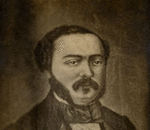
SUBJECT of part 1 of 2
is that?
Bantu peoples ....... the 300–600 ethnic groups in Africa who speak Bantu languages OR The Yoruba culture was originally an oral tradition, and Yoruba people are native speakers of the Yoruba language.
The Yoruba people (Yoruba: Ŕwọn ọmọ Yorůbá) are an ethnic group of Southwestern and North central Nigeria as well as Southern and Central Benin in West Africa.
The Yorůbá constitute over 40 million people
As an ethnic description, the word "Yoruba" was first recorded in reference to the Oyo Empire in a treatise written by the 16th-century Songhai scholar Ahmed Baba.
It was popularized by Hausa usage[18] and ethnography written in Arabic and Ajami during the 19th century, in origin referring to the Oyo.
Oral Language............NO RECORDING?
............should at least based on your Israelite Belief......written or spoken Hebrew.....RIGHT>......?